
Explore the essentials of photometric systems in astronomy, including precision, calibration, and their role in mapping the sky and studying celestial objects.
Understanding Photometric Systems
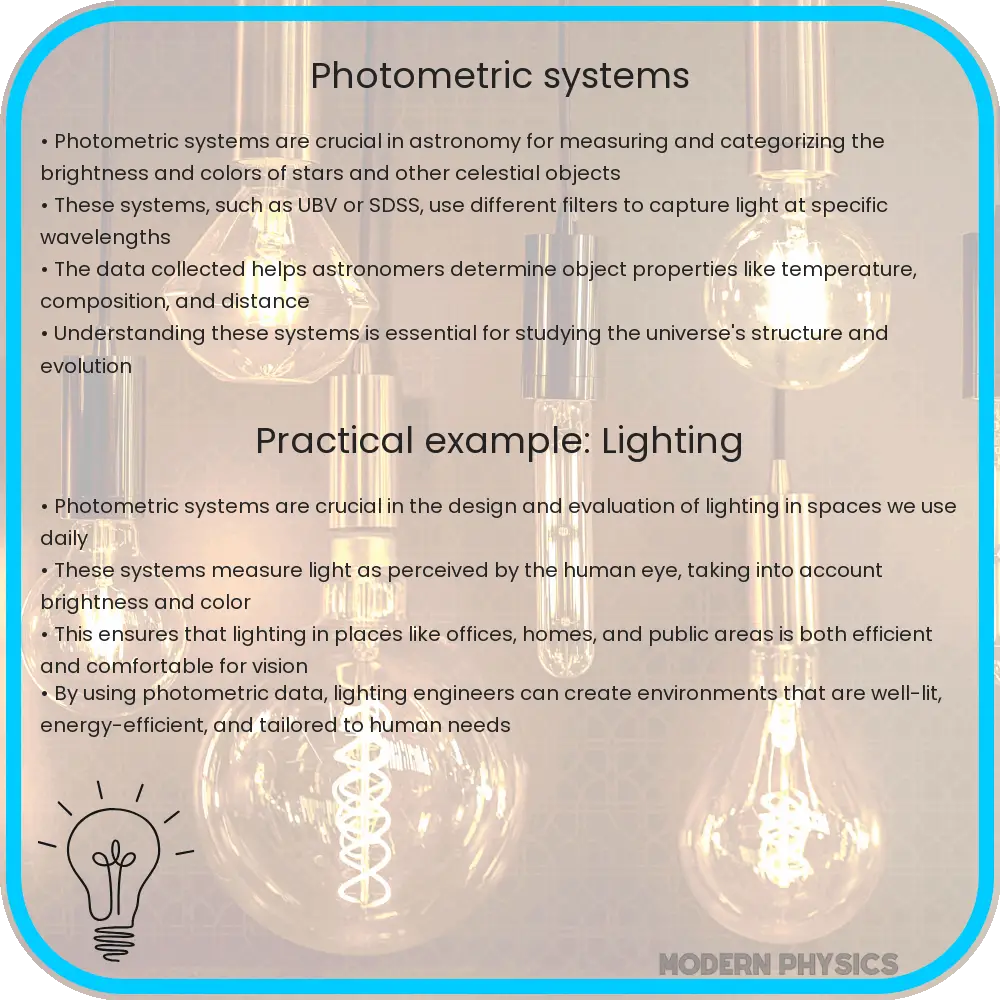
Photometric systems are essential in astronomy for measuring the intensity and color of light from celestial objects. These systems enable astronomers to categorize stars, galaxies, and other celestial bodies based on their light properties. The most common photometric systems include the UBV (Johnson) system, the SDSS (Sloan Digital Sky Survey), and the Gaia photometric system, each with unique filters and measurement techniques.
Precision in Photometric Systems
Precision in photometric measurements is crucial for accurate astronomical observations. It depends on various factors such as atmospheric conditions, instrumental quality, and the calibration of the system. High precision allows astronomers to detect slight variations in the light from celestial bodies, which can indicate important characteristics such as size, temperature, and composition.
Calibration of Photometric Systems
Calibration is the process of setting a standard for measurements. In photometry, calibration involves the comparison of observed measurements with known standards. This is typically done using standard stars with well-defined spectral and luminosity characteristics. The calibration process ensures that measurements from different times and instruments can be compared accurately, which is essential for reliable scientific conclusions.
Sky Mapping and Photometry
Sky mapping in astronomy is the creation of detailed maps of the sky using photometric data. This involves measuring the light from millions of celestial objects and plotting their positions and luminosities in a celestial coordinate system. Sky maps are invaluable for navigation, research, and education, providing a comprehensive view of the celestial sphere.
Through these maps, astronomers can track the movement of objects, identify new celestial bodies, and study the structure of the Milky Way and other galaxies. The precision and calibration of photometric systems are integral to the accuracy and usefulness of these sky maps.
Challenges in Photometric Systems
Despite the advancements in technology, photometric systems face several challenges. Atmospheric interference, such as light pollution and airglow, can affect the precision of ground-based observations. Additionally, the calibration of instruments must be maintained meticulously over time to ensure consistent data quality. Astronomers often employ sophisticated algorithms and correction techniques to mitigate these issues and extract the most accurate information from their observations.
Future of Photometric Systems
The future of photometric systems looks promising with the advent of space-based telescopes and advancements in sensor technology. These developments promise to reduce atmospheric distortions and increase the precision and accuracy of photometric data. Moreover, ongoing and future missions like the James Webb Space Telescope (JWST) and the European Space Agency’s Euclid mission are expected to revolutionize our understanding of the universe through enhanced photometric capabilities.
Conclusion
Photometric systems play a critical role in modern astronomy, enabling scientists to decipher the mysteries of the universe through the study of light. The precision and calibration of these systems are vital for accurate measurements and interpretations. As technology advances, we can expect photometric systems to become even more precise and widespread, opening new vistas in our quest to understand the cosmos. The integration of new technologies and methodologies will continue to push the boundaries of what we can observe and learn from the universe around us.