
Understanding the importance and mechanisms of radiance calibration devices for consistent and accurate light measurement.
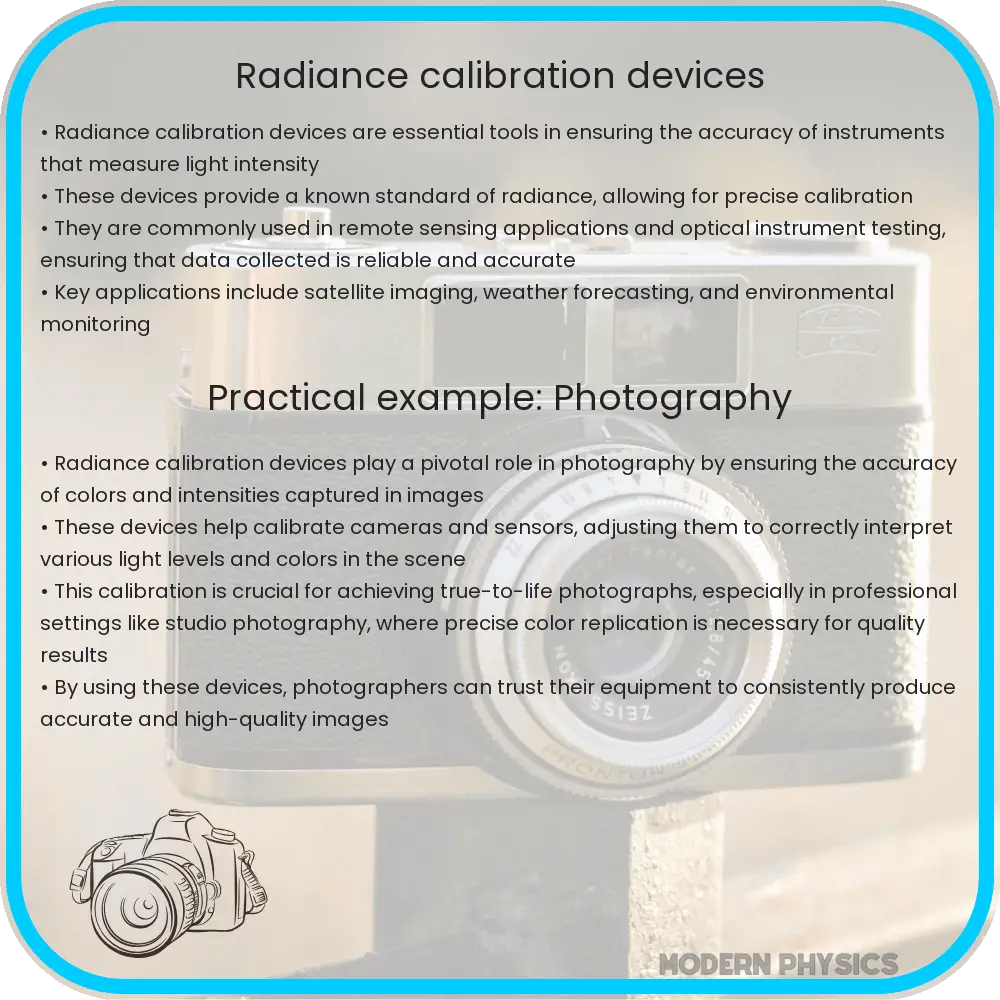
Understanding Radiance Calibration Devices: Essential for Precision in Measurements
Radiance calibration devices are fundamental tools in the field of optical radiometry, where precision and accuracy in the measurement of light are crucial. These devices help ensure that light measurements in experiments and applications are consistent and reliable. This article explores the importance, functionality, and key aspects such as accuracy, stability, and precision of radiance calibration devices.
What is Radiance Calibration?
Radiance calibration involves adjusting the measurements of sensors or detectors that are responsive to light, ensuring that their readings are consistent with predetermined standards. This calibration is crucial in a multitude of scientific and industrial fields, including medical imaging, remote sensing, and environmental monitoring. It involves not just the direct measurement of light intensity but also its distribution within a given spatial angle.
Accuracy of Radiance Calibration Devices
Accuracy in radiance calibration refers to the closeness of a measured value to its true value. High accuracy is essential to minimize errors in readings obtained from various optical instruments. This is usually achieved by using calibration devices that themselves have been calibrated against even higher standards, often maintained by national or international bodies.
- Reference Standards: Calibration devices are frequently gauged against high-standard reference sources, which themselves are traceable to standards like those held by the National Institute of Standards and Technology (NIST) in the USA.
- Controlled Conditions: Accuracy also heavily relies on the environmental and operational conditions in which the calibration is performed. Factors such as temperature and humidity are closely regulated during the calibration process.
Stability in Radiance Calibration Devices
Stability in radiance calibration devices refers to the ability of these devices to provide consistent results over time. A stable calibration device ensures that the calibration remains valid for a longer period, reducing the frequency of recalibration needed and thus saving both time and resources.
- Long-Term Performance: Stability is tested over extended periods under various environmental conditions to ensure the device maintains its calibration state.
- Material Choice: The design and materials used in calibration instruments play a crucial part in their stability. Materials that are less susceptible to environmental changes or deterioration over time are preferred.
Precision of Radiance Calibration Devices
Precision refers to the consistency of repeated measurements under unchanged conditions. In the context of radiance calibration, a device with high precision will yield very similar results in repeated calibrations, which is vital for scientific experiments that rely on reproducible data.
- Repeatability: This is usually assessed by carrying out multiple calibrations over a short period and examining the variation in outputs.
- Design Refinement: Advances in technology and engineering have allowed for increasingly refined designs of calibration devices, enhancing their precision.
Factors Affecting the Performance of Radiance Calibration Devices
Several factors can influence the performance of radiance calibration devices, affecting their accuracy, stability, and precision. Understanding these factors is crucial for maintaining the reliability of calibration in scientific measurements.
- Light Source Variability: The quality and stability of the light source in the calibration device can significantly impact the accuracy of measurements. Any fluctuations can lead to variations in calibration results.
- Detector Sensitivity: The sensitivity of the detectors used in radiance calibration must be consistent and reliable. Changes in detector sensitivity due to aging or environmental factors can skew results.
- Operational Expertise: The skill and knowledge of the operator performing the calibration also play a critical role. Proper handling and understanding of the calibration process are essential for achieving desired outcomes.
Applications of Radiance Calibration in Various Industries
Radiance calibration devices find their applications across a variety of fields, demonstrating their versatility and importance in accurate light measurement.
- Healthcare: In medical imaging, accurate radiance calibration ensures that the imaging devices produce clear and precise images for effective diagnosis.
- Environmental Science: In climatology, calibration devices help in monitoring solar radiation, which is vital for climate modeling and studies related to global warming.
- Manufacturing: In industries where precise color differentiation is required, radiance calibration ensures that lighting conditions are consistently maintained for quality control.
Conclusion
Radiance calibration devices play an indispensable role in the accurate measurement of light across various scientific and industrial domains. By understanding the principles of radiance calibration, alongside its applications, accuracy, stability, and precision, professionals and researchers can significantly enhance the reliability of their measurements. The technology and methodologies behind these devices are continually advancing, promising even more efficient and accurate calibrations in the future. In a world increasingly driven by data precision, the importance of reliable radiance calibration devices cannot be overstated, making them a cornerstone in the field of optical radiometry.