
Learn about photocatalytic water splitting, an innovative method using sunlight and catalysts to split water into hydrogen and oxygen for clean energy.
Introduction to Photocatalytic Water Splitting
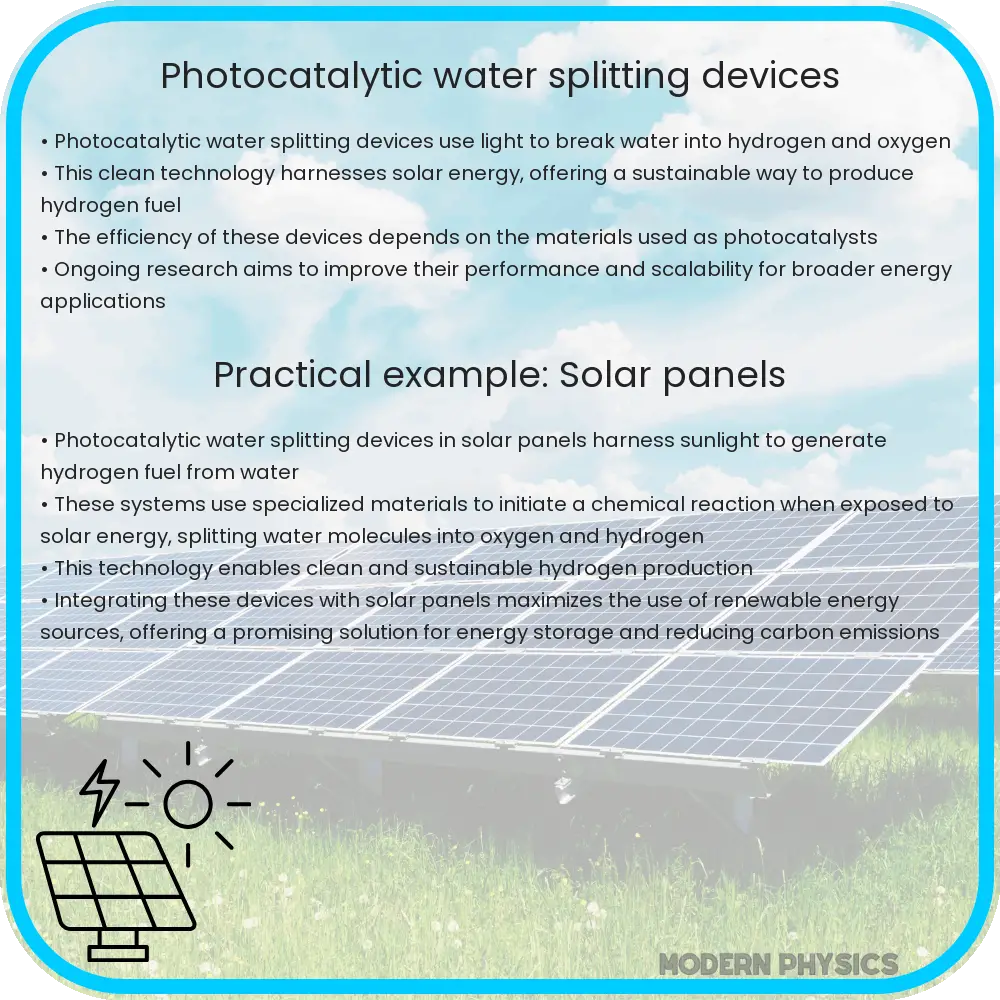
Photocatalytic water splitting is an innovative method of generating hydrogen fuel using sunlight and water, representing a sustainable solution for clean energy production. This process involves using light-absorbing materials or photocatalysts to drive the chemical reaction that divides water into hydrogen and oxygen. The simplicity and sustainability of this method make it a highly appealing source of renewable energy.
The Science Behind Photocatalytic Water Splitting
The foundation of photocatalytic water splitting lies in the absorption of photons from sunlight by a photocatalyst, typically a semiconductor material. When the energy of the absorbed photon exceeds the band gap of the semiconductor, it excites an electron from its valence band to the conduction band, creating a positive hole in the valence band. This electron-hole pair is key to the water splitting reaction.
- The excited electron reduces water molecules, generating hydrogen gas.
- The positive hole oxidizes water, forming oxygen and protons.
This reaction can be summarized by the equation:
2H2O + light → 2H2 + O2
Materials Used in Photocatalytic Devices
The efficiency of photocatalytic water splitting largely depends on the properties of the photocatalyst used. Several materials have been explored, including:
- Titanium Dioxide (TiO2): Widely used due to its stability, non-toxicity, and strong oxidative power. However, its band gap limits its absorption to the UV range.
- Strontium Titanate (SrTiO3): An emerging material showing promise due to its ability to operate under visible light.
- Cadmium Sulfide (CdS): Known for its excellent visible light absorption but suffers from photocorrosion issues.
Advancements in nanotechnology have led to the development of composite and doped materials that enhance light absorption and charge separation to improve the overall efficiency of the water splitting process.
Design and Operation of a Photocatalytic Water Splitting Device
A typical photocatalytic water splitting device consists of a reactor that houses the photocatalysts and a light source that simulates sunlight. In practical applications, these devices are often designed to maximize the surface area of the photocatalyst exposed to light, enhancing the efficiency of the water splitting process. Moreover, many systems integrate methods to capture and store the hydrogen gas produced.
In designing these devices, engineers must also consider factors like water purity, catalyst durability, and overall system stability to ensure effective and sustained operation. The choice of materials and the configuration of the device play crucial roles in these considerations.
Challenges and Future Directions
Despite its promising potential, photocatalytic water splitting faces several technical and economic challenges that must be addressed to make this technology viable on a large scale. Some of these challenges include:
- Efficiency: The quantum efficiency of current photocatalytic materials needs to be improved to compete with traditional energy sources.
- Durability: Photocatalysts must be robust enough to withstand long-term exposure to the harsh conditions during the reaction process.
- Cost: The production and scaling up of photocatalytic materials and devices must be economically feasible.
Research is ongoing to overcome these barriers, with efforts focusing on discovering new materials, enhancing existing photocatalyst designs, and developing cost-effective manufacturing techniques.
Environmental Impact and Sustainability
The ability to produce hydrogen fuel through water splitting without emitting carbon dioxide positions photocatalytic water splitting as a highly sustainable energy source. Here are some of the key environmental benefits:
- Carbon Neutral: Photocatalytic water splitting does not produce greenhouse gases, helping mitigate climate change.
- Use of Abundant Resources: It utilizes sunlight and water, which are abundant and readily available almost everywhere on Earth.
- Reduction in Fossil Fuel Dependence: This technology could lead to decreased reliance on fossil fuels, promoting energy security and sustainability.
As technology advances, the integration of photocatalytic systems with existing renewable energy infrastructures, like solar farms or wind turbines, may become feasible, significantly enhancing their overall efficiency and environmental impact.
Conclusion
Photocatalytic water splitting represents a frontier in the pursuit of sustainable and clean energy. By harnessing sunlight to split water and generate hydrogen, this technology offers a green alternative to fossil fuels. While the challenges of efficiency, durability, and cost remain significant, the potential environmental benefits and ongoing advances in material science and engineering continue to drive research and development in this exciting field. With concerted effort and innovative breakthroughs, photocatalytic water splitting could play a crucial role in our future energy landscape, contributing to a cleaner, more sustainable world.