
Discover the potential of perovskite materials in revolutionizing solar energy: high efficiency, scalability, and sustainability challenges and solutions.
Introduction to Perovskite Materials
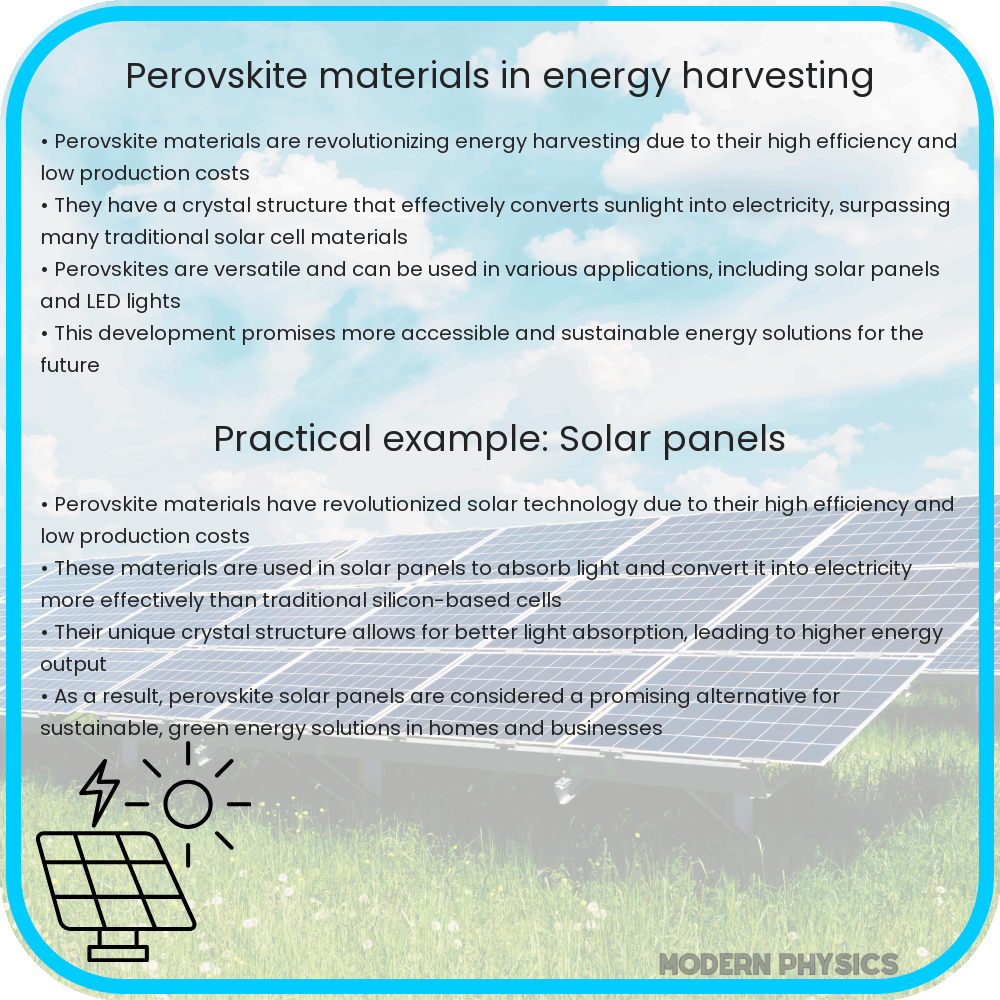
Perovskite materials have taken the spotlight in the field of materials science due to their remarkable properties and potential applications, particularly in solar energy. These materials, characterized by the formula ABX3, where ‘A’ and ‘B’ are cations of different sizes, and ‘X’ is an anion, exhibit a unique crystal structure that contributes to their exceptional optoelectronic properties.
Efficiency of Perovskite Solar Cells
Perovskite solar cells (PSCs) have witnessed unprecedented growth in efficiency, surpassing other photovoltaic technologies in a relatively short time. Their power conversion efficiency (PCE) has increased from a mere 3.8% to over 25% within a decade, rivaling that of traditional silicon-based cells. This rapid improvement is attributed to the perovskites’ high absorption coefficient, enabling them to capture sunlight effectively and convert it into electricity with high efficiency.
Sustainability and Environmental Impact
Perovskites are hailed for their potential to create more sustainable and environmentally friendly solar cells. They are made from abundant materials, reducing reliance on scarce resources. However, the sustainability of perovskite materials is a double-edged sword; some perovskites contain lead, raising concerns about environmental and health risks. Researchers are actively seeking lead-free alternatives to mitigate these issues, focusing on materials like tin-based perovskites.
Scalability and Production
One of the most significant advantages of perovskite materials is their scalability and the ease of production compared to traditional photovoltaic materials. Perovskite solar cells can be manufactured using simple techniques such as solution processing, which allows for low-cost and large-scale fabrication. This scalability is crucial for the widespread adoption of perovskite-based technologies, making renewable energy more accessible worldwide.
Challenges and Future Directions
Despite their promising attributes, perovskite materials face challenges that need addressing before they can be widely adopted. Durability and long-term stability are among the primary concerns, as perovskite solar cells tend to degrade more quickly than their silicon counterparts when exposed to environmental factors such as moisture, heat, and light. Researchers are diligently working to improve the stability of these materials by exploring new compositional strategies, encapsulation techniques, and advanced engineering processes.
Another challenge lies in the scale-up of production. While laboratory-scale processes have shown great success, transitioning to large-scale manufacturing without compromising efficiency and stability remains a hurdle. Addressing this challenge requires innovative manufacturing techniques and the development of quality control standards to ensure the consistent performance of perovskite solar cells on a commercial scale.
Integration into the Energy Market
The integration of perovskite solar cells into the existing energy market holds great promise but requires strategic planning. Compatibility with current grid infrastructure, market competitiveness, and regulatory issues are key factors that must be considered. Furthermore, the development of recycling and waste management strategies for end-of-life perovskite solar cells is critical for promoting a sustainable energy future.
Conclusion
Perovskite materials represent a significant breakthrough in the field of photovoltaics, offering a unique combination of high efficiency, low-cost production, and scalability. While challenges such as stability, environmental impact, and large-scale manufacturing need to be overcome, the potential of perovskite solar cells to revolutionize the solar energy sector is undeniable. Ongoing research and development are crucial to address these issues and unlock the full potential of perovskites. As the technology matures and these challenges are addressed, perovskite solar cells could play a pivotal role in the transition to a more sustainable and renewable energy landscape, making clean energy more accessible and affordable worldwide.