
Explore the intriguing Penrose-Terrell rotation in relativity, its effects on high-speed objects, and its implications in astronomy and physics.
Understanding Penrose-Terrell Rotation: A Journey into Relativity
Penrose-Terrell rotation, a fascinating phenomenon in the realm of special relativity, alters our perception of moving objects. Discovered independently by Roger Penrose and James Terrell, this effect dramatically changes how we understand the appearance of high-speed objects. Contrary to what one might expect, objects traveling close to the speed of light do not appear contracted in the direction of motion, as predicted by Lorentz contraction, but instead, they appear rotated. This intriguing occurrence is not due to the physical rotation of the object itself but results from the way light rays reach the observer.
The Basics of Penrose-Terrell Rotation
At the heart of this phenomenon lies the finite speed of light and the relativistic effects. When an object moves at relativistic speeds, the light rays from different parts of the object take varying amounts of time to reach the observer. This discrepancy causes an apparent distortion in the object’s shape. Interestingly, this effect is purely visual and does not imply any physical deformation of the object.
Visualizing the Unseen: 3D Models and Simulations
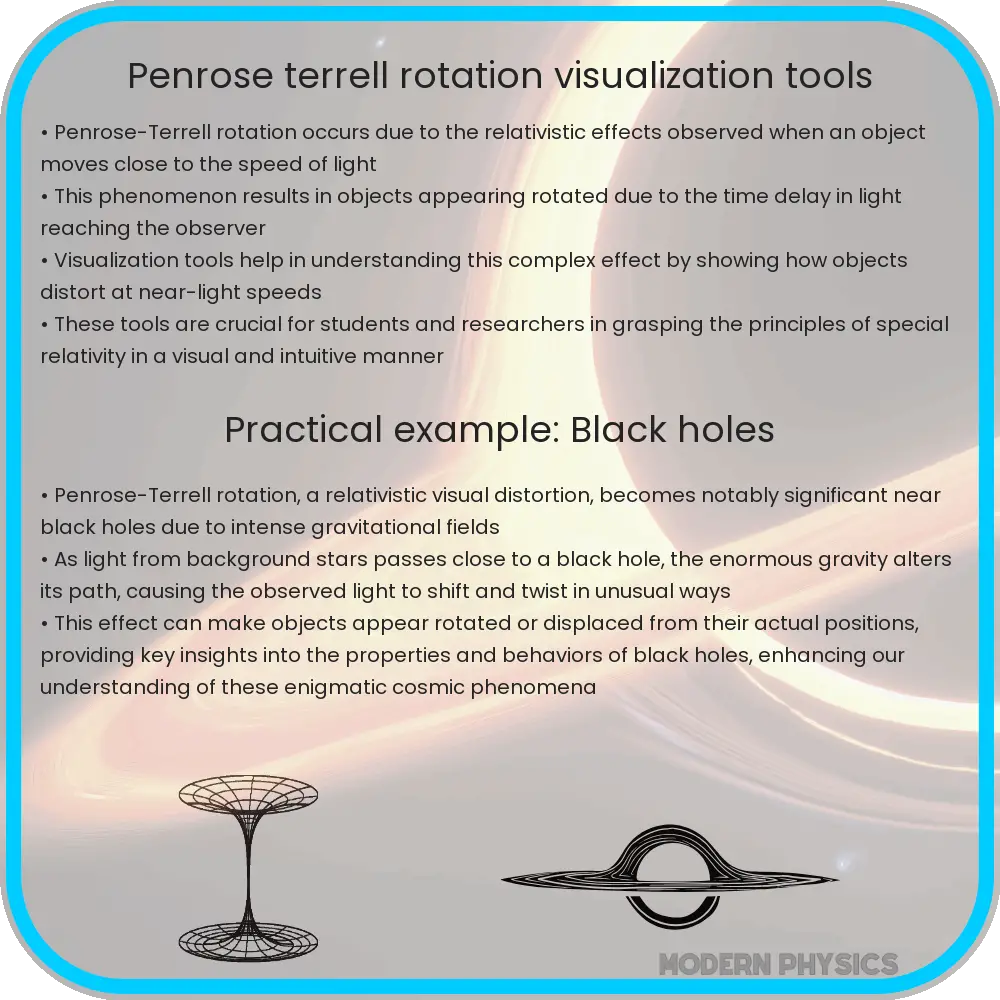
To grasp the complexities of Penrose-Terrell rotation, visual aids such as 3D models and simulations are invaluable. These tools allow for a dynamic representation of the effect, offering a clearer understanding of how it manifests at relativistic speeds. By simulating an object moving near the speed of light and observing the changes in its appearance, one can better comprehend the non-intuitive nature of relativistic effects.
Applications and Implications
Although Penrose-Terrell rotation is primarily of theoretical interest, understanding it has significant implications for various fields, including astrophysics and the study of high-speed particles. For instance, this effect can influence the observed shape of rapidly moving astronomical objects, such as jets emanating from black holes or neutron stars.
In conclusion, Penrose-Terrell rotation challenges our conventional understanding of motion and appearance at high speeds. Through the use of 3D models and simulations, we gain a more profound appreciation of the complex and counterintuitive nature of the universe at relativistic velocities.
Delving Deeper: The Role of Observer’s Perspective
The observer’s position plays a crucial role in Penrose-Terrell rotation. The distortion effect varies depending on the observer’s angle relative to the object’s direction of motion. This angle-dependent variation is essential for correctly interpreting the appearance of high-velocity objects. For instance, an observer positioned directly in the path of a relativistic object would perceive different distortions than an observer viewing the object from the side.
Challenges in Observational Astronomy
In observational astronomy, Penrose-Terrell rotation presents unique challenges. Astronomers must consider this effect when analyzing images of rapidly moving celestial bodies. Failure to account for these distortions can lead to incorrect conclusions about the physical characteristics and behaviors of these distant objects.
Enhancing Educational Tools
Educational platforms benefit significantly from incorporating simulations of Penrose-Terrell rotation. These visual aids provide students and enthusiasts a more intuitive grasp of the principles of special relativity. By interacting with these models, learners can observe firsthand how relativistic effects alter our perception of motion and shape, thereby deepening their understanding of fundamental physics concepts.
Future Research and Exploration
The ongoing research into Penrose-Terrell rotation and similar relativistic phenomena continues to push the boundaries of our understanding of the universe. As technology advances, more sophisticated simulations and models will emerge, offering even deeper insights into the relativistic universe. This research not only enriches our theoretical knowledge but also has potential practical applications in space exploration and astrophysics.
Conclusion
In summary, Penrose-Terrell rotation stands as a remarkable demonstration of the peculiarities of observing objects at near-light speeds. It underscores the importance of considering relativistic effects in both theoretical physics and observational astronomy. The use of 3D models and simulations plays a pivotal role in visualizing and understanding this complex phenomenon. As we continue to explore the vastness of space and delve into the depths of physics, the lessons learned from studying Penrose-Terrell rotation will undoubtedly aid in unraveling more mysteries of our universe.