
Explore the fascinating Terrell Rotation in Special Relativity, its visual effects, and impact on physics, astrophysics, and technology.
Understanding the Terrell Rotation in Special Relativity
Special Relativity, a fundamental theory in physics proposed by Albert Einstein, has revolutionized our understanding of space and time. One of the intriguing aspects of this theory is the Terrell Rotation, a phenomenon that combines the effects of special relativity with the perception of moving objects. This article aims to delve into the nature of Terrell Rotation, its visual effects, and its significance in the realm of physics.
The Basics of Special Relativity
Before exploring Terrell Rotation, it’s essential to grasp the core principles of Special Relativity. Central to this theory are two postulates: the laws of physics are the same in all inertial frames of reference, and the speed of light in a vacuum is constant for all observers, regardless of their relative motion. These postulates lead to groundbreaking conclusions like time dilation and length contraction, phenomena that occur at speeds approaching the speed of light.
Discovering Terrell Rotation
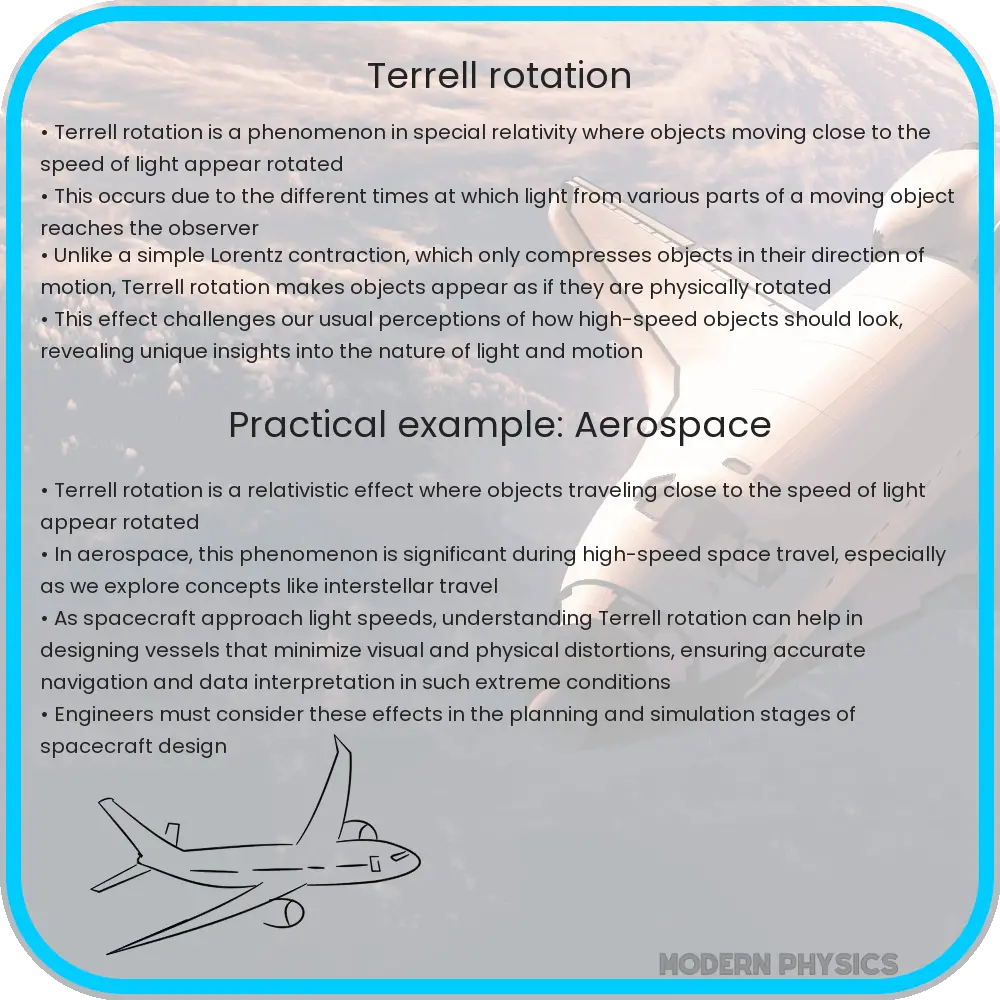
Terrell Rotation, discovered by James Terrell in 1959, arises from the interplay of light speed and the time it takes for light to reach an observer from different parts of a moving object. Contrary to classical expectations, a fast-moving object will not appear contracted in the direction of motion to a stationary observer. Instead, the object appears rotated due to the finite speed of light and the time differences in light reaching the observer from various parts of the object.
Visual Effects and Analysis
The visual effects of Terrell Rotation are both intriguing and counterintuitive. As an object approaches relativistic speeds, it appears to rotate instead of contracting. This rotation is not a physical rotation but a perceptual one, resulting from the time delay of light rays reaching the observer. Analyzing this phenomenon provides insights into the nature of observation in relativistic contexts and challenges our conventional understanding of motion and perception.
The study of Terrell Rotation not only enriches our understanding of Special Relativity but also has implications in astrophysics and cosmology, where objects often travel at significant fractions of the speed of light. By exploring this phenomenon, scientists gain a deeper appreciation of the intricate relationship between space, time, and velocity in the universe.
Practical Implications of Terrell Rotation
The significance of Terrell Rotation extends beyond theoretical physics into practical applications. In astrophysics, understanding this phenomenon is crucial for interpreting the observations of rapidly moving celestial bodies. For instance, the rotation effect can influence how we perceive the shape and orientation of distant galaxies or the behavior of fast-moving objects like pulsars and quasars. Grasping the nuances of Terrell Rotation enhances the accuracy of astronomical measurements and deepens our comprehension of the universe’s dynamics.
Terrell Rotation in Modern Technology
In the realm of technology, Terrell Rotation finds its relevance in the development of high-speed imaging and visual simulation. Advanced simulations that involve objects moving at relativistic speeds must account for this effect to ensure realistic rendering. This has implications in scientific visualization, virtual reality, and even in the entertainment industry where accurate depictions of space travel are sought after.
Challenges and Future Research
Despite its theoretical foundation, experimental validation of Terrell Rotation remains a challenge due to the difficulties in achieving near-light speeds in a controlled environment. Future research in particle accelerators and high-velocity astrophysical phenomena might provide more direct evidence of this effect. Additionally, the advancement in high-speed imaging technology could enable more precise observations and analyses of Terrell Rotation, further enriching our understanding of relativistic effects.
Conclusion
Terrell Rotation, emerging from the profound principles of Special Relativity, reveals the fascinating interplay between velocity, time, and perception. It challenges traditional notions of motion and visibility at high speeds, offering a more complex yet intriguing picture of the universe. The study of this phenomenon not only enriches the theoretical landscape of physics but also has practical implications in astrophysics, technology, and visualization. As we continue to explore the frontiers of high-speed physics, the understanding of Terrell Rotation will undoubtedly play a pivotal role in shaping our comprehension of the relativistic universe.