
Terrell-Penrose rotation reveals how objects moving near the speed of light visually distort, showing a rotational effect due to spacetime transformations in special relativity.
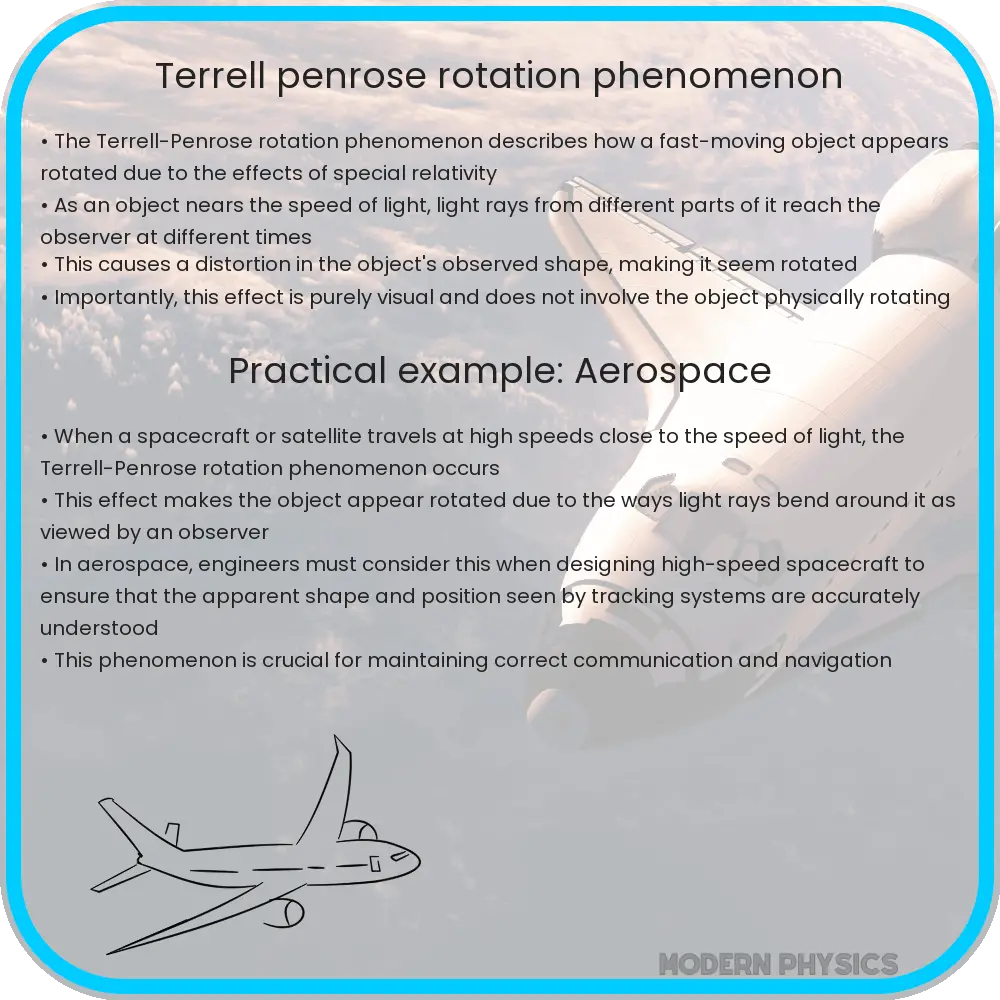
Terrell-Penrose Rotation: Visual Relativity, Illusion & Insight
The concepts of Terrell-Penrose rotation bring fascinating insights into the effects of special relativity on visual perception. When objects move at speeds approaching the speed of light, they exhibit some peculiar visual distortions that challenge our everyday experiences. These phenomena, named after physicists James Terrell and Roger Penrose, highlight how spacetime transformations affect what we see.
Understanding Special Relativity
Special relativity, proposed by Albert Einstein in 1905, introduced a new way of understanding space and time. One of its key postulates is that the speed of light, c, is constant and the same for all observers, regardless of their relative motion. This leads to several non-intuitive effects such as time dilation and length contraction. Terrell-Penrose rotation is a visual manifestation of these relativistic effects.
Classic Relativistic Effects
- Time Dilation: A clock moving at speeds close to the speed of light ticks slower compared to one at rest. Mathematically, this can be expressed as:
\(\Delta t’ = \frac{\Delta t}{\sqrt{1 – \frac{v^2}{c^2}}}\)
where \(\Delta t’\) is the time interval measured by the moving observer, \(\Delta t\) is the time interval measured by the stationary observer, v is the velocity of the moving object, and c is the speed of light.
- Length Contraction: Objects moving near the speed of light appear contracted in the direction of motion. This can be described as:
\(L’ = L \sqrt{1 – \frac{v^2}{c^2}}\)
where L’ represents the contracted length, and L is the proper length measured at rest.
Visual Consequences: Terrell-Penrose Rotation
While time dilation and length contraction are relatively easier to grasp conceptually, visual changes due to these effects are not as straightforward. As one looks at an object moving close to the speed of light, the image perceived is not merely length-contracted; it involves a rotation effect. This is where Terrell-Penrose rotation comes into play.
The apparent rotation is not due to any physical rotation of the object but rather a result of the differing times at which light from different parts of the object reaches the observer. Essentially, due to the finite speed of light, the light from the front and back of the object takes slightly different times to reach the observer, causing what looks like a rotational deformation.
Mathematically, this can be illustrated through spacetime diagrams and Lorentz transformations, but the primary intuition is that different portions of the object are observed at different times due to the speed of light.
Implications of Terrell-Penrose Rotation
This rotational effect has intriguing implications:
- Objects moving at relativistic speeds will appear visually distorted in ways that do not align with simple length contraction predictions.
- Stars and planets observed near the speed of light will seem twisted or rotated, enhancing the understanding of how light behaves under extreme conditions.
- This effect can be instrumental in astrophysics and designing experiments or simulations involving high velocities.
Understanding these visual effects of relativity not only increases our comprehension of physical laws but also deepens the intrigue into the nature of reality itself as perceived through the lens of extreme motion.
Experimental Evidence
Although we rarely encounter objects traveling at relativistic speeds in our daily lives, scientists have devised experiments to test these predictions. Particle accelerators, such as the Large Hadron Collider, speed up particles to velocities close to the speed of light. Observations from these experiments confirm the predictions of special relativity, including phenomena like time dilation and length contraction.
Moreover, astronomers observe relativistic effects in cosmic jets emitted by black holes and neutron stars. These jets travel at extremely high speeds, providing natural laboratories for studying the effects predicted by Einstein’s theory.
Simulations and Visualization
With advancements in computer technology, we can simulate relativistic effects, including Terrell-Penrose rotation. By using software to visualize how fast-moving objects appear, researchers and educators can generate images and videos that give us a window into a relativistic world. These tools are invaluable for education, allowing students to see firsthand how relativity affects our perception.
Simulations help reveal that the Terrell-Penrose rotation doesn’t merely apply to theoretical objects but would affect how we see any fast-moving entity, whether a spaceship, asteroid, or subatomic particle.
Conclusion
The concepts of Terrell-Penrose rotation open our eyes to the fascinating and sometimes counterintuitive ways special relativity influences visual perception. While time dilation and length contraction are crucial effects of moving close to the speed of light, the visual distortions we observe add another layer of complexity to our understanding. These distortions remind us that our perception of reality is conditioned by the fundamental laws of physics.
By exploring the visual implications of relativity through experiments, observations, and simulations, we continue to enhance our understanding of the universe. This journey from theory to visual interpretation not only enriches our scientific knowledge but also invites us to ponder the profound nature of reality as illuminated by the extraordinary speeds of the cosmos.