
Explore the enigmatic realms of particle astrophysics, delving into the mysteries of cosmic collisions and the vast cosmos. Unlock the secrets of the universe.
Unveiling the Mysteries of Particle Astrophysics
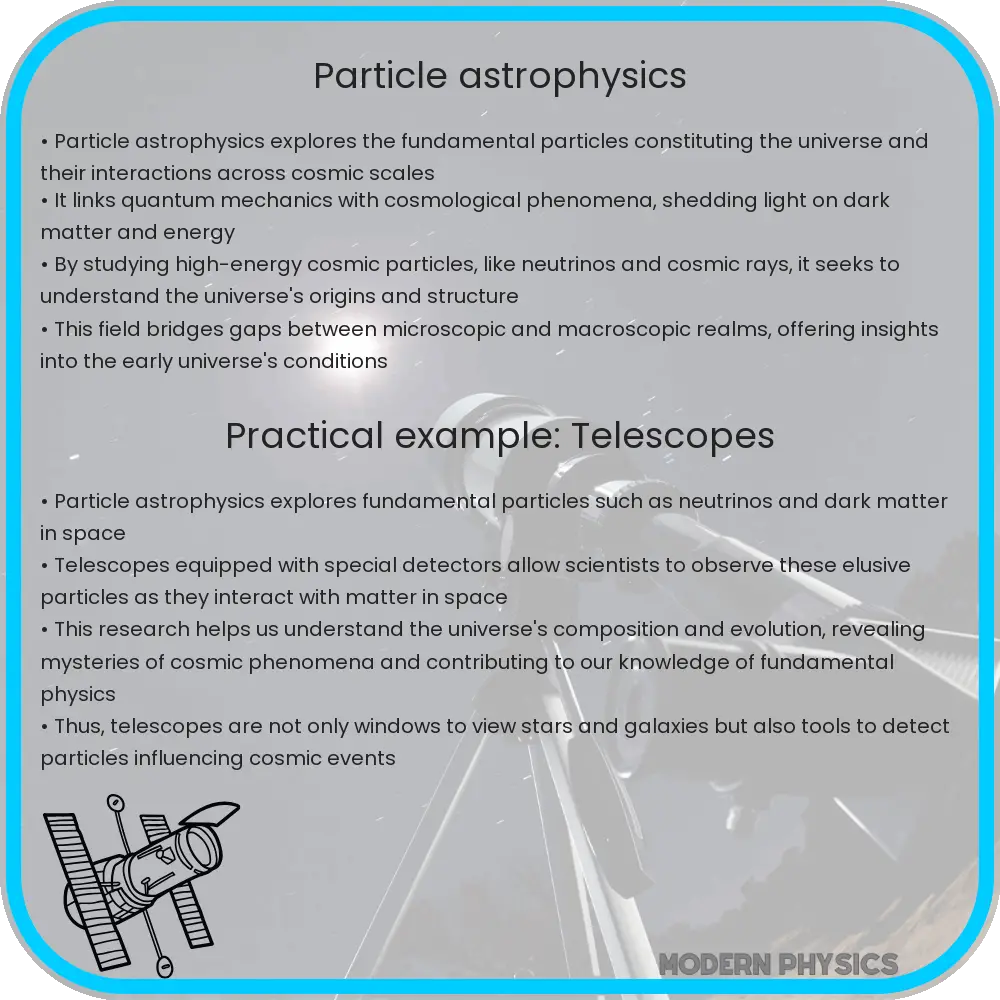
Particle astrophysics is an intriguing field that sits at the crossroads between particle physics and astronomy. It involves the study of the fundamental particles of the universe and their role in the cosmos’ grandest structures and phenomena. This field aims to answer some of the most profound questions about the universe’s origins, structure, and ultimate fate.
The enigmatic nature of dark matter and dark energy forms a central mystery in particle astrophysics. Dark matter, an unseen substance, is thought to constitute about 85% of the total matter in the universe. It does not emit, absorb, or reflect light, making it completely invisible and detectable only through its gravitational effects. Dark energy, even more mysterious, is believed to be the force driving the accelerated expansion of the universe.
Collisions in the Cosmos: A Gateway to Understanding
Cosmic collisions, such as those between galaxies, stars, and other celestial bodies, play a crucial role in the universe’s evolution and are a key focus in particle astrophysics. These events can be cataclysmic, giving rise to phenomena such as black holes, neutron stars, and gravitational waves. The detection of gravitational waves, ripples in the fabric of spacetime caused by such collisions, has opened new avenues for understanding the universe.
High-energy cosmic events also produce cosmic rays and neutrinos, elementary particles that travel through space at nearly the speed of light. By studying these particles, astrophysicists can gain insights into the most energetic and distant processes in the cosmos. For example, the observation of neutrinos emitted from the sun has provided valuable information about solar processes and the behavior of these ghostly particles.
Particle accelerators, like the Large Hadron Collider (LHC), mimic conditions just moments after the Big Bang, allowing scientists to investigate the properties of particles that constitute the universe’s fabric. These experiments complement astronomical observations and help bridge the gap between the known and unknown universe.
Exploring the Enigmatic Realm: Particle Astrophysics
Particle astrophysics stands at the crossroads of particle physics and astronomy, aiming to unravel the mysteries of the universe through the study of its smallest constituents. This interdisciplinary field scrutinizes phenomena such as cosmic rays, dark matter, and the remnants of the Big Bang, offering insights into the fundamental laws that govern the cosmos.
The Enigma of Dark Matter
One of the most compelling enigmas in particle astrophysics is dark matter. Despite constituting approximately 85% of the universe’s mass, dark matter neither emits nor absorbs light, making it invisible and detectable only through its gravitational effects. Theories abound, yet the true nature of dark matter remains elusive, challenging our understanding of the universe’s structure and composition.
Collisions of Cosmic Proportions
High-energy cosmic events, such as supernovae and the collisions of neutron stars, serve as natural laboratories for particle astrophysics. These cosmic collisions produce a plethora of particles and phenomena, including neutrinos and gravitational waves, providing critical clues about the state of matter under extreme conditions. The study of these events not only enriches our understanding of the universe’s evolution but also tests the limits of our physical theories.
The Echoes of the Big Bang
The cosmic microwave background (CMB) radiation, a relic from the early universe, offers a window into the cosmos’s infancy, moments after the Big Bang. Particle astrophysicists analyze fluctuations in the CMB to gain insights into the universe’s initial conditions and its subsequent inflationary expansion. This exploration bridges the gap between the macroscopic scale of cosmology and the microscopic realm of quantum mechanics.
Conclusion
Particle astrophysics continues to unravel the universe’s deepest mysteries, from the dark matter enshrouding galaxies to the primordial signals from the Big Bang. By marrying the macrocosmic scale of astrophysics with the microcosmic realm of particle physics, this field offers a unique perspective on the cosmos. As technology advances and our understanding deepens, particle astrophysics promises to shed light on the dark corners of the universe, challenging and expanding our knowledge of the fundamental principles that govern our world.