
Explore the mystery of Axion-like Particles (ALPs) in high-energy physics, their role in solving the strong CP problem, and potential in dark matter research.
Axion-like Particles: Unveiling the Enigma in High-Energy Physics
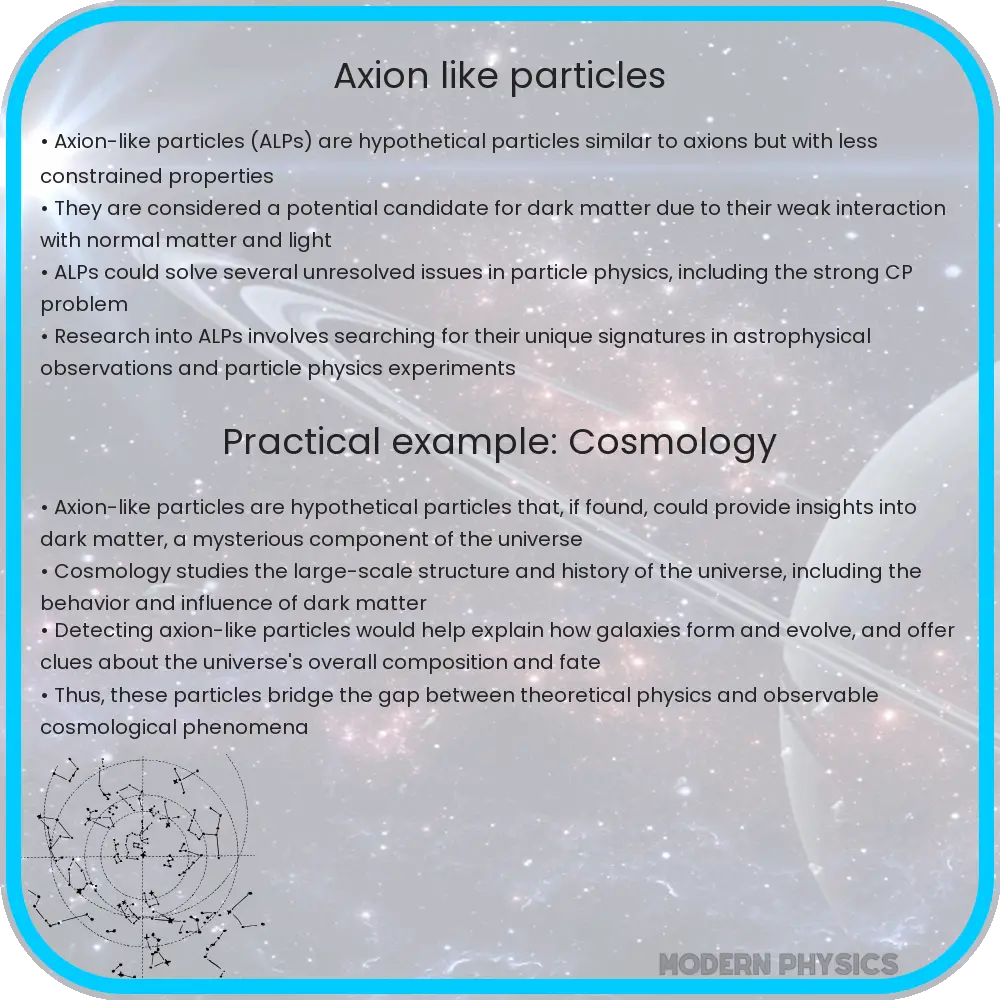
The realm of high-energy physics consistently thrives on the brink of discovery, exploring phenomena that challenge our fundamental understanding of the universe. Among these, axion-like particles (ALPs) stand out due to their enigmatic nature and the potential they hold for solving some of the most perplexing puzzles in physics. Originating from theoretical extensions of the Standard Model, ALPs are hypothetical particles that are similar to axions, which were initially proposed to address the strong CP (Charge Parity) problem in quantum chromodynamics (QCD).
Despite their elusive nature, ALPs have become a focal point in the quest for dark matter, a mysterious component that constitutes about 85% of the universe’s mass. Unlike axions, which have well-defined properties tied to the Peccei-Quinn theory, ALPs lack a specific mass range or coupling strength, making their detection a formidable challenge in experimental physics. Nevertheless, their existence could provide critical insights into beyond-Standard Model physics, potentially bridging gaps in our current understanding.
- Understanding the Strong CP Problem: At the heart of ALP research is the strong CP problem, which arises from the absence of CP violation in strong interactions. This discrepancy between theory and observation suggests that there may be undiscovered principles or particles at play, with axions and ALPs being prime candidates.
- Dark Matter and ALPs: The search for ALPs is intrinsically linked to the quest for dark matter. If ALPs constitute a portion of dark matter, their discovery could illuminate the dark sector’s composition and interactions, reshaping our cosmic perspective.
- Experimental Frontiers: Detecting ALPs requires innovative approaches due to their weak interaction with ordinary matter. Projects like the Axion Dark Matter Experiment (ADMX) and the CERN Axion Solar Telescope (CAST) are at the forefront, utilizing magnetic fields and solar observations to capture elusive signals.
The theoretical versatility of ALPs makes them a cornerstone in the study of high-energy physics. By exploring their potential roles and interactions, scientists are not only probing the boundaries of known physics but are also paving the way for groundbreaking discoveries that could redefine our understanding of the universe.
Advancements and Challenges in ALP Research
The pursuit of axion-like particles represents a dynamic frontier in high-energy physics, encompassing both theoretical advancements and experimental challenges. Theoretical physicists are diligently refining models to predict ALPs’ characteristics and interactions, aiming to guide experimental searches with more precision. Concurrently, experimental physicists are developing and enhancing detection methods, striving to increase sensitivity to ALP-induced phenomena.
Innovative experimental strategies are emerging, such as using laser facilities to observe ALP-induced light conversions or employing astronomical observations to detect ALP effects on cosmic scales. These methods complement traditional detection techniques, broadening the scope of research and increasing the chances of discovering ALPs. Furthermore, collaborations among international research teams are fostering a global effort to solve the ALP puzzle, combining resources, expertise, and data to enhance the collective search capabilities.
Despite the excitement surrounding ALP research, significant challenges remain. The vast parameter space of ALP properties requires extensive exploration, demanding immense time, effort, and resources. Additionally, the subtle nature of ALP interactions with known matter necessitates extremely sensitive and precise instruments, often pushing the limits of current technology. However, each challenge also represents an opportunity for innovation, driving advancements in both theoretical models and experimental techniques.
Conclusion
Axion-like particles, while hypothetical, stand as a pivotal element in the quest to unravel the mysteries of the universe. Their potential to solve the strong CP problem, elucidate the nature of dark matter, and extend our understanding of fundamental physics makes them one of the most intriguing subjects in contemporary high-energy physics. While the journey to discover ALPs is fraught with challenges, it is also ripe with the potential for transformative discoveries. As research continues to advance, the pursuit of ALPs not only pushes the boundaries of scientific knowledge but also exemplifies the relentless human endeavor to comprehend the cosmos. The journey towards understanding and potentially discovering ALPs embodies the spirit of scientific inquiry, promising to unveil new realms of the universe and redefine our place within it.