
Explore the intersection of particle physics and astronomy in this enlightening article on particle astrophysics, uncovering the universe’s deepest secrets.
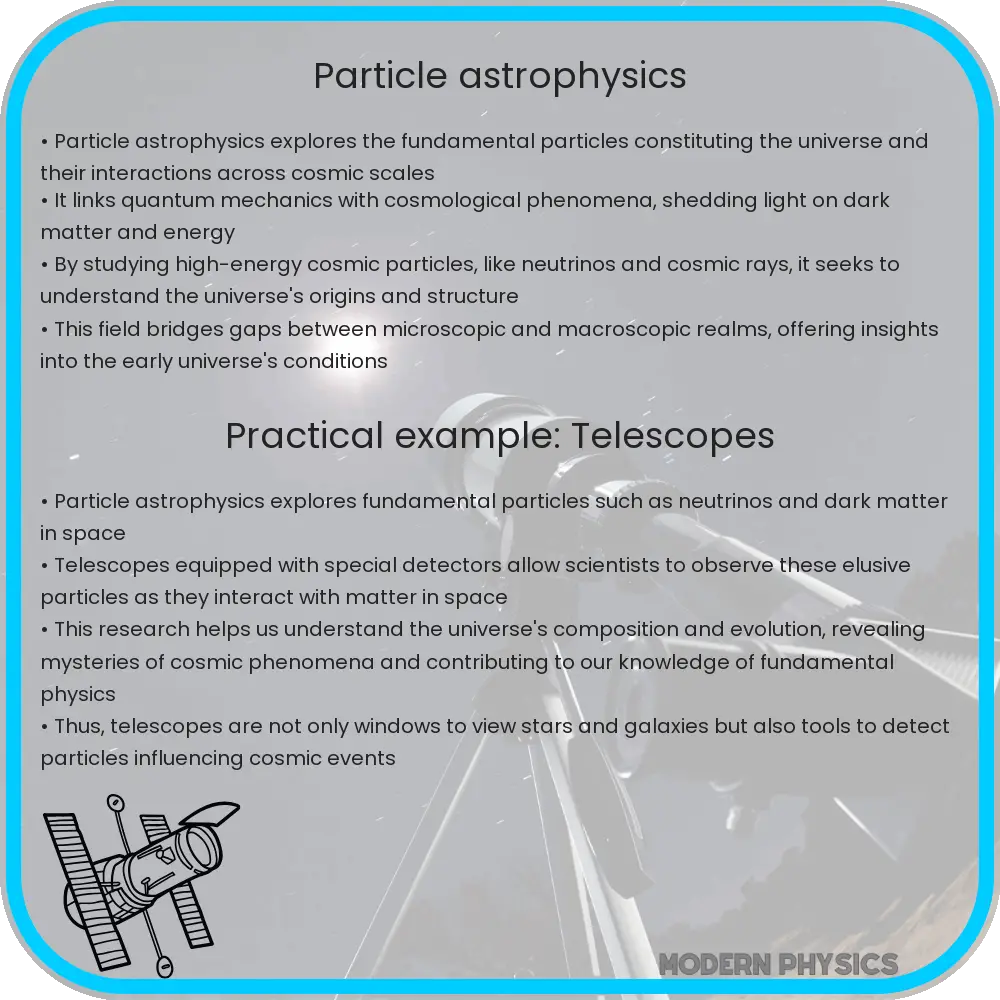
Exploring the Enigmatic World of Particle Astrophysics
Particle Astrophysics stands at the crossroads of particle physics and astrophysics, endeavoring to unravel the mysteries of the universe at its most fundamental level. This intriguing field seeks to understand the very fabric of the cosmos, from the minuscule particles that constitute matter to the vast astronomical structures that fill the universe.
The Enigmatic Particles of the Cosmos
At the heart of particle astrophysics lies the quest to understand cosmic rays, neutrinos, and dark matter. Cosmic rays, high-energy particles that travel through space at nearly the speed of light, bombard the Earth from all directions, offering clues to the violent processes occurring in the universe. Neutrinos, elusive particles that rarely interact with matter, carry information from the sun and distant supernovae, providing insights into stellar processes and the universe’s early moments.
Deciphering the Universe’s Dark Secrets
Perhaps the most mysterious component of the universe is dark matter. Despite constituting approximately 85% of the universe’s total mass, dark matter does not emit, absorb, or reflect light, making it invisible and detectable only through its gravitational effects. Understanding dark matter is crucial for explaining the structure and evolution of the cosmos.
Observational Windows into the Cosmos
Particle astrophysicists employ a variety of observational methods to study these enigmatic particles and phenomena. Ground-based telescopes and detectors, such as the IceCube Neutrino Observatory at the South Pole, capture neutrinos from cosmic events. Similarly, space-based instruments, like the Hubble Space Telescope and the Chandra X-ray Observatory, provide invaluable data on cosmic rays and the distribution of dark matter.
In their pursuit of understanding, scientists also turn to large-scale experiments, such as the Large Hadron Collider (LHC), to recreate and study conditions similar to those just after the Big Bang. These experiments complement astrophysical observations by providing insights into the behavior of fundamental particles under extreme conditions.
Unlocking the Mysteries of the Universe: The Role of Particle Astrophysics
Particle astrophysics stands at the crossroads of particle physics and astronomy, offering insights into the universe’s most fundamental structures and forces. This interdisciplinary field leverages the principles of subatomic particles to unravel the mysteries of cosmic phenomena, such as dark matter, black holes, and the cosmic microwave background. Through the lens of particle astrophysics, scientists aim to bridge the gap between the infinitely small and the infinitely large, providing a more comprehensive understanding of the universe’s origin, structure, and evolution.
The Enigmatic Particles Shaping Our Universe
At the heart of particle astrophysics lie enigmatic particles that challenge our understanding of physical laws. Neutrinos, for instance, are ghostly particles that barely interact with matter, making them incredibly difficult to detect. Yet, they hold crucial information about stellar processes and the early universe. Similarly, the hypothetical dark matter particles, which have yet to be directly observed, are believed to constitute about 85% of the universe’s mass, influencing galaxy formation and structure. The quest to identify and understand these particles involves cutting-edge technology and international collaboration, illustrating the field’s dynamic and exploratory nature.
Exploring the Cosmic Laboratory
The universe serves as a natural laboratory, presenting extreme conditions unattainable on Earth. Particle astrophysicists exploit these conditions, using cosmic rays and gamma-ray bursts to study particle interactions at energies far beyond human-made accelerators. Observatories and detectors, strategically located in remote and inhospitable regions of the Earth, are essential tools in this quest. Facilities like the IceCube Neutrino Observatory at the South Pole or the Large Hadron Collider in Europe exemplify the monumental efforts to detect and analyze cosmic particles, shedding light on the universe’s deepest secrets.
Conclusion
Particle astrophysics is a gateway to understanding the universe’s grandest mysteries. By studying the minute building blocks of matter and their role in cosmic phenomena, scientists are piecing together the puzzle of the universe’s structure and history. Despite the challenges posed by elusive particles and immense distances, the advancements in technology and methodology are leading to unprecedented discoveries. As we continue to explore the cosmos, particle astrophysics promises to deepen our knowledge of the universe, revealing not just what exists, but why it exists, and how everything we know came to be.