
Explore the fascinating realm of quantum gravity phenomenology, where theories like string theory and loop quantum gravity meet experimental challenges.
Introduction to Quantum Gravity Phenomenology
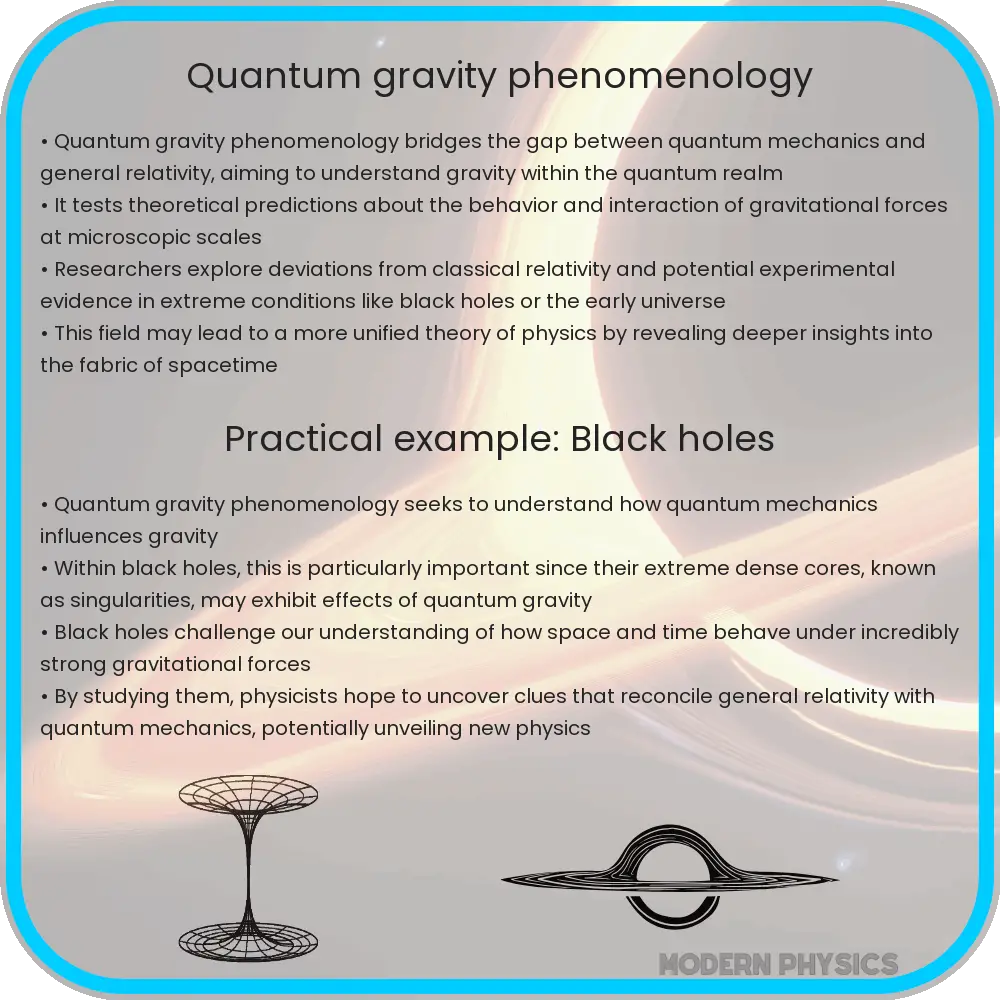
Quantum gravity phenomenology is an exciting and rapidly evolving field that seeks to understand and reconcile the principles of quantum mechanics with general relativity, the two pillars of modern physics. While quantum mechanics governs the microscopic world of particles and forces, general relativity explains the macroscopic world of space-time and gravity. The quest for a unified theory, often referred to as quantum gravity, has led to the development of various approaches and models, with phenomenology playing a crucial role in testing these theories against empirical data.
Theoretical Insights and Approaches
Several theoretical frameworks have been proposed to address the quantum gravity problem. String theory, loop quantum gravity, and causal dynamical triangulation are among the most prominent. String theory suggests that the fundamental constituents of reality are not point-like particles, but rather one-dimensional strings whose vibrations give rise to the particles’ properties. Loop quantum gravity, on the other hand, attempts to quantize space-time itself, proposing that space is made up of tiny, discrete loops. Causal dynamical triangulation combines quantum theory and general relativity principles to model a universe that dynamically evolves over time.
Phenomenological Insights
Quantum gravity phenomenology bridges the gap between abstract theoretical predictions and observable consequences. It involves identifying measurable effects that could indicate the presence of quantum gravity phenomena, such as deviations from Newton’s law of gravitation at short distances, gravitational wave signatures, or anomalies in cosmic ray spectra. These observables provide crucial clues that can guide theoretical development and constrain the plethora of existing models.
Experimental Challenges and Progress
Experimentally testing theories of quantum gravity poses significant challenges due to the scales involved. The Planck scale, the theoretical realm where quantum gravitational effects become significant, is orders of magnitude smaller than what current technologies can probe. Despite these challenges, innovative experimental approaches are being developed. For example, interferometry experiments aim to detect quantum gravitational effects on space-time fabric, and high-energy particle collisions are scrutinized for hints of extra dimensions or microscopic black holes.
Interdisciplinary Impacts and Future Directions
Quantum gravity phenomenology is not just a theoretical curiosity; it has far-reaching implications across physics and beyond. In cosmology, understanding quantum gravity can illuminate the origins of the universe, including the Big Bang and cosmic inflation. In quantum information, insights from quantum gravity could shed light on the nature of quantum entanglement and information paradoxes, particularly in the context of black holes. Moreover, the interdisciplinary nature of this field encourages collaboration between physicists, mathematicians, and computer scientists, fostering innovations and methodologies that can transcend traditional disciplinary boundaries.
Emerging Technologies and Methodologies
Advancements in technology and methodology are crucial for the progression of quantum gravity phenomenology. New observational facilities, such as gravitational wave detectors and high-precision cosmological surveys, are opening unprecedented windows into the universe. Additionally, computational techniques, including numerical relativity and quantum simulations, are becoming increasingly sophisticated, providing new ways to model and understand the quantum aspects of gravity. These tools not only assist in testing existing theories but also stimulate the formulation of novel hypotheses and models.
Conclusion
Quantum gravity phenomenology stands at the frontier of our quest to understand the fundamental nature of reality. It is a field marked by deep questions, theoretical diversity, and innovative experimental approaches. While significant challenges remain, the ongoing interplay between theory, phenomenology, and experiment continues to narrow the gap between quantum mechanics and general relativity. The journey toward a unified theory of quantum gravity is complex and uncertain, yet undeniably thrilling. As we develop more sophisticated technologies and deepen our conceptual understanding, the prospects for significant breakthroughs in quantum gravity phenomenology look increasingly promising. In the end, this endeavor is not just about unifying physical theories but also about expanding our comprehension of the cosmos and our place within it.