
Explore the properties, composition, and applications of Oxide Dispersion Strengthened (ODS) alloys, known for their high strength and heat resistance.
Understanding Oxide Dispersion Strengthened Alloys
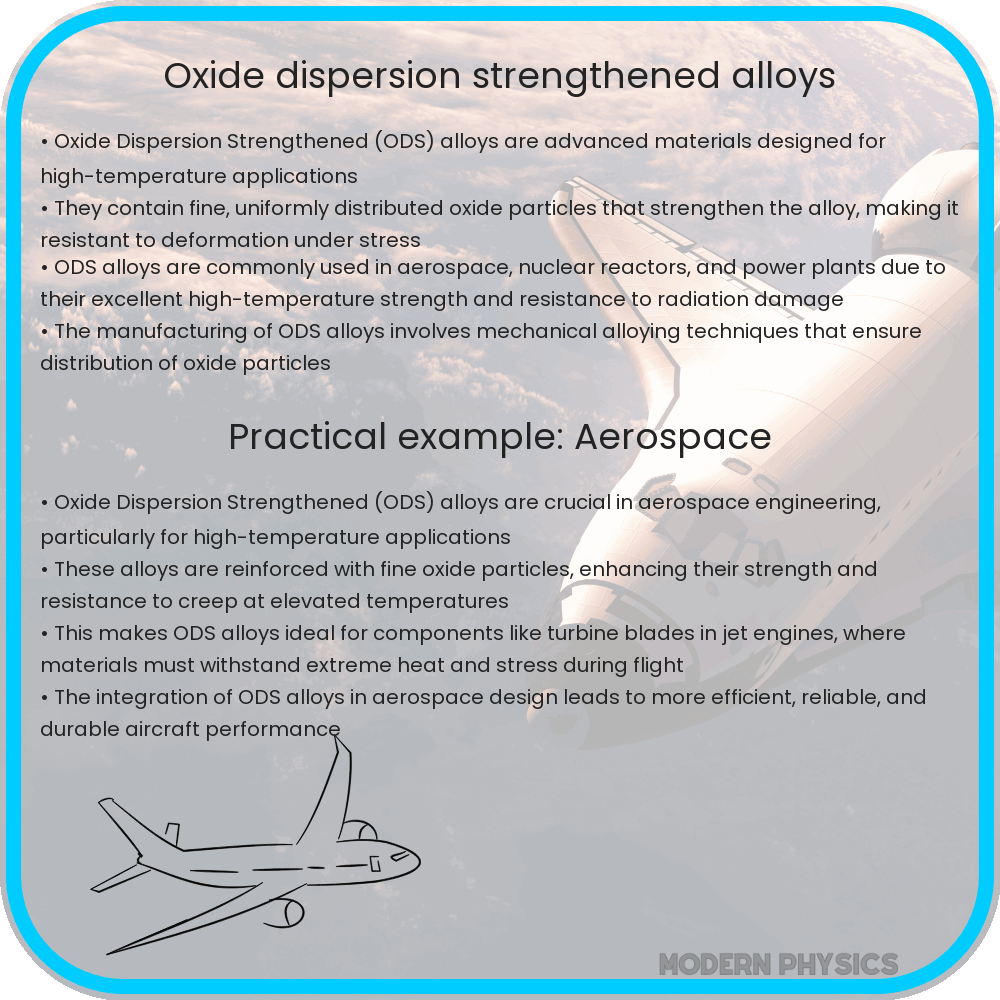
Oxide dispersion strengthened (ODS) alloys represent a significant advancement in material science, offering superior strength, durability, and heat resistance. These materials are especially crucial in applications requiring high performance under extreme conditions, such as in aerospace, nuclear reactors, and high-temperature industrial processes. This article explores the composition, properties, and applications of ODS alloys, providing a foundation to appreciate the innovations in materials engineering.
Composition of ODS Alloys
At the core, ODS alloys are a class of metals that are reinforced with fine, uniformly distributed oxide particles. These alloys are primarily based on iron, nickel, and aluminum, with yttrium oxide (Y2O3) being the most common oxide addition. The oxides serve as strengthening agents, embedded within the metal matrix.
The method of incorporating the oxide particles involves meticulous mechanical alloying. This process starts with the blending of metallic powders with oxide powders, which are then subjected to high-energy ball milling. This results in a highly deformed but homogeneously mixed powder, which, upon compacting and consolidating, forms the ODS alloy.
Enhanced Durability and Strength
The primary advantage of ODS alloys lies in their exceptional strength. The uniform dispersion of oxide particles acts as roadblocks to the movement of dislocations within the metal’s crystalline structure. Dislocations are a primary mechanism through which metals deform under stress. By impeding dislocation movement, these particles significantly enhance the alloy’s yield strength and fatigue resistance.
This dislocation barricade effect is not just beneficial under static loads but also under cyclic loading conditions, which are common in many engineering applications. The presence of oxide particles ensures durability and longevity, even under prolonged stress and strain cycles.
Superior Heat Resistance
ODS alloys are renowned for their excellent high-temperature capabilities. The key to their performance at elevated temperatures lies in the stability of the oxide particles. Unlike other precipitates which might dissolve or coarsen under high temperatures, the oxides used in ODS alloys, such as yttrium oxide, remain stable and effectively pin the grain boundaries.
This stabilization prevents the grains from growing larger at high temperatures—a process known as grain coarsening—which would otherwise lead to a reduction in strength. Therefore, ODS alloys maintain their mechanical properties and structural integrity even when exposed to extreme temperatures, making them ideal for high-heat applications.
Applications of ODS Alloys
ODS alloys are employed in several high-tech industries. In aerospace, they are used in components such as turbine blades and heat shields, which require materials that can withstand high temperatures and stress. In the field of nuclear power, ODS alloys contribute to the development of safer, more efficient reactors by forming part of the fuel cladding materials, which must resist radiation damage and thermal creep.
In the automotive industry, the thermal stability and strength of ODS alloys allow for their use in exhaust systems and turbocharger components, which experience high thermal cycling and temperatures. These applications illustrate the critical role that ODS alloys play in modern engineering and high-performance environments.
The incorporation of ODS alloys into various sectors not only enhances the performance and safety of these applications but also points to the future direction of material innovation and engineering design. By understanding the fundamental properties and benefits of ODS alloys, one can appreciate their potential to revolutionize industries and improve the operational limits of conventional materials.
Challenges and Advancements in ODS Alloy Technology
While ODS alloys offer remarkable benefits, their production and application come with challenges. One major challenge is the cost and complexity of the production process. High-energy ball milling and the processes required for consolidating the powdered materials can be energy-intensive and expensive. Furthermore, ensuring the uniform distribution of oxide particles, which is critical to achieving the desired properties, requires precise control during manufacturing.
Advancements in technology, however, are addressing these challenges. Researchers are exploring alternative methods of production, such as additive manufacturing (3D printing), which could potentially lower production costs and improve the scalability of ODS alloy manufacturing. Moreover, ongoing research into new types of oxide materials might lead to even higher performance and more application-specific customization of ODS alloys.
Sustainability and Recycling of ODS Alloys
The question of environmental impact and sustainability is also crucial in the context of ODS alloys. The production processes, which involve high energy consumption and sophisticated materials, must be weighed against environmental concerns. Recycling ODS alloys presents another challenge due to the specialized nature and high integration of oxide particles within the alloy matrix.
Efforts are being made to develop more sustainable production techniques and effective recycling methods that can mitigate these issues, making ODS alloys a more environmentally friendly option in the long term. This is key to ensuring that the use of these advanced materials aligns with global sustainability goals.
Conclusion
Oxide dispersion strengthened (ODS) alloys represent a breakthrough in materials science that blends innovative engineering with remarkable performance. Their capacity to operate under extreme conditions makes them invaluable in sectors such as aerospace, nuclear energy, and automotive industries. The infusion of oxide particles within a metal matrix not only enhances strength and durability but also greatly improves high-temperature performance.
As industries continue to push the boundaries of what’s possible, the role of ODS alloys becomes increasingly significant. Overcoming the challenges related to their production and sustainability will further solidify their position at the forefront of advanced material solutions. With ongoing research and development, the potential applications of ODS alloys are broadening, pointing towards a future where materials are both highly effective and aligned with sustainability objectives. By understanding these complex and potent materials, we gain insights into the future of engineering and innovation.