
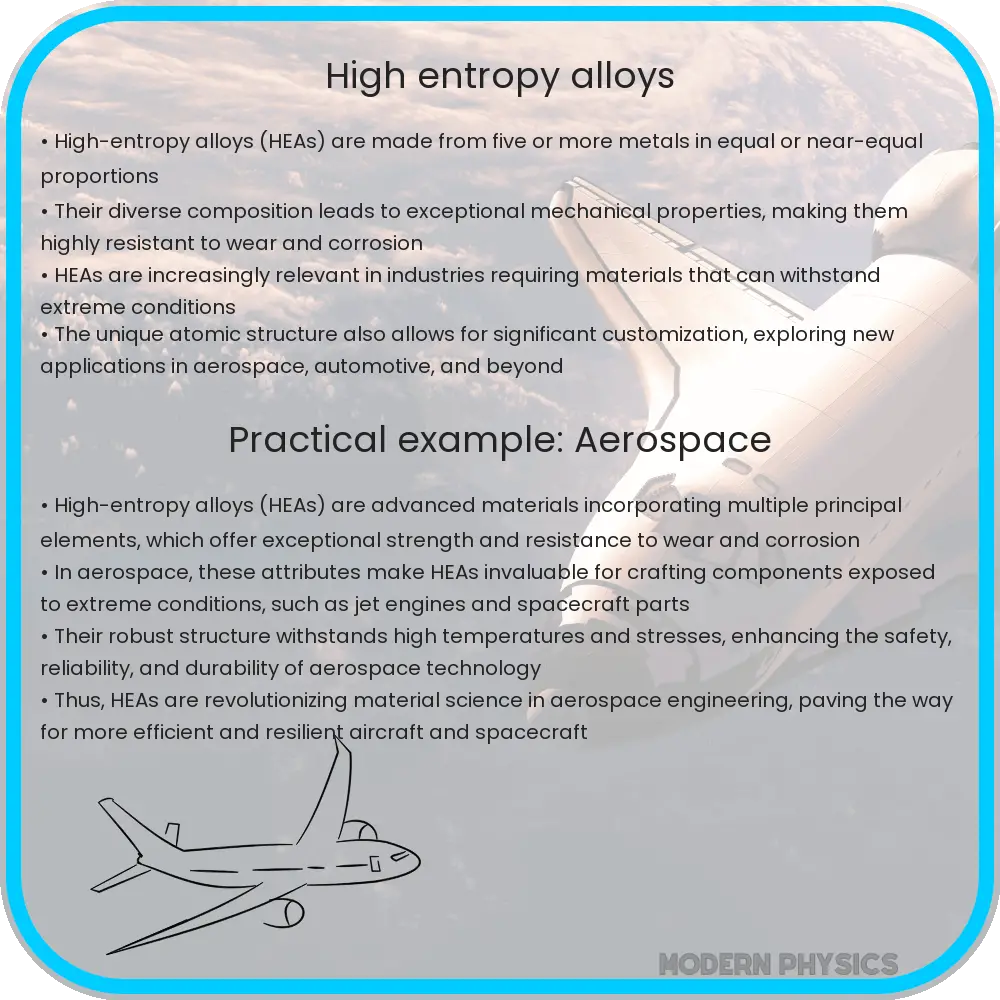
High-Entropy Alloys (HEAs) are advanced materials using five or more elements to enhance durability and performance in diverse applications.
Exploring High-Entropy Alloys: A Leap in Material Science
High-Entropy Alloys (HEAs) represent a significant breakthrough in material science, extending the frontiers of alloys traditionally dominated by one or two principal elements. These innovative materials leverage five or more elements, each contributing roughly between 5% and 35% of the total. This diverse elemental makeup enhances their properties, making HEAs essential in applications demanding high durability, versatility, and exceptional performance.
Understanding the Composition and Structure of High-Entropy Alloys
The fundamental hypothesis behind high-entropy alloys is that increased entropy can lead to enhanced material properties. Entropy, a concept often associated with randomness or disorder, plays a pivotal role here. By mixing multiple principal elements in nearly equal proportions, HEAs maximize entropy within the alloy. This elevated entropy contributes to the formation of simple solid solution phases, typically either face-centered cubic (FCC) or body-centered cubic (BCC) structures, rather than more complex intermetallic compounds.
The Durability of High-Entropy Alloys
One of the most compelling attributes of high-entropy alloys is their exceptional durability. Traditional alloys often suffer from weaknesses due to the presence of predominant elements which govern their thermal and mechanical behaviors. In contrast, the balanced, multi-element nature of HEAs tends to distribute and thus mitigate these weaknesses. This uniform distribution leads to improved hardness, tarnish resistance, and longevity under extreme conditions.
- Improved strength: The diverse atomic makeup in HEAs often results in a denser, more impenetrable microstructure, enhancing the alloy’s overall strength.
- Corrosion resistance: HEAs have demonstrated superior resistance to oxidative degradation and corrosion compared to conventional alloys, making them ideal for harsh environments.
- Enhanced wear resistance: The hard and stable crystalline structures of HEAs contribute to their ability to withstand surface wear and tear from frequent physical contact or friction.
Versatility Across Applications
HEAs are not just about durability. Their unique compositions allow for customization to meet specific requirements, thus serving various industrial applications. From aerospace to automotive, and even in nuclear reactors, the potential end uses of high-entropy alloys are broad and impactful. The ability to tailor these alloys for high-temperature performance, specific electronic or magnetic properties, or unique optical characteristics, further accentuates their versatility.
This bespoke adaptability is particularly valuable in fields where traditional materials cannot withstand the extreme operating conditions or where there is a need for a reduced alloy footprint without compromising functionality.
- Aerospace: High-entropy alloys can withstand the extreme temperatures and pressures prevalent in aerospace environments, making them suitable for components like turbine blades and heat shields.
- Automotive: The automotive industry benefits from the lightweight yet strong nature of HEAs, leading to more fuel-efficient vehicles without sacrificing safety or performance.
- Energy sector: In energy production, particularly in high-temperature nuclear reactors, HEAs offer the possibility of more durable and reliable components, which could lead to safer and more efficient power plants.
High Performance under Extreme Conditions
Perhaps one of the most crucial aspects of high-entropy alloys is their ability to perform under extreme conditions. The innate toughness and phase stability of HEAs make them reliable in environments that are too challenging for standard materials. Whether it’s the intense cold of outer space or the soaring temperatures inside a jet engine, high-entropy alloys maintain their integrity and function.
Studies reveal that the thermal stability of HEAs, which refers to their ability to maintain mechanical properties at elevated temperatures, is markedly superior to that of conventional alloys. This is particularly significant in applications where materials are exposed to cyclic loading at high temperatures, further proving the performance advantages of high-entropy alloys.
Economic and Environmental Impacts of High-Entropy Alloys
High-entropy alloys not only excel in performance but also offer significant economic and environmental benefits. Their enhanced durability and longevity mean fewer material replacements and reduced maintenance costs. Moreover, the ability to incorporate multiple recycled materials into HEAs aligns with sustainable manufacturing practices, helping to reduce the ecological footprint of industrial production.
- Cost-effectiveness: Although HEAs can be more expensive to produce initially, their extended lifespan and reduced maintenance requirements can lead to lower costs over time.
- Environmental sustainability: By utilizing elements that are abundant or recycled, HEAs can help minimize waste and decrease the reliance on rare elements, contributing to resource conservation and sustainability in manufacturing.
Challenges in the Development of High-Entropy Alloys
Despite their numerous advantages, the development of high-entropy alloys faces several challenges. The complexity of their composition can lead to difficulties in manufacturing and processing. Additionally, the lack of a comprehensive understanding of the phase behavior and properties of mixed-element systems means that further research and development are crucial for advancing the use of HEAs.
- Manufacturing complexities: The precise control needed in the alloying process can complicate production, requiring advanced technologies and skilled personnel.
- Research needs: There is a need for more extensive research into the long-term performance and potential applications of HEAs to fully exploit their capabilities and bring them into mainstream use.
Conclusion
High-entropy alloys represent a remarkable progression in material science that could shape the future of various industries. Their ability to withstand extreme conditions, tailored properties, and overall resilience make them an attractive choice for applications that demand high performance. While there are challenges to overcome, particularly in terms of manufacturing and comprehensive understanding, the potential benefits of HEAs, including environmental sustainability and economic efficiency, make them a promising area for continued research and development. Harnessing the full capabilities of high-entropy alloys could lead to innovations in aerospace, automotive, and energy sectors, pushing the limits of what materials can achieve in modern engineering applications.