
Learn about high-temperature alloys, known as superalloys, which excel in resisting extreme heat and stress in industrial applications.
Introduction to High-Temperature Alloys
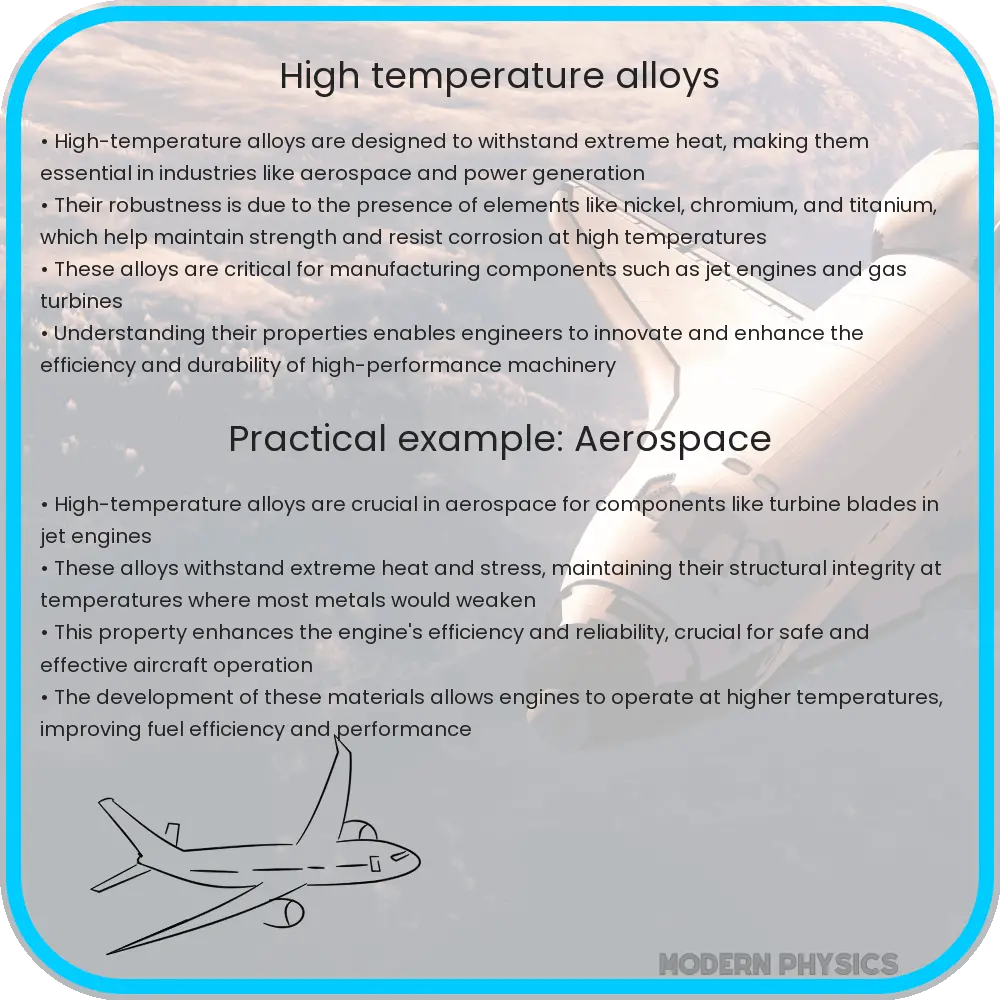
High-temperature alloys, also known as superalloys, are materials that can withstand high temperatures and extreme mechanical stress. They play a crucial role in various industries, including aerospace, automotive, and power generation, due to their exceptional combination of durability, efficiency, and strength.
Composition and Types
High-temperature alloys are primarily made up of nickel, iron, and cobalt, often enhanced with elements like chromium, molybdenum, and titanium to improve their performance in harsh environments. These materials are engineered to operate effectively at temperatures that can exceed 1000°C, making them indispensable in many high-tech applications. The most common types of high-temperature alloys include:
- Nickel-based: These alloys contain more than 50% nickel and are known for their superior strength and resistance to oxidation and corrosion at high temperatures.
- Iron-based: Typically less expensive than nickel-based alloys, these contain varying amounts of chromium and nickel, offering balanced properties for moderately high-temperature applications.
- Cobalt-based: With a higher melting point, these alloys are used in the hottest sections of gas turbines and other applications where thermal stability is critical.
Mechanical Properties
The standout characteristics of high-temperature alloys lie in their mechanical properties. These alloys maintain their strength, stiffness, and dimensional stability even under thermal stress, where many materials would succumb to creep, thermal fatigue, or other forms of degradation. This resilience is due to their complex microstructure and the formation of stable strengthening phases like gamma prime (γ’) and carbides.
Creep Resistance
One of the most critical properties of high-temperature alloys is their resistance to creep, which is the tendency of a solid material to move or deform permanently under the influence of mechanical stresses. Creep resistance is especially important in applications such as turbine blades, where the material must endure high stress for extended periods at high temperatures. The equation often used to describe creep behavior is:
ε = A * σn * e-(Q/RT)
where ε is the strain, σ is the stress, n is the stress exponent, Q is the activation energy for creep, R is the universal gas constant, and T is the absolute temperature.
Efficiency and Performance in High-Temperature Applications
The efficiency of high-temperature alloys is not only about withstanding high temperatures or stresses but also about maintaining performance over the lifespan of the components made from these materials. This includes minimizing thermal fatigue – the weakening of material caused by repeated cycles of heating and cooling. The optimized balance of alloying elements in high-temperature alloys helps combat this effect, thereby enhancing the overall efficiency of the system in which they are used.
Applications in Industry
High-temperature alloys find their applications in industries where reliability under extreme conditions is paramount:
- Aerospace: Components like jet engines and propulsion systems rely on the exceptional heat resistance and strength of superalloys.
- Automotive: In exhaust systems and turbochargers where high temperatures are prevalent, high-temperature alloys contribute to durability and performance enhancement.
- Energy: Superalloys play a critical role in the operation of power plants, including nuclear reactors and gas turbines, by providing reliability and efficiency at high operational temperatures.
Understanding the capabilities and uses of high-temperature alloys helps in designing more effective and enduring technological solutions across a broad spectrum of applications.
Future Trends and Innovations
In the quest for improved performance and sustainability, research into high-temperature alloys continues to evolve. Innovations focus on developing even more heat-resistant alloys and manufacturing techniques that can produce complex parts with improved life cycles and reduced environmental impact. Scientists and engineers are exploring the use of additional rare elements and the integration of computational materials science to predict alloy behavior under extreme conditions accurately.
Maintaining and Testing High-Temperature Alloys
With their critical role in demanding applications, maintaining the integrity of high-temperature alloys is essential for safety and efficiency. Regular testing methods like stress rupture testing, thermal stability tests, and metallurgical analysis are employed to ensure that these materials perform as expected over time. New non-destructive testing techniques are also being developed to monitor the health of components in real-time, reducing downtime and maintenance costs.
Sustainability and Recycling
Given the extensive use of valuable resources in these alloys, the recycling and reusability of high-temperature materials have become increasingly important. Efforts are being intensified to reclaim and recycle these materials from retired machinery. This not only helps in reducing the environmental burden but also in managing the cost implications associated with raw materials, thereby contributing to the sustainability of manufacturing practices.
Conclusion
High-temperature alloys, with their remarkable capabilities to endure extreme conditions, have paved the way for advancements in several critical sectors such as aerospace, automotive, and energy. By understanding their unique properties, composition, and applications, industries can continue to innovate and develop solutions that push the boundaries of what’s possible in technology and engineering. The ongoing research and development in this field are essential for optimizing performance and sustainability, driving forward the capabilities of these indispensable materials. As we look towards future challenges and demands, the role of high-temperature alloys remains fundamentally crucial in shaping the next generation of engineering innovations.