
Explore the fascinating dynamics of orbital resonance in exoplanets, including stability patterns and observational techniques, revealing the secrets of planetary systems.
Understanding Orbital Resonance in Exoplanets
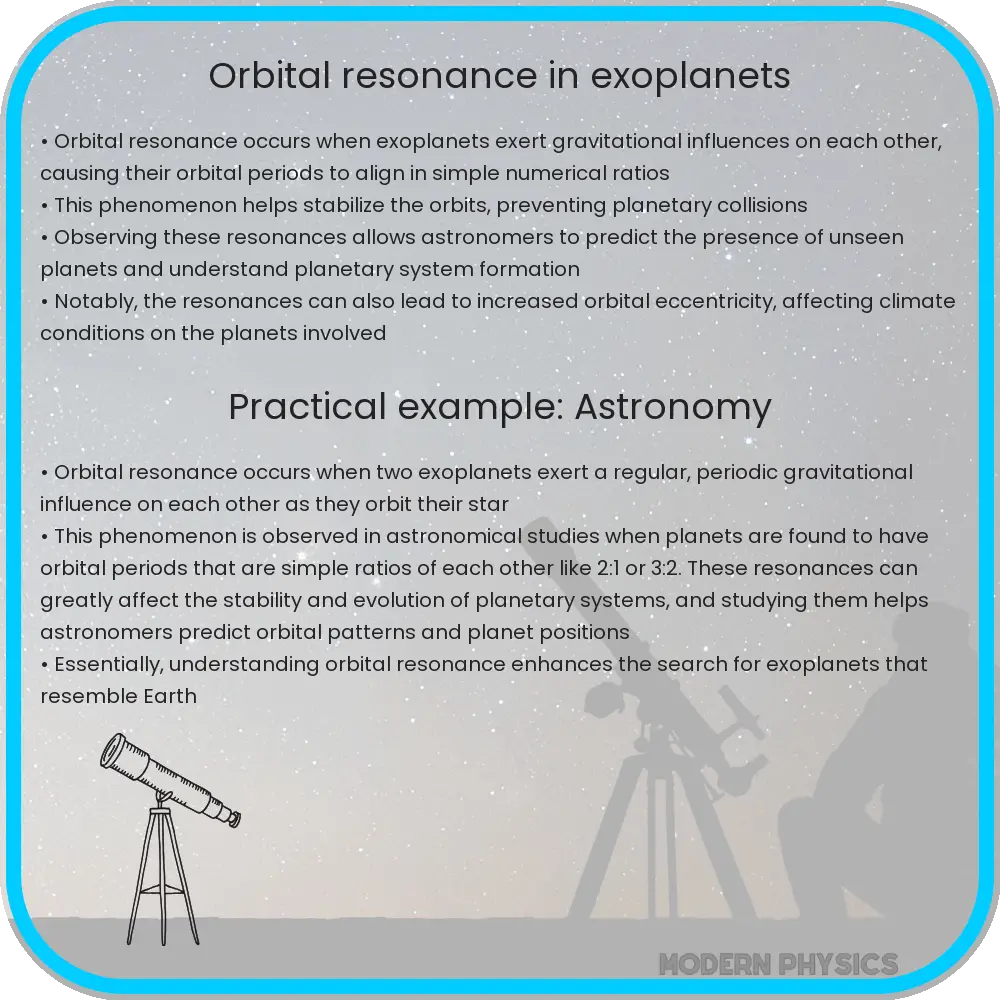
Orbital resonance occurs when two orbiting bodies exert a regular, periodic gravitational influence on each other, typically due to their orbital periods being related by a ratio of small integers. This phenomenon is particularly fascinating when observed in exoplanets, as it reveals complex dynamics and stability patterns that can inform us about the formation and evolution of planetary systems beyond our own.
Dynamics of Orbital Resonance
The dynamics of orbital resonance in exoplanetary systems are governed by the gravitational interactions between planets and the central star. When exoplanets are in orbital resonance, their gravitational forces work in sync to stabilize their orbits. For example, a 2:1 resonance means that for every orbit one planet completes, another planet completes exactly half as many. This synchronization can lead to observable patterns in the planets’ orbital velocities and positions, offering clues about the history and configuration of the planetary system.
Stability and Its Implications
Stability is a crucial aspect of orbital resonance. In many cases, resonance can stabilize the orbits of exoplanets, preventing them from colliding with each other or being ejected from the planetary system. This stability is essential for the long-term survivability of planetary systems, especially in tightly packed environments. However, under certain circumstances, resonance can also lead to chaotic behavior, where small perturbations can significantly alter the orbits of the planets involved.
Patterns of Resonance
The most common patterns of orbital resonance found in exoplanet systems include mean-motion resonances, where the orbital periods of two or more planets are in a simple integer ratio. This can lead to distinctive orbital configurations, such as Laplace resonances, seen in the Galilean moons of Jupiter, and can significantly affect the thermal and geological activity of the planets involved.
Studying these patterns not only helps scientists understand the formation and evolution of exoplanet systems but also aids in the identification of potentially habitable planets. By examining the stability and dynamics of orbital resonance, astronomers can predict the long-term behavior of planetary systems and assess their suitability for life.
Exploring Resonance Varieties and Their Effects
Beyond mean-motion resonances, exoplanets can exhibit other types of orbital interactions, such as secular resonance. In these scenarios, the gravitational forces between planets align over much longer periods, affecting their orbital shapes and orientations rather than their periods directly. Such interactions can lead to significant changes in eccentricity and inclination, impacting climate cycles and environmental stability on these worlds.
Observational Techniques and Discoveries
Astronomers utilize various observational techniques to detect and study orbital resonances in exoplanetary systems. Transit timing variations (TTVs) and radial velocity measurements are among the most effective methods for identifying gravitational interactions between exoplanets. These techniques have led to the discovery of numerous resonant chains, providing insights into the diverse conditions and evolutionary pathways of planetary systems across the galaxy.
For instance, the TRAPPIST-1 system, with its seven Earth-sized planets, showcases a complex chain of resonances that has implications for the system’s stability and habitability. Such discoveries underscore the importance of orbital resonance in the architecture and dynamics of exoplanetary systems.
Conclusion
Orbital resonance plays a pivotal role in shaping the architecture and dynamics of exoplanetary systems. Understanding the intricate dance between exoplanets in resonance offers valuable insights into their formation, stability, and potential habitability. The study of orbital resonance not only enhances our understanding of the cosmos but also pushes the boundaries of our knowledge, leading to the discovery of new worlds and unraveling the mysteries of planetary system evolution. As observational techniques continue to improve, the future of exoplanet research looks promising, promising new revelations about the complex interactions that govern the celestial dance of planets across the universe.