
Explore the fundamentals of planetary dynamics and orbital mechanics, including celestial forces, orbital evolution, and their impact on space exploration.
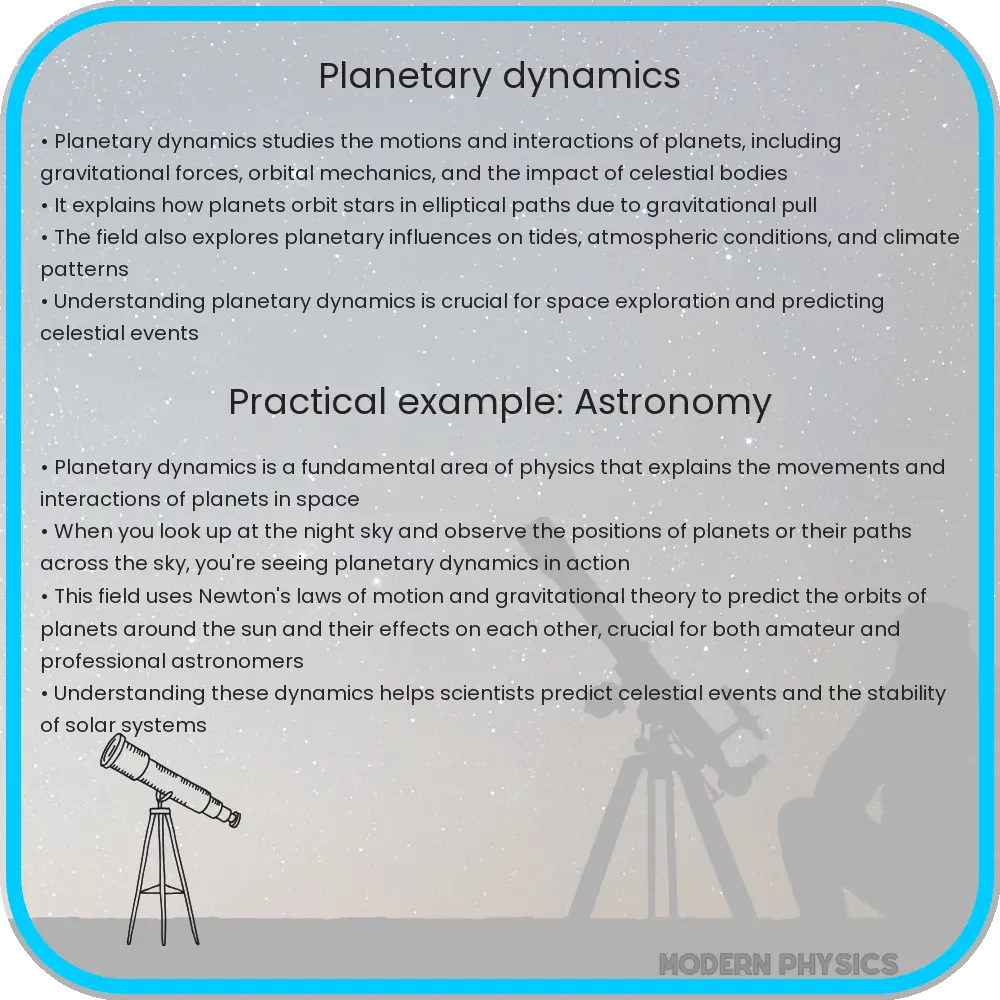
Introduction to Planetary Dynamics and Orbital Mechanics
Planetary dynamics and orbital mechanics are fundamental aspects of astrophysics and celestial mechanics that describe the motion of celestial bodies as they orbit one another. This field is crucial for understanding how planets, moons, comets, and asteroids move within our solar system and beyond, offering insights into the forces that govern their trajectories and the evolution of their orbits over time.
The Fundamentals of Orbital Mechanics
Orbital mechanics, also known as flight mechanics, involves the application of physics, specifically Newton’s laws of motion and universal gravitation, to predict the paths of celestial objects. The most basic orbit is an ellipse, as described by Kepler’s First Law, with the central body located at one of the two foci. The shape and size of an orbit are defined by its semi-major axis and eccentricity, parameters that determine an object’s orbital period and distance from the central body.
Gravitational Forces and Their Impact on Orbits
The primary force acting on celestial bodies is gravity, an attractive force that pulls objects toward each other. According to Newton’s Law of Universal Gravitation, the force between two masses is directly proportional to the product of their masses and inversely proportional to the square of the distance between their centers. This principle explains why orbits occur and how they are shaped. For example, the more massive a central body, the stronger its gravitational pull, leading to faster orbital speeds for satellites or planets in close proximity.
Evolution of Planetary Orbits
Over time, the orbits of celestial bodies can undergo significant changes due to various factors such as gravitational interactions with other objects, the effects of tidal forces, and the loss or gain of mass. These evolutionary processes can lead to phenomena such as orbital resonance, where two orbiting bodies exert a regular, periodic gravitational influence on each other, typically by aligning their orbital periods.
Understanding Planetary Dynamics and Orbital Mechanics
Planetary dynamics and orbital mechanics are fundamental concepts in the study of celestial bodies. They describe the movements of planets, moons, and artificial satellites, governed by the laws of physics. At the heart of these phenomena is Newton’s law of universal gravitation, which explains how every object in the universe attracts every other with a force proportional to the product of their masses and inversely proportional to the square of the distance between their centers.
The Evolution of Celestial Orbits
The orbits of planets and other celestial bodies are not static. They evolve over time under the influence of various gravitational forces, a process known as orbital evolution. This can result from natural events such as passing stars or internal factors like mass redistribution within a planet. For example, the Moon is slowly moving away from the Earth at a rate of approximately 3.8 centimeters per year due to tidal forces, altering its orbit gradually.
Forces Influencing Orbital Mechanics
- Gravitational Forces: The primary force driving orbital mechanics is gravity, which pulls objects towards each other. This force is central to Kepler’s laws of planetary motion, which describe how planets orbit the sun in elliptical paths with varying speeds.
- Tidal Forces: These are secondary effects of gravity that cause stretching and squeezing of a celestial body due to the differential gravitational pull from another body, such as the Earth’s interaction with the Moon.
- Thrust Forces: In the context of artificial satellites and spacecraft, thrust forces from engines can alter orbits, allowing for maneuvers and changes in trajectory.
Conclusion
The interplay between gravitational forces, tidal dynamics, and additional factors like thrust forces from human-made spacecraft leads to the rich and complex field of planetary dynamics and orbital mechanics. Understanding these principles is crucial for space exploration, predicting celestial events, and even for the long-term sustainability of satellites in Earth’s orbit. As we continue to explore the cosmos, the principles of planetary dynamics and orbital mechanics will guide our journey, enabling further discoveries and advancements in space technology.