
Explore the mysteries of exoplanets, their diverse compositions, and unique orbits. Learn about detection techniques and future missions that could unveil new worlds.
Exoplanet Discovery: Unveiling New Worlds
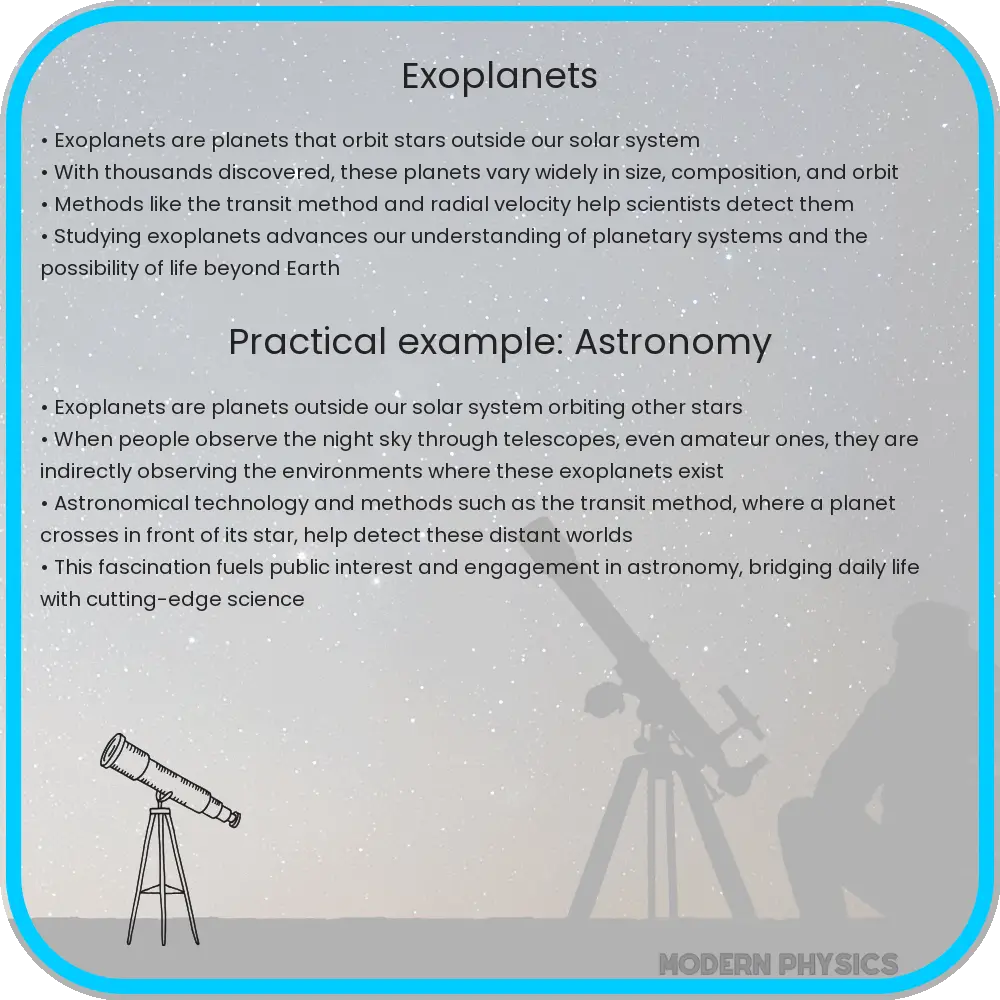
The quest to find planets beyond our solar system, known as exoplanets, has revolutionized our understanding of the universe. These discoveries have not only expanded the catalogue of known planets but have also unveiled a wide variety of worlds, each with unique mysteries and characteristics. From gas giants larger than Jupiter to rocky Earth-sized planets, the range is vast and fascinating.
Mysteries of Exoplanets
One of the greatest mysteries of exoplanets involves their formation and the diverse environments they present. Unlike the relatively homogeneous composition of planets in our solar system, exoplanets exhibit a vast array of compositions and conditions. Some are found in tight, close orbits around their stars, exhibiting extremely high surface temperatures, while others are located in the habitable zone, where conditions could potentially support liquid water and life.
Another intriguing aspect is the ‘hot Jupiters,’ gas giants that orbit very close to their host stars, a scenario not found in our solar system. These planets challenge our traditional theories of planetary formation and migration. Additionally, the discovery of ‘super-Earths’ and ‘mini-Neptunes’ fills the gap between Earth-sized rocky planets and Neptune-sized gas giants, raising questions about their formation, atmosphere, and potential habitability.
Composition and Atmosphere
The composition of exoplanets varies significantly, influenced by factors such as their distance from the host star, mass, and formation history. Scientists use various methods to deduce their composition, primarily through transit spectroscopy and direct imaging. By analyzing the light spectrum, researchers can identify the presence of elements and compounds in the atmosphere of these distant worlds. Commonly found elements include hydrogen (H2), helium (He), and water vapor (H2O), but more exotic atmospheres with silicates and metals have also been observed.
Orbital Characteristics and Dynamics
The orbits of exoplanets reveal much about their history and dynamics. Many have highly eccentric orbits, unlike the nearly circular orbits seen in our solar system. These eccentric orbits can lead to extreme temperature variations and dynamic climates, challenging our understanding of planetary systems. The study of these orbits, combined with the mass and radius of the planets, helps astronomers determine their density and, consequently, their overall composition and structure.
Advanced Detection Techniques and Future Missions
Advancements in detection techniques have been pivotal in the surge of exoplanet discoveries. The primary methods include the transit method, where a planet passes in front of its host star, causing a slight dimming detectable by telescopes; and the radial velocity method, which measures the star’s slight wobble due to gravitational pull from an orbiting planet. Additionally, direct imaging and gravitational microlensing offer unique insights, allowing astronomers to study exoplanets’ atmospheres and even identify planets without a host star.
Future missions, such as the James Webb Space Telescope (JWST) and the European Extremely Large Telescope (E-ELT), promise to revolutionize our understanding of exoplanets. These missions aim to provide more detailed spectra of exoplanetary atmospheres, identify the chemical signatures of potential biological activity, and image Earth-like exoplanets directly.
Implications of Exoplanetary Research
The study of exoplanets extends beyond the mere cataloging of new worlds. It challenges and refines our models of planetary formation, migration, and atmospheric dynamics. By comparing exoplanets with the planets in our solar system, scientists can understand the universal principles governing planetary systems. Moreover, this research brings us closer to answering the age-old question of whether life exists elsewhere in the universe. The detection of biosignatures, such as oxygen or methane, in an exoplanet’s atmosphere would be a significant step towards identifying habitable environments or even extraterrestrial life.
Conclusion
The discovery and study of exoplanets represent one of the most thrilling frontiers in astronomy and space science. Each new exoplanet discovered adds to our understanding of the universe’s diversity and complexity. As detection techniques improve and future missions launch, we will delve deeper into the mysteries of these distant worlds. The ongoing research and exploration of exoplanets not only challenge our scientific paradigms but also expand our imagination about what forms planets can take and the possibilities of life beyond Earth. The journey into the realm of exoplanets continues to unfold, promising new discoveries, insights, and perhaps, one day, the detection of a world much like our own.