
Explore the future of secure and fast communication with quantum devices, delving into their mechanisms, benefits, and the transformative potential of quantum technology.
Understanding Quantum Communication Devices
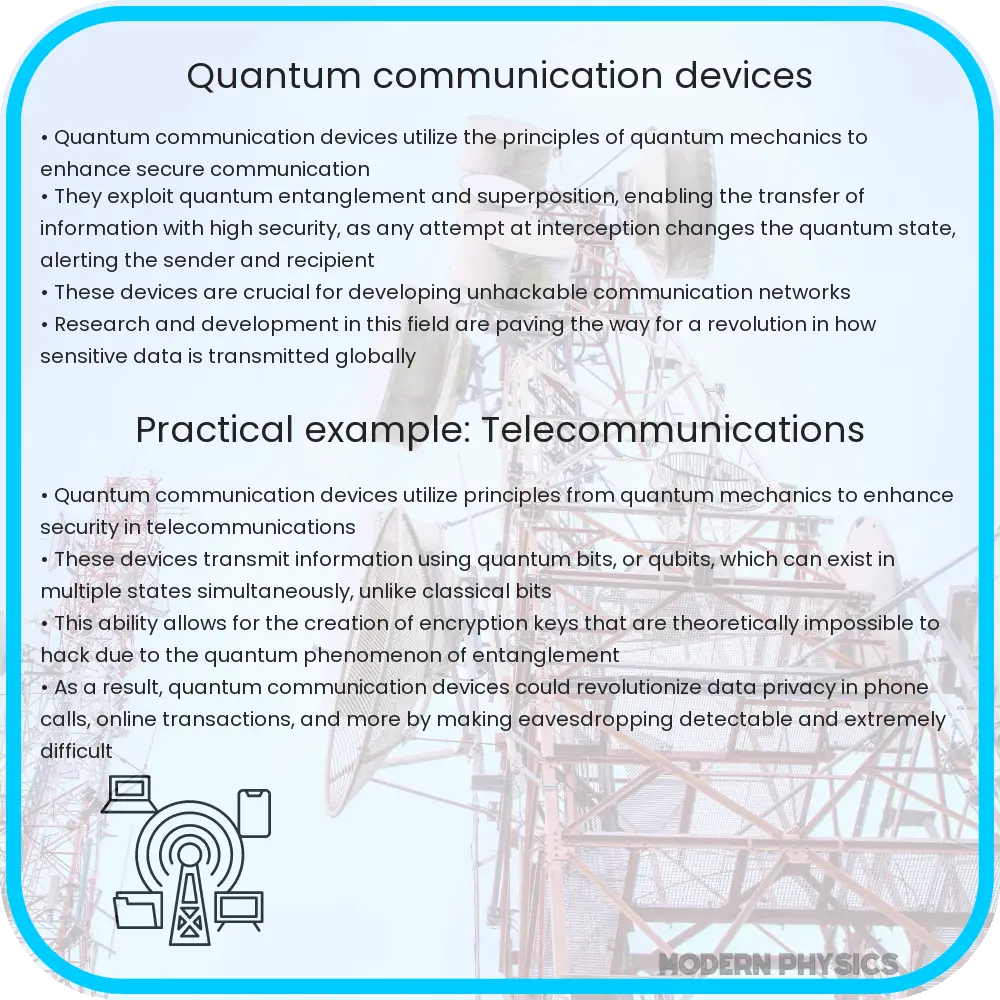
Quantum communication devices represent a cutting-edge frontier in secure and efficient information transfer. Leveraging the principles of quantum mechanics, these devices offer unparalleled security and speed, making them a vital component for the future of communication technology. This article delves into the core aspects of quantum communication, highlighting its mechanisms, benefits, and potential applications.
The Mechanism Behind Quantum Communication
At the heart of quantum communication is the concept of quantum entanglement, a physical phenomenon where particles such as photons become interconnected in such a way that the state of one (no matter the distance separating them) can instantly influence the state of the other. This principle is harnessed in quantum communication to transmit information in a way that is fundamentally secure from eavesdropping.
Quantum Key Distribution (QKD) is one of the most prominent applications of quantum communication. QKD uses quantum mechanics to secure a communication channel, allowing two parties to generate a shared, secret key used to encrypt and decrypt messages. The security of QKD lies in the fact that any attempt at eavesdropping disturbs the quantum states of the particles involved, alerting the communicating parties to the intrusion.
Advantages of Quantum Communication Devices
- Unprecedented Security: The use of quantum entanglement in communication offers a level of security that is theoretically impossible to breach without detection.
- High Speed: Quantum communication devices can operate at high speeds, facilitating rapid transmission of information across vast distances.
- Future-Proof: As quantum computing advances, traditional encryption methods are becoming increasingly vulnerable. Quantum communication provides a solution that is resilient against the computational power of quantum computers.
Despite these advantages, the development and deployment of quantum communication devices face significant challenges, including technical hurdles related to maintaining quantum states over long distances and the high cost of implementation. However, ongoing research and technological advancements are steadily overcoming these obstacles, bringing us closer to a new era of communication.
Potential Applications and Future Directions
The potential applications of quantum communication are vast and varied, extending well beyond secure communication to impact fields such as cybersecurity, computing, and even space exploration. Financial institutions, government agencies, and military operations stand to benefit greatly from the unparalleled security features, potentially revolutionizing the way sensitive information is transmitted. Additionally, quantum communication could enhance the security of the internet at large, offering a robust defense against cyber threats in an increasingly digital world.
One of the most exciting prospects is the development of a quantum internet, which would utilize quantum devices and principles to create a network that is not only secure but also vastly more powerful than the current internet. This quantum network would enable the instant transfer of large amounts of data, support the operation of quantum computers in distributed settings, and facilitate complex scientific research by connecting researchers around the globe.
Challenges and Considerations
Despite the promising advantages, the practical implementation of quantum communication technology faces several hurdles. The delicate nature of quantum states requires sophisticated technology to preserve them over long distances, posing a significant challenge for global communication networks. Moreover, the integration of quantum communication with existing infrastructure necessitates substantial investment and innovation.
Furthermore, while quantum communication offers enhanced security, it also raises new ethical and privacy concerns that must be addressed. The development of regulations and standards that can keep pace with the rapid advancement of quantum technologies is crucial to ensuring that this revolutionary form of communication benefits society as a whole.
Conclusion
Quantum communication devices stand on the brink of transforming the landscape of digital communication, offering secure, fast, and advanced solutions that promise to redefine the boundaries of what is possible. As we navigate the complexities of implementing these technologies, their potential to secure our digital future and propel us into a new era of connectivity is undeniable. The journey towards a quantum-powered world is fraught with challenges, but the rewards — a safer, faster, and more connected planet — are well worth the effort. With continued research, investment, and collaboration, the dream of quantum communication can become a reality, ushering in a new age of technological innovation and security.