
Explore the role of optical lattices in quantum simulation, delving into their precision, control, and insights into Quantum Electrodynamics.
Understanding Optical Lattices in Quantum Simulation
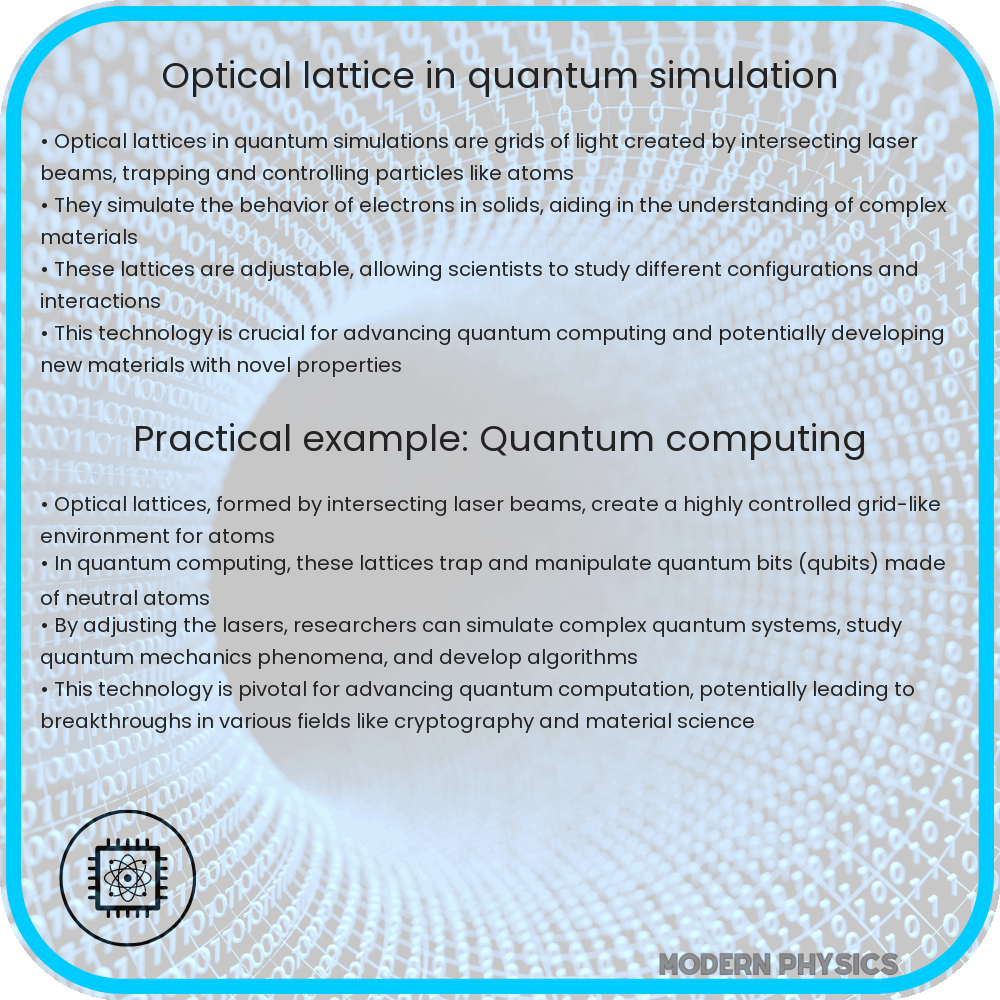
Optical lattices, a pivotal tool in quantum simulation, present a remarkable method for investigating complex quantum systems. By using intersecting laser beams to create a periodic potential, these lattices trap and control ultra-cold atoms, often alkali metals like Rubidium (37Rb87). This setup mimics the behavior of electrons in solid materials, thereby allowing unprecedented insights into quantum many-body systems.
The Role of Precision and Control
The key to the success of optical lattices in quantum simulation lies in their extraordinary precision and control. By adjusting the intensity, polarization, and configuration of the laser beams, researchers can manipulate the properties of the lattice. This includes the lattice depth, geometry, and the interaction strength between atoms. Such control enables the simulation of various physical phenomena, from simple models like the Hubbard model to more complex scenarios involving quantum phase transitions and topological states.
Quantum Electrodynamics (QED) Insights
Optical lattices also offer a unique platform for exploring Quantum Electrodynamics (QED) in a controlled environment. By simulating the interaction of light and matter at a fundamental level, researchers gain insights into phenomena like the quantum Hall effect and light-induced superconductivity. The ability to simulate these effects in a controlled setting is pivotal for understanding the underlying principles of QED and could lead to breakthroughs in quantum computing and materials science.
Applications and Future Prospects
The applications of optical lattices in quantum simulation are vast and diverse. They extend beyond fundamental physics to areas like quantum computing, where they can be used to create qubits and study quantum algorithms. Additionally, the insights gained from these simulations are crucial for the development of new materials with exotic properties. Looking ahead, the ongoing advancements in laser technology and atomic cooling are set to further enhance the capabilities of optical lattices, promising even more exciting discoveries in the realm of quantum physics.
In the next section, we will delve deeper into the technical aspects of optical lattices, including their setup, the role of laser cooling, and specific examples of quantum phenomena they have helped to elucidate.
Technical Aspects of Optical Lattices
Delving into the technicalities, optical lattices are formed by superimposing multiple laser beams, creating a standing wave pattern. Atoms are cooled to near absolute zero using techniques like Doppler cooling and evaporative cooling. This extreme cooling reduces the kinetic energy of the atoms, allowing them to be trapped at the potential minima formed by the intersecting laser beams. The result is a crystalline structure of atoms, mirroring the lattice structure of a solid without the complexity of electronic properties.
Laser Cooling and Atom Manipulation
Laser cooling is integral to optical lattice experiments. This process involves slowing down atoms using the radiation pressure of light. When an atom absorbs and re-emits photons, it loses momentum, leading to cooling. Precisely controlled magnetic fields and additional laser techniques are used to further cool and trap the atoms in the optical lattice. This level of control is crucial for studying quantum phenomena in isolation from external perturbations.
Exploring Quantum Phenomena
Optical lattices have facilitated groundbreaking studies in quantum mechanics. For instance, they have been instrumental in observing Bose-Einstein condensates, where atoms coalesce into a single quantum state at ultra-low temperatures. They also enable the simulation of quantum phase transitions, critical for understanding superconductivity and magnetism. Furthermore, optical lattices have allowed for the exploration of quantum walks, essential for the development of quantum algorithms.
Conclusion
In conclusion, optical lattices represent a cornerstone in the field of quantum simulation, offering a versatile and highly controlled environment for studying complex quantum systems. The precision of these systems in manipulating individual atoms and photons allows for a deeper understanding of quantum mechanics and its applications. As technology advances, optical lattices will continue to be at the forefront of quantum research, potentially unlocking new realms in quantum computing, material science, and beyond. Their contribution to our understanding of the quantum world is invaluable, marking a significant stride in the journey to unravel the mysteries of the universe.