
Explore the role of optical isolators in fiber networks, their types, impact on efficiency and stability, and future advancements in this field.
Understanding Optical Isolators in Fiber Networks
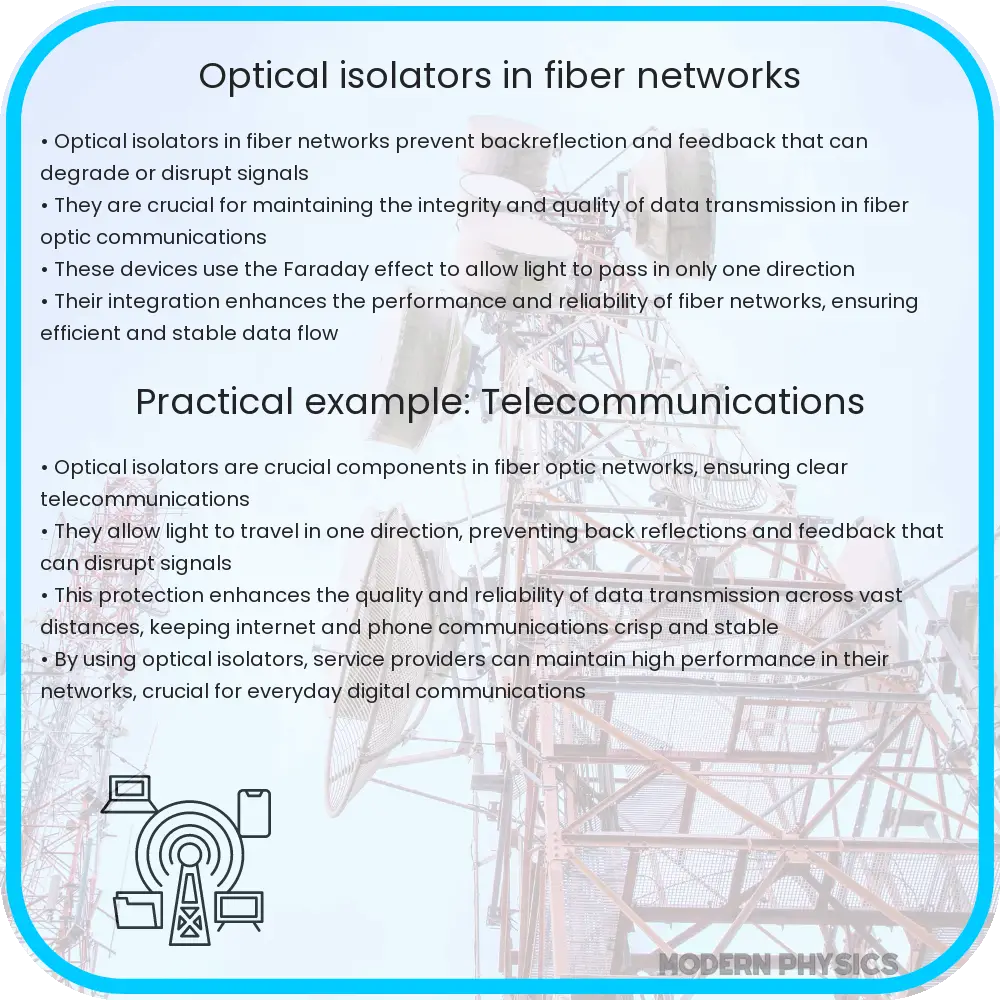
Optical isolators play a crucial role in enhancing the efficiency, stability, and performance of fiber optic networks. These devices, often overlooked, are essential in protecting sensitive optical equipment from potentially damaging reflected light. This article delves into the workings of optical isolators, their importance in fiber networks, and how they contribute to overall system efficiency and stability.
The Role of Optical Isolators
At their core, optical isolators allow light to pass in only one direction. This unidirectional flow is critical in preventing back reflections and scattered light from reaching sensitive components such as lasers. Back reflections can lead to numerous issues, including laser instability, signal degradation, and even permanent damage to the light source. By integrating optical isolators into a fiber network, these risks are significantly mitigated.
Types of Optical Isolators
There are two main types of optical isolators: the Faraday Rotator and the Polarization Dependent Isolator. The Faraday Rotator, based on the Faraday effect, uses a magnetooptic material like Yttrium Iron Garnet (Y3Fe5O12) to rotate the polarization of light. This rotation, combined with polarizers, ensures that light can only pass in one direction. On the other hand, Polarization Dependent Isolators rely on polarization properties of light, using birefringent materials to achieve unidirectional transmission.
Impact on Efficiency and Stability
Optical isolators directly contribute to the efficiency of fiber optic networks by minimizing light loss and maintaining signal integrity. They prevent the destabilizing effects of back reflections on laser sources, ensuring consistent performance. This stabilization is particularly crucial in high-speed and long-distance communication, where signal integrity is paramount. Moreover, by protecting against feedback, optical isolators prolong the lifespan of optical components, reducing maintenance costs and downtime.
Advancements in Optical Isolator Technology
Recent advancements in optical isolator technology have focused on improving efficiency and minimizing insertion loss. Modern isolators offer higher isolation levels, lower polarization dependency, and are capable of operating over a broader wavelength range. These improvements are essential in supporting the ever-increasing demand for higher data rates and longer transmission distances in fiber optic networks.
In the next section, we will explore the integration and application of optical isolators in various fiber optic systems, and discuss the future outlook of this technology.
Integration and Application of Optical Isolators in Fiber Networks
Integrating optical isolators into fiber networks is a straightforward yet critical process. In telecommunications, they are often installed directly after the laser source to immediately guard against back reflections. In more complex systems, such as dense wavelength division multiplexing (DWDM), isolators play a vital role in each channel to maintain the integrity and independence of multiple signal paths. This integration is essential in ensuring the network’s robustness and reliability, especially in environments with high data traffic and long-distance transmissions.
Optical Isolators in Different Fiber Network Configurations
Optical isolators are versatile and find applications in various network configurations. In point-to-point links, they ensure stable laser operation and protect against back reflections from the end terminals. In ring architectures, isolators are critical in preventing circulating light, which can cause interference and instability. Similarly, in mesh networks, they contribute to the overall health of the system by isolating faults and preventing them from affecting the entire network.
Future Outlook of Optical Isolator Technology
The future of optical isolator technology is promising, with ongoing research focusing on miniaturization, cost reduction, and enhanced performance. Innovations like integrated photonic isolators and tunable isolators are on the horizon. These advancements will not only make optical isolators more efficient and versatile but also more accessible for a wider range of applications beyond traditional telecommunications, such as in quantum computing and biomedical imaging.
Conclusion
In conclusion, optical isolators are indispensable components in the realm of fiber optic networks. Their ability to allow unidirectional light transmission while protecting sensitive optical components from back reflections is crucial for the efficiency, stability, and performance of these networks. With ongoing technological advancements, optical isolators will continue to evolve, offering enhanced capabilities and opening new avenues for their application. Their role in ensuring the seamless transmission of data across vast distances highlights their importance in the modern world, where communication and information transfer are paramount. As fiber networks grow more complex and demand for higher data rates increases, the significance of optical isolators in maintaining system integrity and performance will only become more pronounced.
Is this conversation helpful so far?