
Explore how optical isolators enhance laser system efficiency, stability, and safety, with insights into their operation, advancements, and selection.
Understanding Optical Isolators in Laser Systems
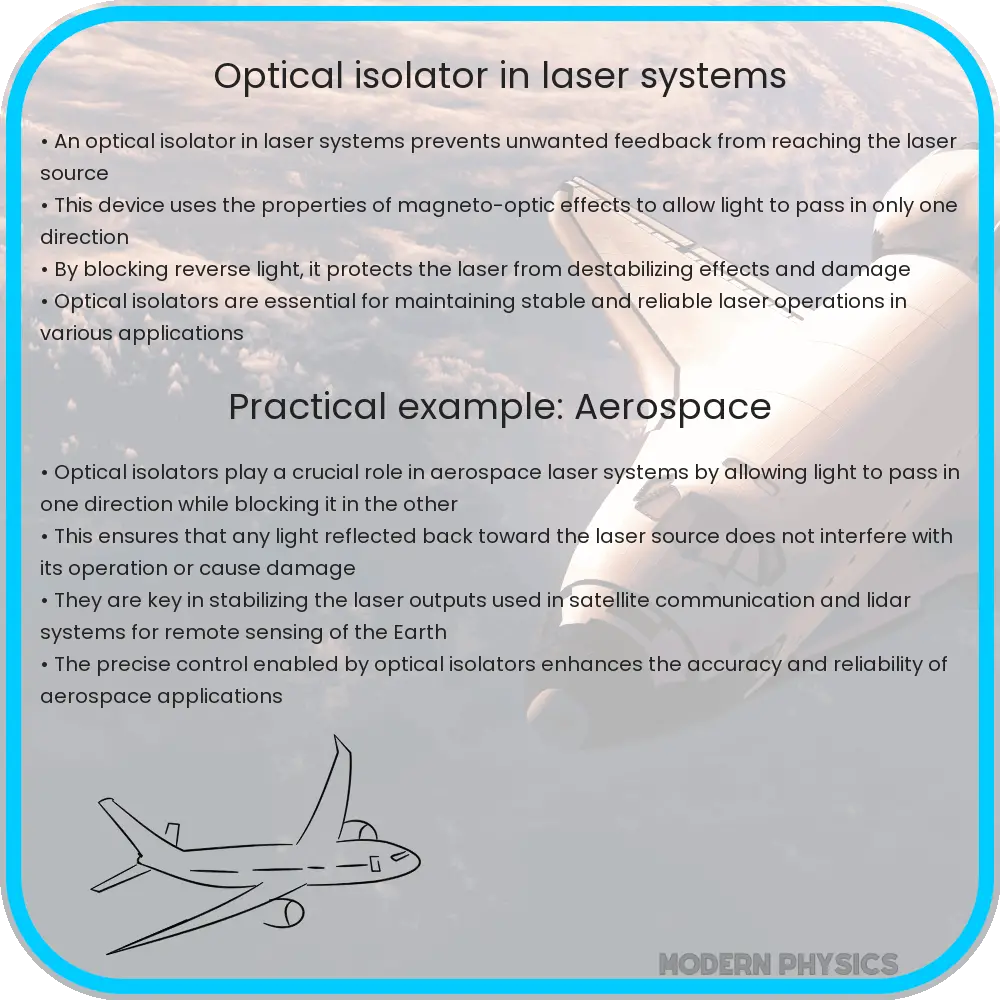
Optical isolators play a critical role in enhancing the efficiency, stability, and safety of laser systems. They are specially designed to allow light to pass in one direction while blocking it in the opposite direction. This unique property makes them essential components in a variety of optical applications, from research laboratories to industrial settings.
Efficiency and Performance
The primary function of an optical isolator is to protect the laser source from destabilizing feedback. In laser systems, even a small amount of light reflected back into the laser can cause fluctuations in output, mode hopping, or, in severe cases, damage to the laser itself. By preventing back reflections, optical isolators significantly improve the laser’s efficiency and performance stability. They ensure that the laser operates at its optimal wavelength without interference from external light sources.
Stability and Safety
Optical isolators also contribute to the overall stability of laser systems. By maintaining a constant direction of light flow, they prevent unwanted feedback that can lead to instabilities in the laser output. This stability is crucial not only for the quality of the laser’s performance but also for the safety of its operation. A stable laser is predictable and reduces the risk of accidents in sensitive applications. Furthermore, optical isolators protect delicate components within the laser system from damage caused by reflected light, enhancing the longevity and reliability of the system.
The Principle of Operation
The operation of optical isolators is based on the principles of nonreciprocal light transmission. Most isolators use a combination of polarizers and magneto-optical materials, such as garnets (e.g., Yttrium Iron Garnet – Y3Fe5O12). These materials, when subjected to a magnetic field, exhibit the Faraday effect, rotating the polarization of light passing through them in only one direction. This rotation, coupled with polarizers positioned at the input and output of the isolator, ensures that light can only travel in the intended direction.
Advancements in Optical Isolator Technology
Recent advancements in optical isolator technology have led to the development of more compact, efficient, and broadband isolators. Innovations in materials science, particularly in magneto-optical materials, have paved the way for isolators that can operate over a wider range of wavelengths and temperatures. This versatility makes them even more valuable in complex optical systems that require precise control over light propagation.
Integration in Modern Laser Systems
In modern laser systems, optical isolators are seamlessly integrated to enhance performance and safety. They are particularly crucial in systems that utilize high-power lasers or those that operate in sensitive environments, where the stability of the laser beam is paramount. With the advent of fiber optics, optical isolators have also been adapted for use in fiber-optic communications, where they prevent back reflections that could degrade the signal quality.
Choosing the Right Optical Isolator
Selecting the right optical isolator for a specific laser system requires consideration of several factors, including the wavelength of operation, isolation degree needed, and the optical power of the system. The physical size and insertion loss of the isolator are also important considerations, especially in compact or portable laser systems. Manufacturers now offer a range of isolators designed for specific types of lasers and applications, ensuring that there is an isolator suited to almost any requirement.
Conclusion
Optical isolators are indispensable components in the realm of laser technology, significantly enhancing the efficiency, stability, and safety of laser systems. Their ability to prevent unwanted back reflections ensures that lasers can operate at their peak performance without the risk of damage or instability. As laser technology continues to evolve and find new applications, the role of optical isolators will only grow in importance. With ongoing advancements in materials and design, future optical isolators will offer even greater performance, enabling more innovative and powerful laser systems. The continual development of optical isolator technology is a testament to its vital role in the advancement of optical sciences and its contribution to the safety and reliability of laser operations worldwide.