
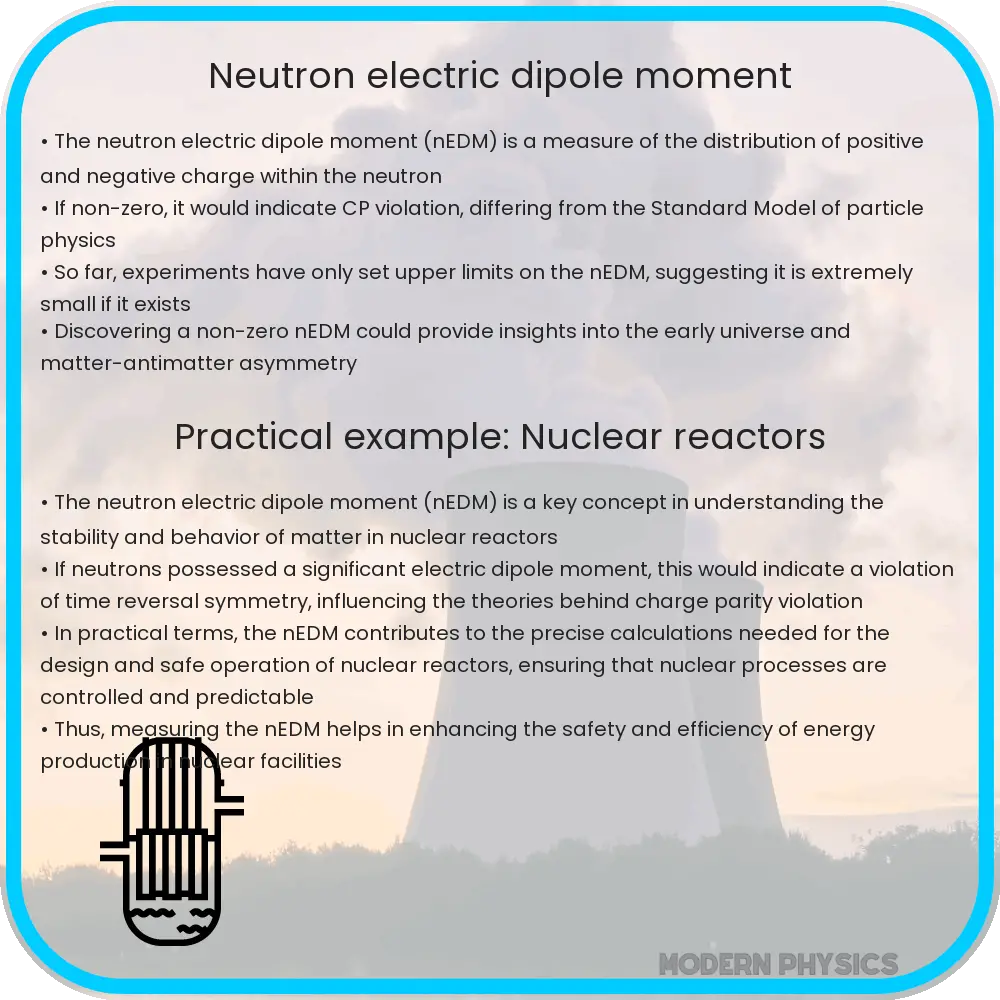
The neutron electric dipole moment (nEDM) explores potential CP violation and matter-antimatter asymmetry, enhancing understanding of fundamental physical laws.
Understanding the Neutron Electric Dipole Moment
The concept of the electric dipole moment is pivotal in understanding atomic and subatomic structures. However, its implications reach further when we consider particles such as neutrons. The neutron electric dipole moment (nEDM) is an intriguing quantum mechanical phenomenon that could provide insights into some fundamental aspects of the universe, including CP violation and the overall matter-antimatter asymmetry observed in cosmology.
What is an Electric Dipole Moment?
An electric dipole moment is a measure of the separation of positive and negative electrical charges within a system. For a simple two-charge system, it is defined as the product of the charge magnitude and the distance between them. Mathematically, the electric dipole moment p is expressed as:
p = q * d,
where q represents the charge and d the displacement vector between charges.
Neutrons and the Electric Dipole Moment
Neutrons are subatomic particles found in the nucleus of an atom, well known for being electrically neutral. Since they do not possess a net electric charge, the concept of a traditional electric dipole might seem non-applicable. However, the internal structure of a neutron involves charged quarks, suggesting the possibility of a separation of charges inside the neutron and hence, a dipole moment.
Importance of Detecting the nEDM
The search for the neutron electric dipole moment carries significant implications for physics beyond the simple structure of subatomic particles. Notably, the existence of an nEDM could demonstrate a form of charge-parity (CP) violation, which is not accounted for by the Standard Model of particle physics as it currently stands.
CP violation involves a discrepancy in the physical laws that apply to matter versus antimatter and is thought to be a crucial component in explaining why the observable universe is predominantly matter, with much less antimatter.
- The Standard Model and CP Violation: The Standard Model does incorporate CP violation in weak force interactions but fails to account for the observed matter-antimatter asymmetry in the universe. Therefore, the detection of nEDM could point to new physics beyond the Standard Model.
- Experimental Challenges: Measuring the nEDM is an extraordinarily delicate task, given its expected size is incredibly small (if it exists at all). Techniques involve observing neutrons in ultra-cold conditions and under high precision magnetic and electric fields.
Experimental Approaches to Measure nEDM
Various experiments have been conducted to measure the neutron’s electric dipole moment, most of which capitalize on the techniques of ultracold neutrons stored in traps at low temperatures. The sensitivity of these experiments must be exceedingly high due to the minute magnitude of the expected dipole moment, estimated to be less than 1e-26 e*cm.
Investigators typically use a setup that includes a strong magnetic field and an electric field aligned either parallel or antiparallel to the magnetic field. Observations of the neutron’s spin precession in these fields can potentially reveal the existence and size of an nEDM.
Despite intense experimental efforts, no definitive signals of a nonzero nEDM have been detected as of the latest findings. However, the upper limits posed by these experiments continue to refine theoretical physics and enhance our understanding of fundamental symmetries in nature.
- The most recent and sensitive experiments have placed upper bounds on the nEDM that improve upon previous measurements by orders of magnitude, continuously pushing the boundaries of quantum physics and technology.
Theoretical Implications of nEDM Detection
If the neutron electric dipole moment were to be discovered, it would be a groundbreaking event in theoretical physics. Such a finding would not only confirm the presence of CP violation beyond the interactions of the weak force but might also offer insights into the unification of forces and even hint at the existence of new, undiscovered particles.
- Unification of Fundamental Forces: Discovery of an nEDM might influence theories that advocate for a grand unification of electromagnetism, the strong force, and the weak force, potentially altering our understanding of the universe’s fundamental workings.
- Implications for the Multiverse Theory: An nEDM detection could provide empirical support for theories suggesting multiple universes or dimensions, broadening the scope of cosmology and the study of universal laws.
Future Prospects in nEDM Research
Given the significant technological advances in measurement techniques, future experiments designed to detect the neutron electric dipole moment are expected to be more sensitive. Researchers continue to refine their approaches, often incorporating new materials and technologies to enhance experimental setups. This ongoing development indicates a promising future for deeper insights into the structure of matter and the foundational laws of physics.
Moreover, collaborations among international research facilities are expanding, pooling resources and knowledge to tackle the complexities of nEDM measurements. These cooperative efforts not only accelerate the pace of research but also foster a global scientific community focused on solving one of physics’ most elusive mysteries.
Conclusion
The quest to measure the neutron electric dipole moment encapsulates a fundamental challenge in modern physics, straddling the intersection of theoretical realms and experimental ingenuity. While current experiments have not yet confirmed the existence of an nEDM, the pursuit itself has propelled advancements in quantum physics, particle detection technologies, and our understanding of the universe. Continued research into nEDM not only holds the potential to upend established theories but also paves the way for new discoveries that could reshape our scientific paradigms. Regardless of the outcome, the journey to uncover the mysteries of the neutron and its properties promises to enlighten our comprehension of the most basic elements that construct our world.