
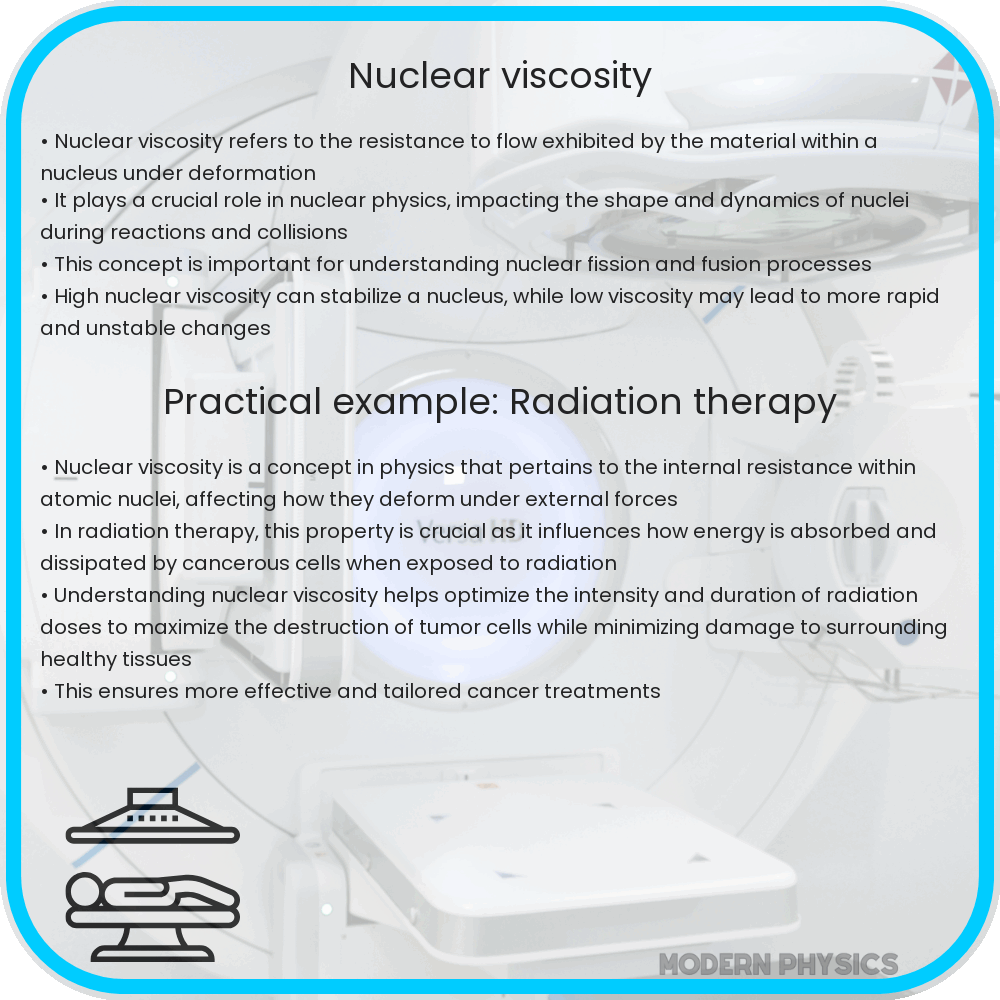
Nuclear viscosity measures the resistance of nucleons within an atomic nucleus to flow past each other, impacting nuclear dynamics and stability.
What is Nuclear Viscosity?
Nuclear viscosity is a concept within nuclear physics, part of the broader discipline that studies the properties and behavior of atomic nuclei. While most people are familiar with the idea of viscosity in fluids—essentially how thick or resistant to flow a liquid is—the notion of viscosity at the nuclear level involves how the internal components of a nucleus, such as protons and neutrons, interact and move relative to each other.
In more practical terms, nuclear viscosity can be described as the measure of the nucleons’ (protons and neutrons) resistance to flow past each other inside the nucleus. This parameter plays a crucial role in determining the dynamics within the nucleus, particularly during nuclear reactions such as fission or fusion.
Understanding Nuclear Viscosity
Understanding nuclear viscosity involves delving into the quantum mechanics that govern nuclear interactions. Much like atomic particles, nucleons are influenced by various forces, predominantly the strong nuclear force which is intensely powerful but operates at very short ranges. This force is primarily responsible for the binding of protons and neutrons in the nucleus, overcoming the repulsion between the positively charged protons.
The viscosity in a nucleus affects how it deforms and flows during reactions. A nucleus with high viscosity means the nucleons are more tightly bound and resist deformation. In contrast, a low-viscosity nucleus is more malleable, affecting its stability and the way it interacts during nuclear reactions.
Significance of Nuclear Viscosity
The practical implications of nuclear viscosity are profound, impacting areas such as nuclear power generation, radiation therapy in medical applications, and our understanding of stellar processes. In nuclear reactors, for example, the stability and flow properties of the nuclei undergoing fission can influence the efficiency and safety of the energy production process.
In astrophysics, nuclear viscosity concepts are significant in understanding stellar evolution, including phases like supernova explosions where heavy nuclei rapidly break down and new elements are formed through nucleosynthesis.
Moreover, in medical physics, the decay characteristics of nuclei, which are influenced by their internal viscous properties, determine the effectiveness and safety of radioactive treatments used in combating cancers and other diseases.
Measuring Nuclear Viscosity
Measuring the viscosity of a nucleus is a challenging aspect due to the minuscule size and the extremely high forces at play. Techniques involve high-energy particle collisions and precise measurements of nuclear decay rates. Giant resonances, for instance, which are oscillations of the entire nucleus, can provide insights into the nuclear viscosity by analyzing the damping of these oscillations — essentially, how quickly they diminish, indicating the viscosity.
Experimental physics employs particle accelerators to create and study these resonances, giving scientists valuable information about the internal dynamics of nuclei. Understanding the viscosity at this level helps in predicting nuclear behavior in various conditions, which is critical for both theoretical physics and practical applications.
Challenges in Studying Nuclear Viscosity
Despite its significance, studying nuclear viscosity presents a host of challenges. The primary difficulty lies in the quantum scale at which nuclear forces operate. Unlike macroscopic fluids where viscosity can be observed and measured relatively easily, nuclear viscosity must be inferred from indirect observations and complex theoretical models.
Furthermore, the transient nature of nuclear reactions, especially in environments like particle accelerators, means that any measurements need to be extremely precise and are often difficult to replicate. This requires not only sophisticated equipment but also a deep theoretical understanding of nuclear physics and quantum mechanics.
Future Prospects in Nuclear Viscosity Research
The future of research in nuclear viscosity looks promising with the advent of more advanced technologies in particle physics. As accelerators and detection technologies become more sophisticated, the accuracy of measurements and the ability to control experimental conditions improve significantly.
This advancement could lead to better models and simulations that replicate nuclear behavior more accurately. In turn, this might enhance our capabilities in fields like energy production, where understanding nuclear dynamics is key to optimizing nuclear reactors and minimizing waste and safety risks.
Moreover, improved knowledge of nuclear viscosity might open new avenues in nuclear medicine, possibly leading to more effective and less invasive treatment options for cancer and other diseases. The potential for developing new materials and technologies based on a deeper understanding of nuclear properties is also an exciting possibility.
Conclusion
Nuclear viscosity, though a complex and challenging field, is integral to our understanding of nuclear physics and its applications. From the microcosmic interactions within a nucleus to the grand scale of stellar phenomena, the study of how nucleons resist movement relative to one another shapes our comprehension of both the natural and engineered world. As technology progresses, so too will our understanding of nuclear viscosity, potentially unlocking new paradigms in energy production, medical treatment, and beyond. By continuing to study and unravel the mysteries of nuclear viscosity, scientists pave the way for innovations that could profoundly impact our day-to-day lives and the health of our planet.