
Explore the role of neutron capture processes in stellar evolution, nucleosynthesis, and energy production, uncovering the cosmic journey from stars to the elements.
Neutron Capture Processes in Stellar Evolution
The cosmos serves as an immense nuclear laboratory, where stars produce and transmute elements through a series of complex processes. Among these, neutron capture mechanisms play a crucial role in nucleosynthesis, the creation of new atomic nuclei, and contribute significantly to our understanding of stellar evolution and energy production.
Understanding Neutron Capture
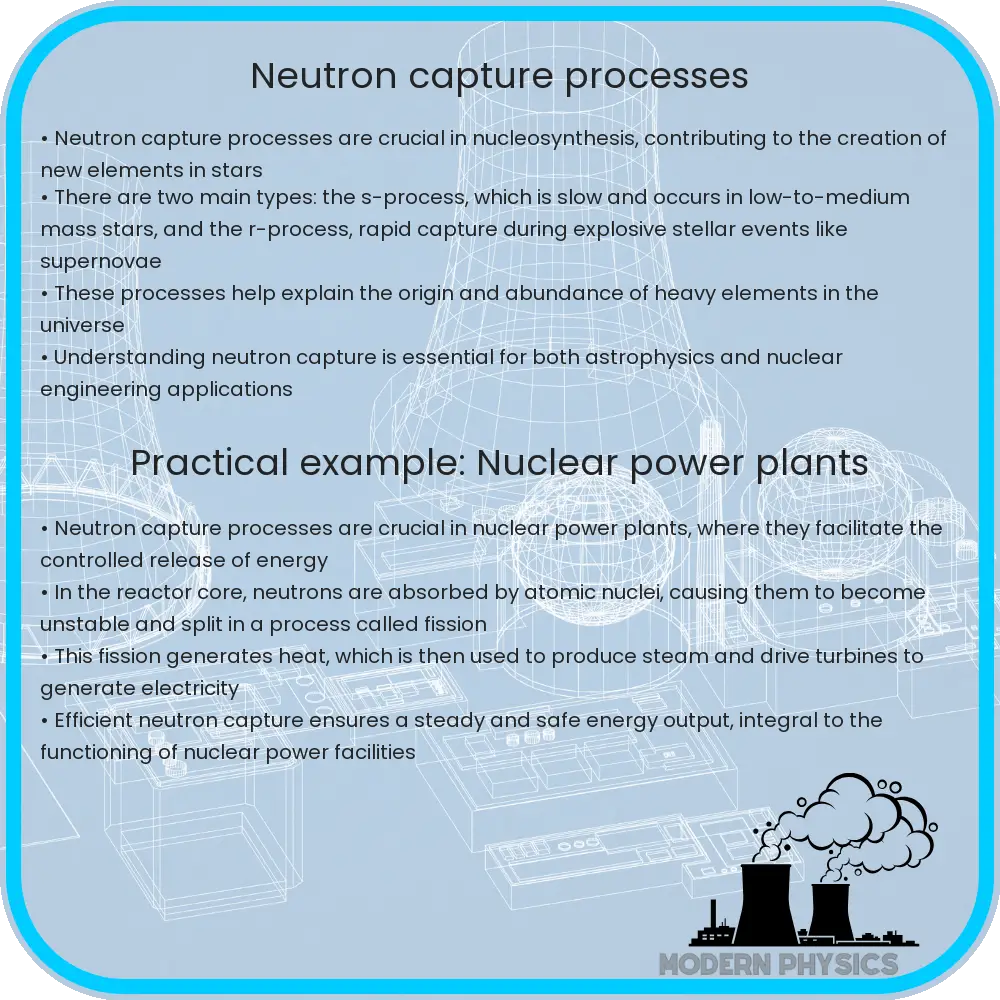
Neutron capture is a nuclear reaction in which an atomic nucleus absorbs a neutron. This process alters the atomic number and mass, leading to the formation of a different isotope or element. In the stellar context, there are two primary neutron capture processes: the slow (s-process) and the rapid (r-process).
- The S-Process: Occurring at relatively low neutron densities and high temperatures, the s-process is predominant in asymptotic giant branch (AGB) stars. This process involves the slow absorption of neutrons, allowing the nucleus to decay to a stable state before capturing another neutron. It is responsible for creating approximately half of the atomic nuclei heavier than iron.
- The R-Process: In contrast, the r-process takes place under extreme conditions of high neutron flux, such as those found in supernova explosions or neutron star mergers. Here, nuclei capture neutrons rapidly, before they have a chance to decay, leading to the production of very heavy and often unstable elements.
Role in Stellar Evolution and Energy
Neutron capture processes are integral to the life cycle of stars. In the s-process, as stars evolve into red giants and later into AGB stars, they synthesize heavier elements in their cores and outer layers. This nucleosynthesis releases energy, which counteracts the force of gravity, playing a crucial role in the star’s stability and longevity.
Conversely, the r-process is associated with the death throes of stars, particularly in the explosive environments of supernovae. The intense energy and neutron-rich conditions facilitate the creation of the heaviest elements in the universe, which are then scattered into space, contributing to the cosmic chemical abundance and influencing subsequent star formation.
Impact on the Cosmic Landscape
The elements synthesized through neutron capture processes are dispersed into the interstellar medium during various stages of a star’s life cycle. This enrichment fosters the formation of new stars, planets, and ultimately, life itself. The materials produced by the s-process and scattered during the peaceful final stages of low-mass stars contrast with those forged in the violent r-process events, showcasing the diverse pathways through which the universe evolves chemically.
Neutron Capture and Astronomical Observations
Astronomers study the remnants of neutron capture processes to understand the history and evolution of the cosmos. Observations of stellar spectra, supernova remnants, and neutron star mergers provide insights into the conditions under which different elements are created. This information helps scientists refine models of stellar evolution and nucleosynthesis, contributing to a deeper understanding of the universe’s composition and the lifecycle of stars.
Concluding Thoughts
Neutron capture processes are fundamental to the alchemy of the cosmos, transforming simpler elements into the complex, heavier ones that make up much of our world and beyond. The s-process and r-process not only illuminate the life and death of stars but also shape the chemical and physical landscape of the universe. Through the study of these processes, we gain not only insights into stellar behavior and evolution but also a greater appreciation for the intricate connections that bind the cosmos. As we continue to explore and understand these stellar phenomena, we unravel the mysteries of our origins and the fabric of space itself.