
Explore gravitational settling in stars: its mechanisms, impacts on star evolution, and the challenges faced in studying this fundamental astrophysical process.
Understanding Gravitational Settling in Stars
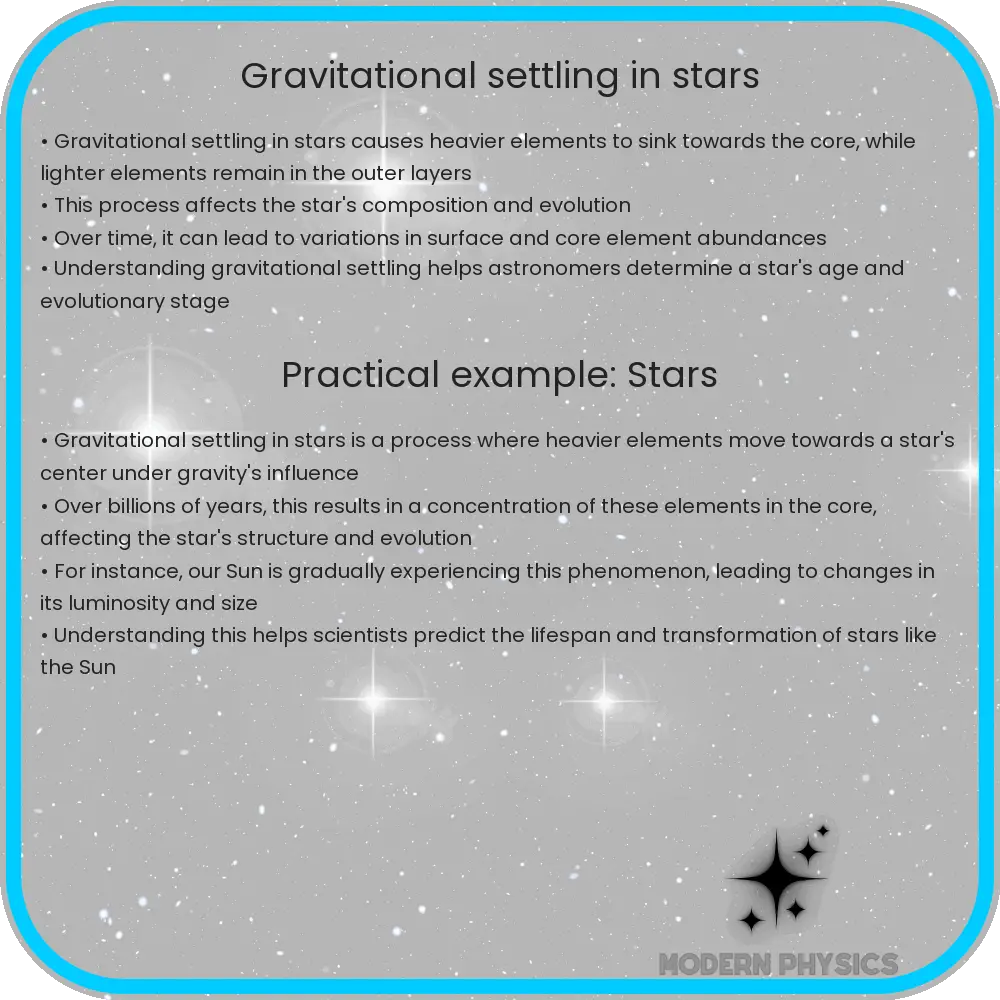
Gravitational settling, also known as sedimentation, is a critical process affecting the composition and structure of stars over their lifetimes. This astrophysical phenomenon involves the gradual movement of heavier elements towards a star’s center due to the force of gravity, while lighter elements float towards the surface. This segregation of elements impacts a star’s thermal structure, luminosity, and evolutionary path.
Mechanisms Behind Gravitational Settling
The primary mechanism behind gravitational settling is the stellar gravity itself, which creates a density gradient within the star’s interior. In the hot, dense environment of a star, particles such as ions and electrons move at high speeds. Heavier elements, with more protons and neutrons, experience a stronger downward gravitational pull compared to lighter elements. Over time, this results in the accumulation of elements like iron (Fe) and other heavy metals in the star’s core, while hydrogen (H) and helium (He) remain more abundant in the outer layers.
Impact on Star Evolution
Gravitational settling plays a significant role in the evolution of stars. As heavier elements accumulate in the core, the star’s opacity, energy transport mechanisms, and nuclear fusion rates change. This can lead to variations in the star’s brightness, size, and temperature. For example, in the Sun, gravitational settling leads to a depletion of helium and heavier elements in the outer layers, altering its luminosity and thermal structure over billions of years.
Studies and Observations
Scientists study gravitational settling in stars through a combination of observational astronomy and theoretical modeling. Observations of star spectra allow astronomers to infer the elemental composition of stellar atmospheres, while theoretical models predict how these compositions change over time due to gravitational settling. Advanced telescopes and spectroscopic instruments provide data critical for understanding this process, contributing to our broader knowledge of stellar physics and evolution.
Challenges and Techniques in Studying Gravitational Settling
Studying gravitational settling in stars presents numerous challenges. One significant hurdle is the immense time scales over which settling occurs, typically spanning millions to billions of years. Additionally, the internal conditions of stars are extreme and cannot be replicated on Earth, making direct observations of gravitational settling impossible. Researchers rely on sophisticated techniques such as helioseismology and astroseismology, which study the oscillations and vibrations within stars, to infer internal compositions and movements indirectly.
Gravitational Settling in Different Types of Stars
The effects and significance of gravitational settling vary among different types of stars. In white dwarfs, gravitational settling leads to pure hydrogen or helium outer layers, as heavier elements sink to the core. In main-sequence stars like the Sun, the process affects surface abundances and solar activity cycles. Understanding gravitational settling in various stellar environments helps astronomers predict star lifetimes, supernova occurrences, and the chemical evolution of galaxies.
Future Prospects in Gravitational Settling Research
Future research in gravitational settling aims to improve the accuracy of stellar models and expand our understanding of stellar populations across the universe. Upcoming space missions and ground-based observatories will provide more detailed observations, while advances in computational astrophysics will enhance theoretical models. These developments promise to unveil the intricate details of gravitational settling and its implications for star formation, evolution, and demise.
Conclusion
Gravitational settling is a fundamental process shaping the structure and evolution of stars. Through the combined efforts of observational and theoretical astrophysics, our understanding of this phenomenon has significantly advanced. However, many questions remain, particularly regarding the precise impact of settling on different types of stars and their evolutionary paths. As technology and methodologies improve, the continued study of gravitational settling will no doubt contribute profoundly to our knowledge of the cosmos, offering deeper insights into the life cycles of stars and the dynamic processes governing their evolution.