
Explore the s-process nucleosynthesis, the cosmic phenomenon creating heavy elements within stars, shaping stellar evolution, and contributing to the universe’s chemical diversity.
S-process Nucleosynthesis: Unveiling the Mysteries of Star-Made Elements
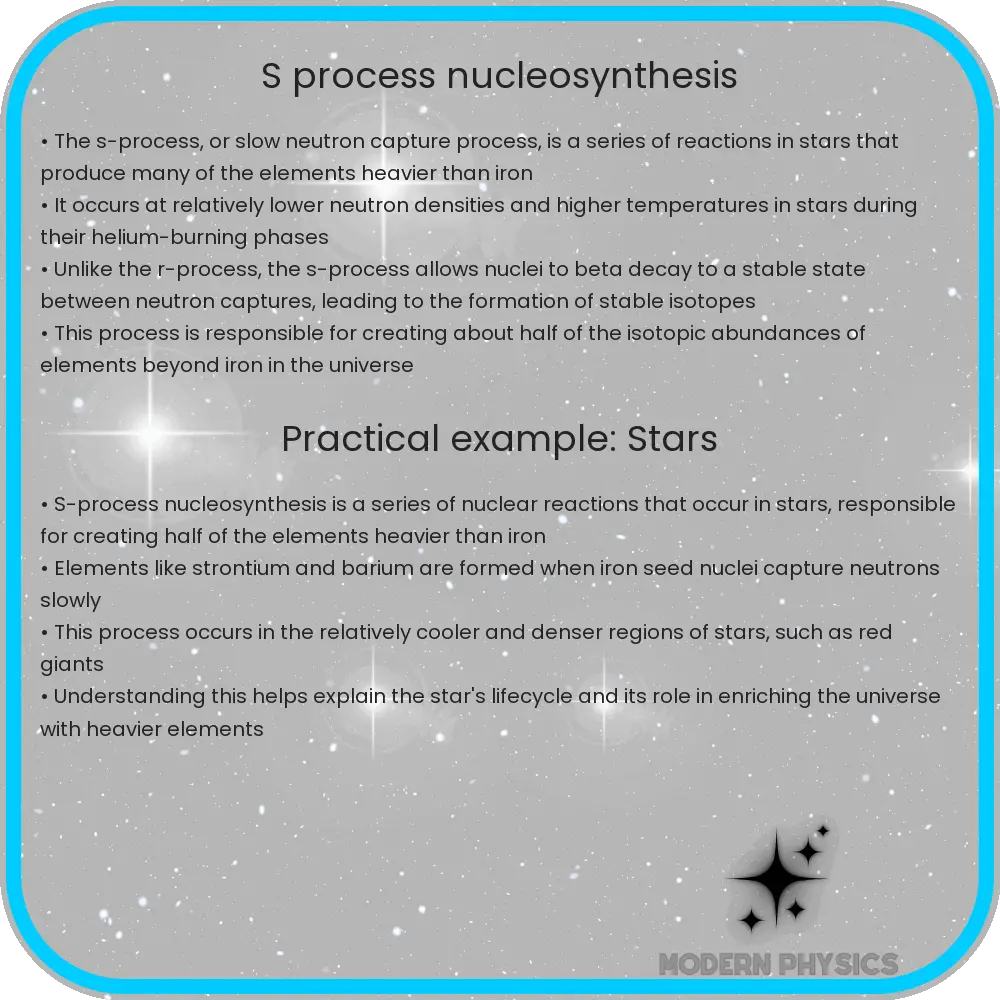
The cosmos is a grand tapestry interwoven with elements that narrate the saga of the universe. Among the pivotal processes contributing to this cosmic story is the s-process, or slow neutron capture process, a path of nucleosynthesis central to the creation of heavy elements within stars. This process is not just a mere reaction sequence; it is a bridge connecting stellar evolution to the chemical abundance we observe in the universe today.
Understanding the S-process
The s-process nucleosynthesis occurs predominantly in the interior of asymptotic giant branch (AGB) stars. These stars are in a late evolutionary stage, characterized by a core of carbon and oxygen surrounded by shells where helium and hydrogen are burning intermittently. The s-process unfolds in the region where neutrons are produced at a rate allowing them to be captured slowly by nuclei. This rate is crucial as it permits the nuclei to undergo beta decay, converting a neutron into a proton, before capturing another neutron. This transformation path is essential for the creation of heavier elements from iron (Fe) up to bismuth (Bi).
Neutron Sources and Reactions
The s-process relies on neutron sources for its operation. The primary neutron source in AGB stars is the 13C(α, n)16O reaction, occurring in the He-intershell region. Another notable reaction is 22Ne(α, n)25Mg, which predominantly occurs at higher temperatures and contributes to neutron production in massive stars. These reactions provide the neutrons necessary for the subsequent neutron captures by heavier nuclei.
Pathways and Products
The pathway of the s-process is determined by the nuclear properties of the atoms involved. It typically follows the valley of beta stability, meaning that the synthesized nuclei are generally stable. This slow but steady process leads to the production of approximately half of the heavy elements beyond iron, including strontium (Sr), barium (Ba), and lead (Pb). The exact pattern and yield of elements produced during the s-process depend significantly on the stellar mass, composition, and the specific conditions within the stellar interior.
Role in Stellar Evolution and Galactic Chemistry
The s-process plays a crucial role in the context of stellar evolution and the chemical evolution of galaxies. As stars evolve and eventually shed their outer layers, they enrich the interstellar medium with s-process elements. This stellar material, ejected into the surrounding space, becomes part of the cosmic building blocks for new stars, planets, and eventually, life itself. Therefore, the s-process is a fundamental mechanism by which the universe self-enriches in heavy elements over astronomical timescales.
Observational Evidence and Research
Observational evidence of s-process elements comes from the analysis of stellar spectra. Astronomers can identify the specific fingerprints of different elements in the light from stars, revealing the presence and abundances of s-process products. Additionally, studies of meteorites and ancient stellar remnants provide insights into the nucleosynthetic processes of past stellar generations, offering a unique glimpse into the chemical history of our galaxy.
Challenges and Future Directions
Despite its importance, the s-process is not yet fully understood. Challenges include the precise determination of neutron capture cross-sections, the conditions under which different neutron sources are activated, and the impact of stellar rotation and magnetic fields on the distribution of elements. Future research, empowered by advanced astronomical instruments and computational models, promises to unravel these mysteries, providing deeper insights into the life cycles of stars and the chemical evolution of the cosmos.
Conclusion
The s-process nucleosynthesis is a testament to the intricate and beautiful processes that govern the universe. It connects the life cycles of stars to the very elements that make up our world and beyond. Through the slow capture of neutrons within aging giants of the cosmos, the s-process weaves the elements that form the backbone of existence. As we continue to explore and understand this fundamental process, we not only uncover the secrets of the stars but also the origins of the elements that are crucial to life, technology, and the universe itself. The s-process stands as a pivotal chapter in the ongoing story of cosmic evolution, reminding us that we are indeed made of star-stuff.