
Explore the mysteries and impacts of the neutrino halo effect in astrophysics, its role in cosmic phenomena, and the cutting-edge research uncovering its secrets.
Exploring the Neutrino Halo Effect in Astrophysics
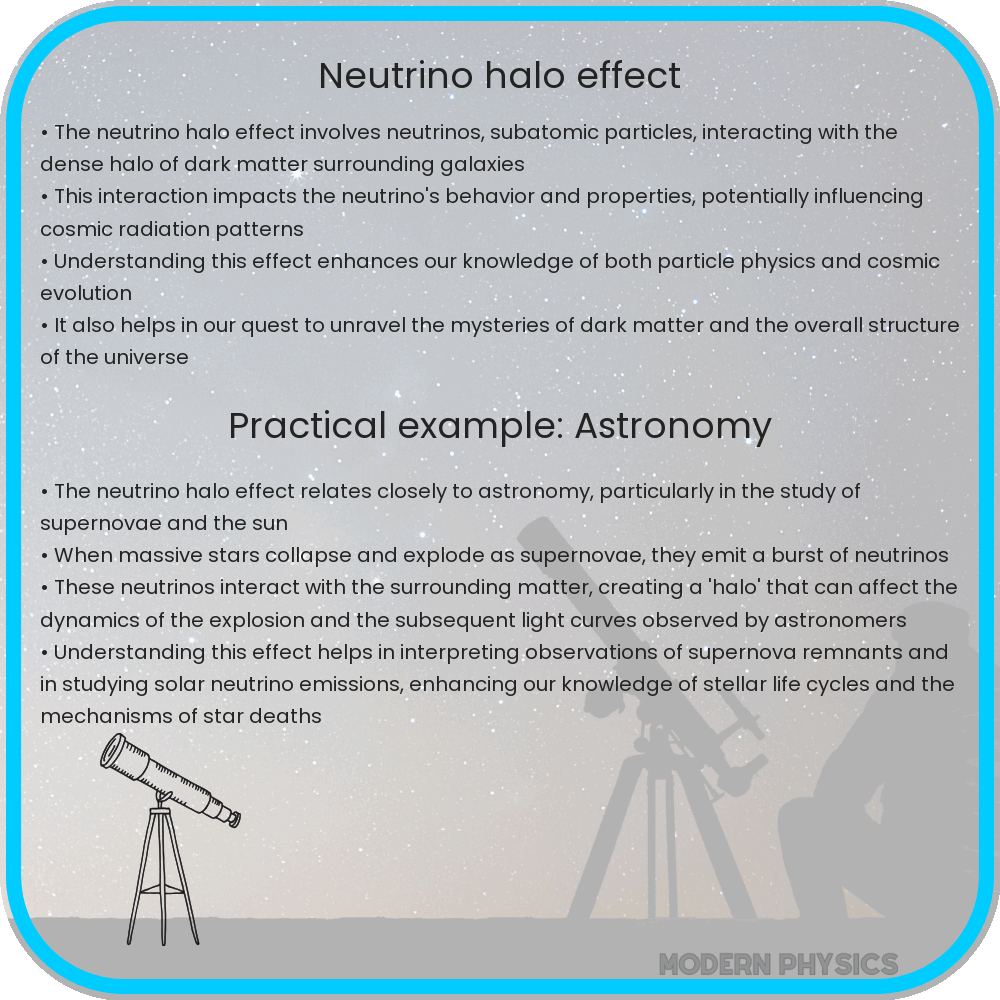
The neutrino halo effect remains one of the captivating mysteries in the field of astrophysics. This phenomenon pertains to the theoretical halo of neutrinos that may surround celestial bodies, influencing various astrophysical processes. Neutrinos are elusive subatomic particles, nearly massless and neutral, making them incredibly difficult to detect as they pass through matter almost undisturbed.
Mysteries of the Neutrino Halo Effect
One of the principal enigmas surrounding the neutrino halo effect involves its detection and measurement. Since neutrinos interact weakly with other matter, understanding the specifics of this effect poses a significant challenge. Scientists hypothesize that these particle halos could affect the dynamics of supernovae explosions and the distribution of dark matter in the universe. However, the subtle nature of neutrinos means that confirming these impacts requires highly sensitive equipment and innovative detection techniques.
Impacts on Astrophysical Phenomena
The potential impacts of the neutrino halo effect on celestial phenomena are profound. In the context of supernovae, neutrinos play a critical role in the explosion mechanism and the resulting nucleosynthesis. The neutrino halo could influence the shape and energy distribution of these cosmic blasts. Furthermore, understanding this effect is essential for interpreting the cosmic microwave background radiation and the structure formation in the early universe.
Current Research and Methodologies
Research into the neutrino halo effect is at the forefront of astrophysical studies. Scientists employ a range of methodologies to probe this phenomenon, from deep underground neutrino observatories like the IceCube Neutrino Observatory to space-based telescopes. These facilities aim to detect the faint signals of neutrinos coming from the sun, supernovae, and other cosmic sources. By analyzing these particles, researchers hope to uncover clues about the nature and effects of neutrino halos.
Collaborations across the globe are essential in this quest, as no single instrument can cover the vast energy spectrum of neutrinos emitted by different astrophysical sources. The challenges are immense, but the potential rewards—unlocking new understanding of the universe—are equally significant.
Challenges and Future Directions in Neutrino Halo Research
The quest to fully understand the neutrino halo effect is fraught with challenges, primarily due to the elusive nature of neutrinos themselves. One of the main hurdles is the development of detectors sensitive enough to catch these ghostly particles without being overwhelmed by background noise. Additionally, the theoretical models that describe neutrino interactions are complex and require further refinement to accurately interpret observational data.
Future directions in this research involve the enhancement of neutrino detection technologies and the integration of data from different observational platforms. Scientists are also exploring innovative theoretical frameworks to better describe the interactions between neutrinos and other cosmic entities. Collaboration between experimental and theoretical physicists is crucial for advancing our understanding of the neutrino halo effect and its implications for cosmology and particle physics.
Conclusion
The neutrino halo effect represents one of the most intriguing frontiers in astrophysics, offering a unique window into the workings of the universe. As researchers continue to unravel the mysteries of neutrino interactions and their cosmic implications, we stand on the cusp of potentially revolutionary discoveries. The challenges are significant, but the pursuit of knowledge about these enigmatic particles and their effects on celestial phenomena continues to drive forward the boundaries of science. With each discovery, we gain not only insights into the neutrino halo effect but also a deeper understanding of the cosmos and our place within it.