
Explore the intriguing world of neutrino detectors in astrophysics: uncover how they reveal secrets of the cosmos through the detection of the universe’s ghostly particles.
Understanding Neutrino Detectors in Astrophysics
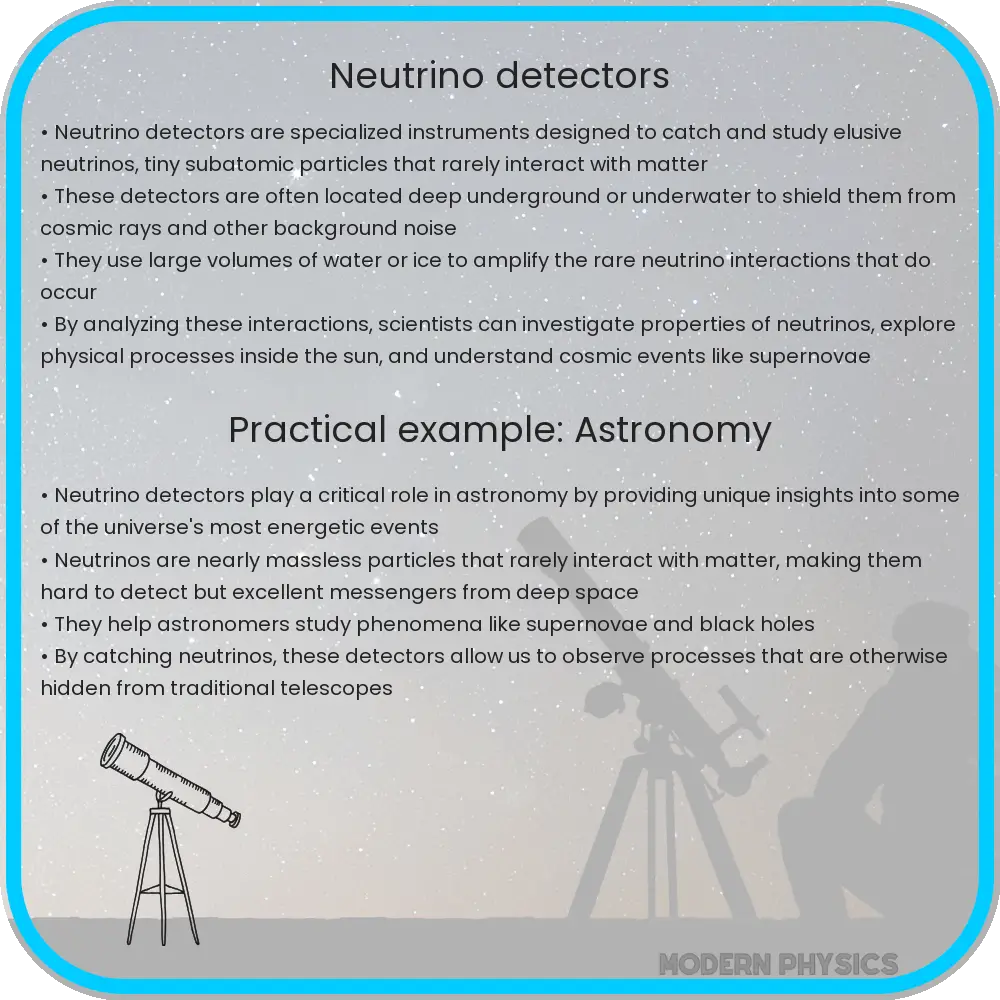
Neutrino detectors play a pivotal role in astrophysics, offering unique insights into the cosmos. These highly sensitive instruments detect neutrinos, elusive particles that are nearly massless and interact weakly with matter. Understanding neutrino detectors is essential for unraveling mysteries of the universe, from the mechanisms of stellar explosions to the behavior of distant celestial objects.
The Mechanics of Neutrino Detection
Neutrino detectors are sophisticated devices designed to observe interactions between neutrinos and matter. They vary in design but generally consist of massive volumes of water or ice, serving as the medium for neutrino interactions. When a neutrino collides with a nucleus or an electron in this medium, it creates a distinctive light pattern, known as Cherenkov radiation. This phenomenon allows scientists to not only detect the presence of neutrinos but also determine their energy and direction of travel.
Types of Neutrino Detectors
- Water Cherenkov Detectors: These detectors use large volumes of water surrounded by sensitive photodetectors. The Super-Kamiokande in Japan is a prime example, situated deep underground to shield it from cosmic ray interference.
- IceCube Neutrino Observatory: Located at the South Pole, IceCube uses a cubic kilometer of Antarctic ice as its detection medium. It monitors for neutrino interactions within the ice, providing valuable data on high-energy cosmic neutrinos.
- Liquid Argon Time Projection Chambers (LArTPCs): This type of detector uses liquid argon as the medium, offering high-resolution imaging of neutrino interactions. LArTPCs are particularly effective for studying neutrino oscillations and properties.
Significance in Astrophysics
Neutrino detectors have revolutionized our understanding of the universe. They provide a window into processes that are otherwise invisible to traditional telescopes, such as the heart of the sun or the remnants of supernovae. By analyzing neutrino signals, astrophysicists can extract information about the composition, dynamics, and mechanisms of various astrophysical phenomena, contributing significantly to our knowledge of the cosmos.
Understanding Neutrino Detectors in Astrophysics
Neutrino detectors are pivotal instruments in astrophysics, offering profound insights into the universe’s most enigmatic particles. Neutrinos, nearly massless and rarely interacting with matter, challenge detection efforts, making their study both fascinating and complex. The significance of neutrino detectors extends beyond mere detection; they are windows into cosmic events and fundamental physical processes.
The Mechanism of Neutrino Detection
Neutrino detectors operate based on the elusive interactions between neutrinos and matter. These interactions are infrequent due to neutrinos’ weakly interacting nature. However, when they do interact, they can produce charged particles like electrons or muons, which can be detected through their radiation emissions in substances like water or ice. The most common method involves large volumes of water or heavy water surrounded by sensitive light detectors, capturing the faint light signals produced by neutrino interactions.
Types of Neutrino Detectors
- Water Cherenkov Detectors: Utilize vast tanks of pure water to detect the Cherenkov radiation emitted by particles produced in neutrino interactions.
- Scintillation Detectors: Use organic liquids or solids that emit light when charged particles pass through them, providing another method to observe neutrino interactions.
- Cryogenic Detectors: Operate at extremely low temperatures to detect the minute energy deposits of neutrino interactions within solid materials.
Astrophysical Sources of Neutrinos
Neutrinos are omnipresent, produced in abundance by the Sun, supernovae, and other cosmic phenomena. They carry untouched information from the cores of stars and the distant reaches of the universe. Studying these particles can reveal the inner workings of stellar processes and the dynamics of the cosmos.
Conclusion
Neutrino detectors are indispensable tools in astrophysics, enabling scientists to probe the universe’s most elusive aspects. They provide unique insights into stellar interiors, the mechanisms of supernovae, and the remnants of the Big Bang. As technology advances, these detectors will continue to evolve, offering deeper understanding and new discoveries about the universe’s fundamental properties and the role of neutrinos within it. The study of neutrinos, thus, stands as a testament to human curiosity and our relentless pursuit to understand the cosmos.