
Nanoscale Thermal Interface Materials (TIMs) are engineered solutions designed to enhance heat dissipation in electronic components, improving their efficiency and durability.
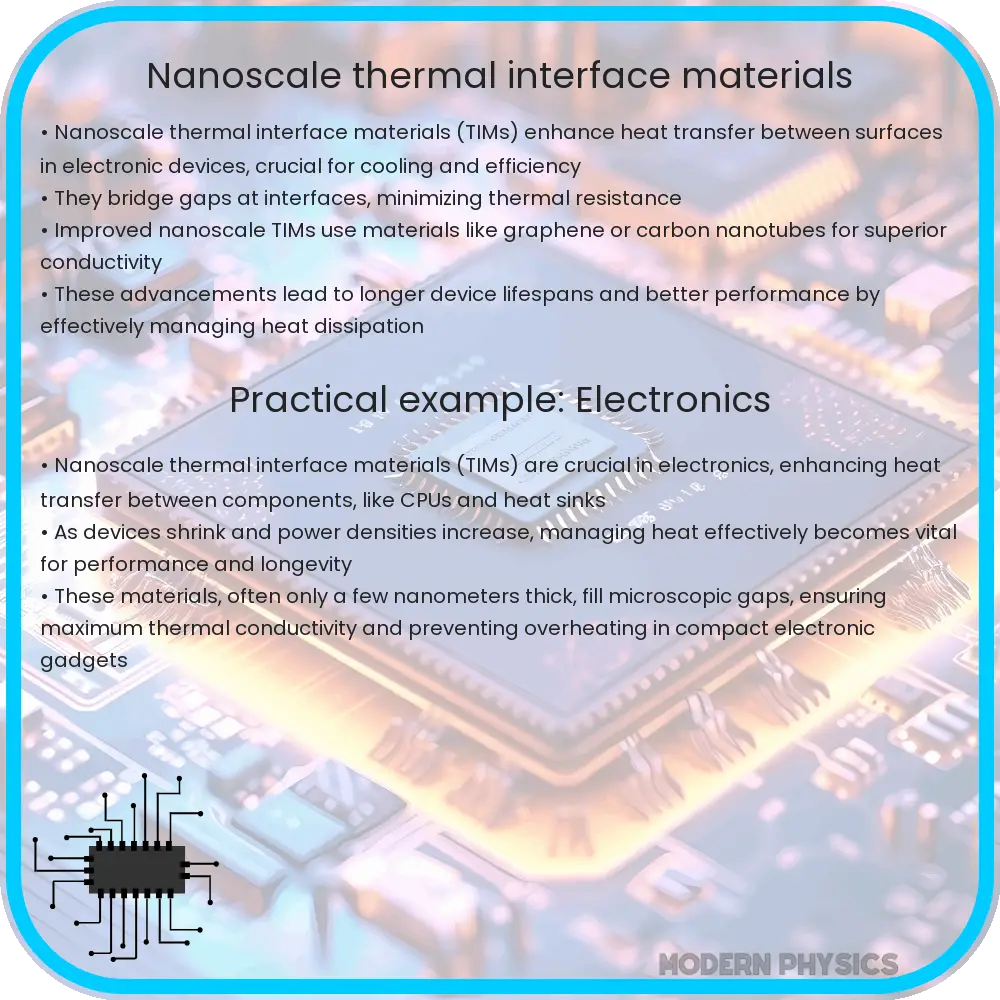
Nanoscale Thermal Interface Materials: Enhancing Efficiency and Durability through Innovation
As the electronics industry pushes towards increasingly miniaturized devices, managing heat effectively becomes critical. Nanoscale Thermal Interface Materials (TIMs) are engineered solutions devised to ensure better heat dissipation in electronic components, which are fundamental to preventing overheating, enhancing performance, and prolonging device life. This article will explore the efficiency, durability, and innovative aspects of these crucial materials.
What are Thermal Interface Materials (TIMs)?
Thermal Interface Materials are used to fill microscopic irregularities between two surfaces, enhancing heat dissipation. At the interface where heat is transferred from a semiconductor device, such as a CPU or GPU, to a heatsink, TIMs play a pivotal role. They replace the less thermally conductive air gaps with materials that have superior heat conduction properties.
Why the Nanoscale Matters
The shift toward nanoscale in TIMs relates directly to the size of the irregularities they need to fill. Typical surface imperfections on metal interfaces range at the micron or larger scale, but going down to the nanoscale can potentially fill finer gaps, thus drastically improving heat conduction. By using nanoparticles or thin layers of nanomaterials, the TIM can achieve close molecular contact, facilitating excellent heat flow.
Increased Efficiency through Innovation
One of the remarkable benefits of nanoscale TIMs is their increased efficiency in heat transmission. This involves several key improvements:
- Enhanced Surface Conformity: Nanoparticles, due to their minuscule size, adapt better to the microscopic topography of the surfaces they contact. This results in a thinner and more uniform thermal interface layer, which significantly reduces thermal resistance.
- High Thermal Conductivity Materials: The development of nanoscale materials such as graphene, carbon nanotubes, or metal-based nanoparticles has been a game-changer. These materials inherently possess high thermal conductivities that can exceed those of conventional materials.
Durability at the Nanoscale
Durability in TIMs is crucial for the reliability of electronic devices over their operational lifetime. Nanoscale enhancements in TIMs have not only improved efficiency but also durability in several ways:
- Chemical Stability: Nanomaterials can be designed to be chemically inert, meaning they do not easily react with the components they are in contact with. This property prevents degradation over time and maintains the efficiency of the thermal interface.
- Mechanical Stability: Uniform distribution of nanomaterials within the TIM can contribute to its mechanical stability. This is particularly important during thermal cycling, where expansion and contraction can lead to material fatigue or breakdown.
The intersection of materials science with nanotechnology has spurred considerable advancements in TIMs, translating theoretical knowledge into practical applications that substantially impact electronic device performance. By tackling challenges on the nanoscale, these materials offer not only thermal management solutions but also promise longevity and reliability in rapidly evolving tech environments.
Innovative Applications of Nanoscale TIMs
The innovative applications of nanoscale TIMs include a wide variety of new and improved features across multiple technologies:
- High-Performance Computing: Advanced CPUs and GPUs in high-performance computing environments benefit immensely from efficient heat management, which sustains peak performance while managing power consumption and heat dissipation.
- Renewable Energy Systems: Solar panels and fuel cells, which are susceptible to efficiency losses due to heat, can leverage advanced TIMs to improve overall energy conversion efficiency.
- Automotive Technology: Electric vehicles (EVs) and hybrid systems make use of powerful batteries and motors that generate significant amounts of heat. Effective thermal management through advanced TIMs is essential in these applications to enhance their durability and performance.
The ongoing research and development in the field of nanoscale TIMs not only promise further enhancements in thermal management strategies but also pave the way for newer, more efficient electronic systems in the future.
Future Directions and Challenges
The future of nanoscale Thermal Interface Materials (TIMs) holds exciting possibilities, yet it comes with its set of challenges that must be addressed to fully harness their potential:
- Scalability: While nanoscale TIMs offer superior performance, scaling up their production to meet global demand remains a challenge. The processes involved in synthesizing these materials must become more cost-effective and efficient.
- Environmental Impact: The environmental impact of producing and disposing of nanomaterials used in TIMs is still under scrutiny. Sustainable methods of production and recycling are crucial to minimize the ecological footprint.
- Integration with Existing Technologies: Integrating advanced nanoscale TIMs with existing manufacturing processes and product designs requires careful consideration. This integration must be seamless to ensure that the benefits of nanoscale enhancements are fully realized without disrupting current production lines.
Addressing these challenges requires ongoing research and collaboration across various scientific and engineering disciplines, ensuring that the advancements in nanoscale TIMs translate into practical, scalable, and environmentally friendly solutions.
Conclusion
The development of nanoscale Thermal Interface Materials marks a significant leap forward in our ability to manage heat in electronic devices. As we have explored, the benefits of these materials are manifold, providing not only enhanced thermal conductivity and durability but also innovative applications across various industries. From high-performance computing to renewable energy and automotive technologies, the role of nanoscale TIMs is proving to be pivotal.
Despite the challenges such as scalability and environmental concerns, the potential benefits make the pursuit of advanced TIMs worthwhile. Continued innovation and research in this field are essential as electronic devices become smaller, more powerful, and more integrated into our daily lives. Ultimately, the ongoing development of nanoscale TIMs will play a crucial role in the sustainable growth of technology and its applications in the future.
In conclusion, as we embrace the era of miniaturization and high efficiency, nanoscale TIMs stand out as a key component in ensuring the performance and longevity of electronic systems. Their evolving role in various sectors underscores the importance of materials science in addressing some of the most pressing challenges in technology and engineering today.