
Explore the enigmatic world of magnetic monopoles, their theoretical basis, experimental searches, and potential impact on physics and cosmology.
Magnetic Monopoles: The Quest for Isolated North and South Poles
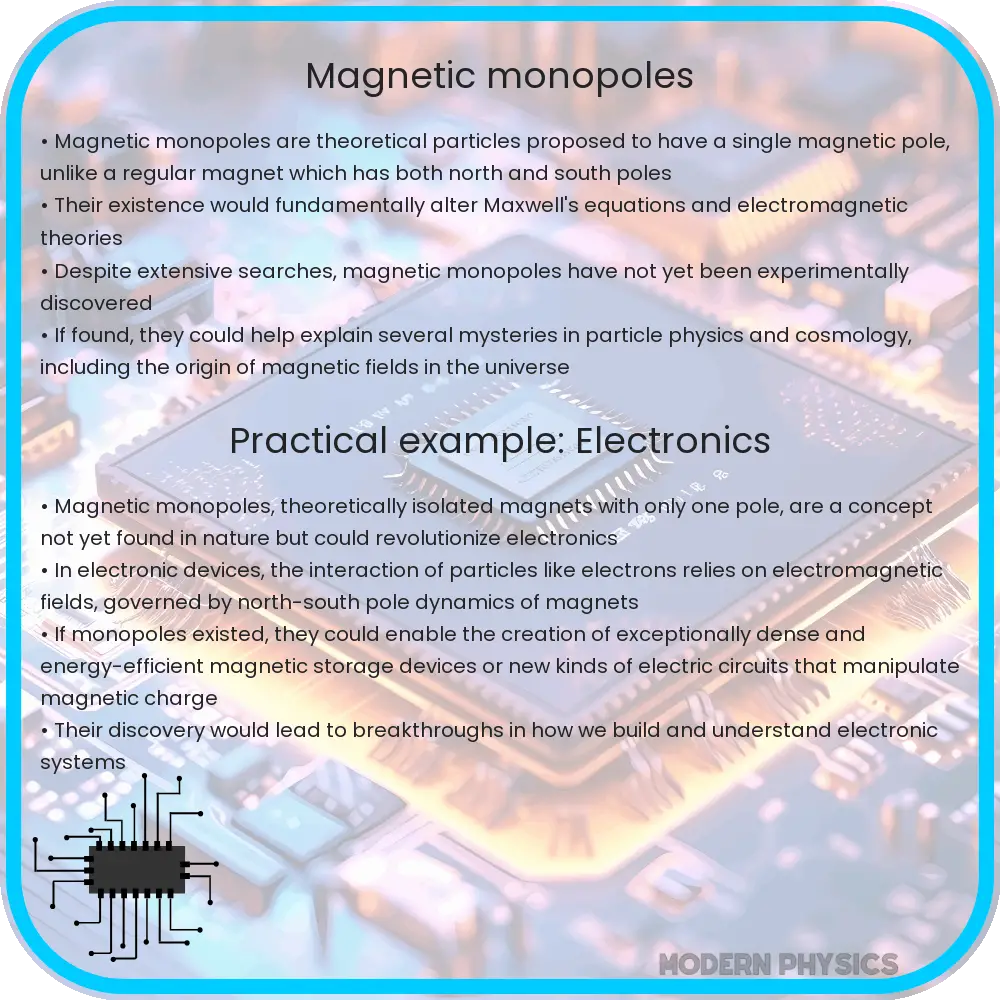
Magnetic monopoles have been a subject of fascination and debate within the scientific community for decades. Unlike conventional magnets, which have both a north and a south pole, a magnetic monopole would possess only one type of magnetic pole, either north or south. This concept challenges our traditional understanding of magnetic fields, which, according to Maxwell’s equations, are always produced by dipoles—pairs of north and south magnetic poles.
Theoretical Foundations
The existence of magnetic monopoles was first hypothesized by physicist Paul Dirac in 1931. Dirac’s groundbreaking theory merged quantum mechanics with the Maxwell equations of electromagnetism, leading to the surprising conclusion that the existence of monopoles could explain the quantization of electric charge. He proposed that if magnetic monopoles exist, they would carry a magnetic charge, quantized in such a way that it could explain why all observed electric charges are multiples of a basic unit.
Experimental Searches and Discoveries
Despite the compelling nature of the theoretical framework, magnetic monopoles have eluded direct detection. Experiments have been conducted in various environments, from particle accelerators to cosmic ray detectors, yet no definitive evidence has been found. One of the most notable experiments is the search for monopoles in materials known as spin ices. These materials exhibit magnetic properties that mimic the behavior of theoretical monopoles, leading to what are referred to as “magnetic monopole-like excitations. However, these are not true monopoles but rather emergent phenomena that resemble the properties predicted by theory.
Impact and Implications
The discovery of magnetic monopoles would have profound implications for physics and our understanding of the universe. It would not only validate Dirac’s theory but also necessitate a major revision of Maxwell’s equations. Moreover, it could provide new insights into the grand unification of forces, suggesting a symmetry between electric and magnetic fields. The quest for magnetic monopoles continues to be one of the most tantalizing in physics, representing a bridge between classical electromagnetism, quantum mechanics, and cosmological theories.
Challenges in the Hunt for Monopoles
One of the greatest challenges in detecting magnetic monopoles is their presumed rarity and the immense energy required to create them. Theoretical models suggest that if monopoles exist, they could have been produced during the high-energy conditions of the early universe but would be exceedingly scarce today. Furthermore, their unique properties mean that conventional detection methods might not be effective, requiring innovative experimental approaches and highly sensitive equipment.
Future Prospects
Advancements in technology and experimental methods continue to open new avenues for the search for magnetic monopoles. For example, the use of large-scale particle detectors, such as those used in CERN’s Large Hadron Collider (LHC), and improvements in cryogenic technology offer new hope for detecting these elusive particles. Additionally, interdisciplinary research involving astrophysics, particle physics, and condensed matter physics is expanding the potential for discovering monopoles in unexpected places.
Moreover, the development of quantum computing and exotic materials may provide the necessary tools to either confirm the existence of monopoles or understand why they cannot exist. As theoretical and experimental physics evolve, the puzzle of magnetic monopoles remains a key piece in the quest to unify the fundamental forces of nature.
Conclusion
The search for magnetic monopoles is more than just a quest for a new particle; it is a journey at the heart of fundamental physics, intertwining quantum theory, electromagnetism, and cosmology. Despite decades of research and experimentation, the existence of magnetic monopoles remains one of physics’ most intriguing mysteries. Whether or not they are eventually discovered, the pursuit of magnetic monopoles continues to drive scientific innovation, challenge our understanding of the natural world, and inspire curiosity and wonder about the universe’s unseen forces. As we stand on the brink of new discoveries, the hunt for monopoles exemplifies the relentless human quest for knowledge and the desire to uncover the universe’s deepest secrets.