
Explore the enigmatic world of magnetic monopoles, their theoretical significance in physics, and the ongoing quest to detect these elusive particles.
Understanding Magnetic Monopoles
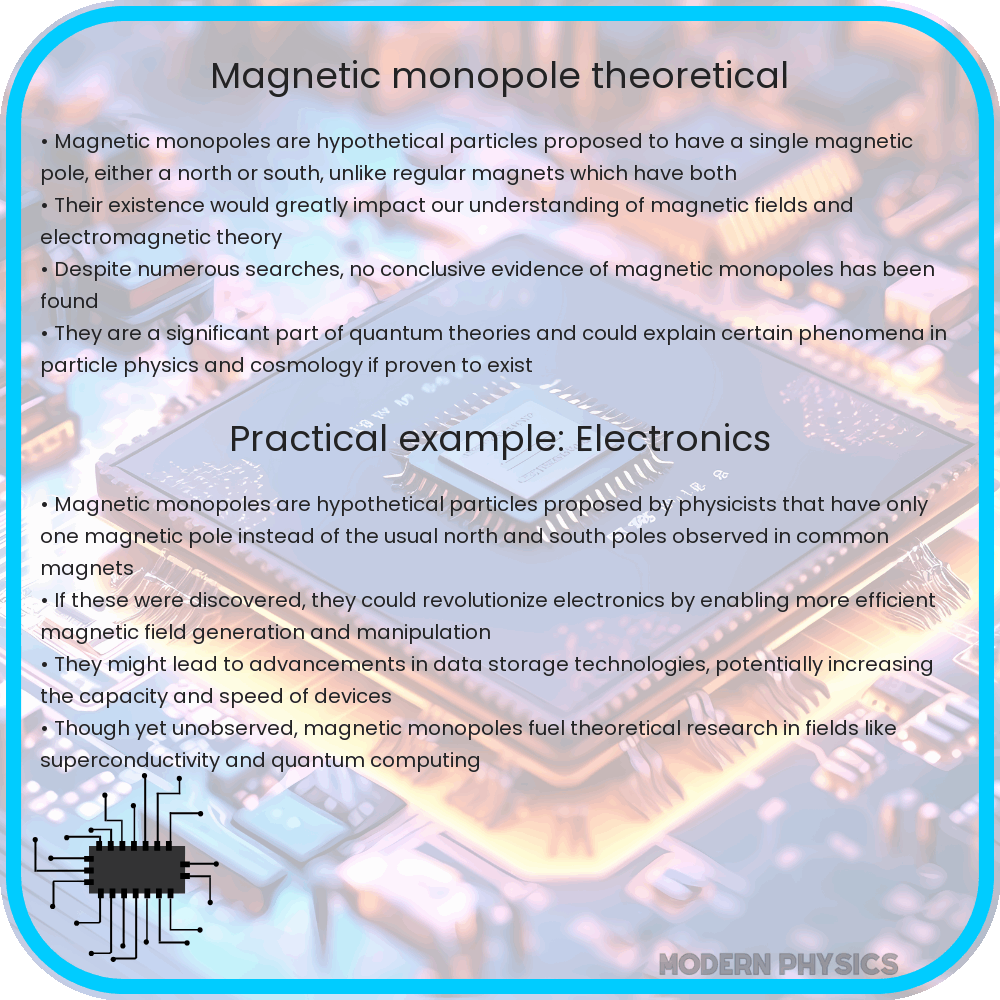
Magnetic monopoles have long captivated the imagination of physicists and enthusiasts alike. These hypothetical particles, unlike common magnets which have both a north and south pole, possess only one magnetic pole. This concept, which challenges the traditional understanding of magnetostatics, has profound implications in the realm of theoretical physics and beyond.
Theoretical Foundations
The search for magnetic monopoles dates back to the early 20th century. In classical electromagnetism, magnetic fields are generated by moving electric charges, and every magnet is dichotomous, having both a north and south pole. This dichotomy is encapsulated in Maxwell’s equations, which are the cornerstone of classical electromagnetic theory. However, the idea of a solitary magnetic pole was first proposed by physicist Paul Dirac in 1931. Dirac’s theory introduced the concept of magnetic monopoles within the framework of quantum mechanics, suggesting their existence could explain the quantization of electric charge.
Implications in Quantum Theory
Dirac’s hypothesis was groundbreaking because it offered a solution to the quantization of electric charge, a phenomenon where charges occur as integer multiples of the elementary charge. He proposed that the existence of even a single magnetic monopole in the universe could account for this quantization. This proposition bridged the gap between Maxwell’s classical electromagnetism and the quantum world, offering a more unified understanding of fundamental forces.
Experimental Searches and Challenges
Despite their theoretical appeal, magnetic monopoles have eluded direct detection. Over the decades, numerous experiments have been conducted to find these elusive particles, ranging from particle accelerator experiments to cosmic ray observations. The difficulty in detecting monopoles arises from their predicted characteristics: they are expected to be massive, far beyond the reach of current particle accelerators, and extremely rare in the universe.
Advancements in magnetostatics and particle physics continually fuel the search for monopoles. Magnetostatics, the study of magnetic fields in systems of steady currents, plays a crucial role in understanding how magnetic monopoles, if they exist, would interact with familiar magnetic fields. Theoretical models predict unique signatures that monopoles would leave in magnetic fields, guiding experimentalists in their quest.
In conclusion, while magnetic monopoles remain undetected, their potential existence continues to inspire and challenge physicists. The pursuit of these particles is not just a quest for a new elementary particle but a journey towards a deeper understanding of the fundamental laws that govern our universe.
Advanced Theoretical Models
In modern theoretical physics, magnetic monopoles have found a place in grand unified theories (GUTs) and string theory. GUTs, which aim to unify the electromagnetic, weak, and strong nuclear forces, predict the existence of monopoles as a byproduct of the universe’s evolution. Similarly, in string theory, which proposes that fundamental particles are one-dimensional “strings” rather than point-like particles, magnetic monopoles emerge naturally from the mathematical framework. These advanced theories not only accommodate monopoles but also suggest that their discovery could be a crucial test of the theory itself.
Impacts on Technology and Cosmology
The implications of discovering magnetic monopoles extend beyond theoretical physics. In technology, they could revolutionize magnetic storage methods and electromagnetic device design. In cosmology, their existence would provide valuable insights into the early universe and the conditions immediately after the Big Bang. Monopoles are believed to have been produced in copious amounts during the early universe, and their detection could offer a new window into understanding cosmic inflation and the evolution of the universe.
Current and Future Research
Current research in the hunt for magnetic monopoles is more vigorous than ever. Experiments like the Large Hadron Collider (LHC) and specialized detectors like the Monopole and Exotics Detector at the LHC (MoEDAL) are at the forefront of this search. These experiments are equipped to detect the signature of monopoles, such as their high mass and the unique way they would interact with magnetic fields. In addition, astrophysical observations continue to play a critical role, as cosmic rays could potentially carry these particles to Earth.
Future research could leverage advances in particle accelerator technology and detector sensitivity, potentially increasing the chances of discovering monopoles. Furthermore, as theoretical models evolve, they may offer new predictions about the properties of monopoles, guiding experimentalists in refining their search strategies.
Conclusion
In summary, magnetic monopoles remain one of the most intriguing and elusive concepts in physics. Their theoretical implications span across quantum mechanics, cosmology, and unified field theories. While their existence is yet to be confirmed, the ongoing search for these particles is a testament to the relentless pursuit of knowledge in the scientific community. The discovery of magnetic monopoles, should it occur, would not only validate key theoretical predictions but also potentially open up new realms of technological innovation and deepen our understanding of the universe’s history and structure.