
Explore the Mach-Zehnder Interferometer’s precision, uses, and setup. Discover its role in science and tech, from telecommunications to quantum research.
Mach-Zehnder Interferometer: An Overview
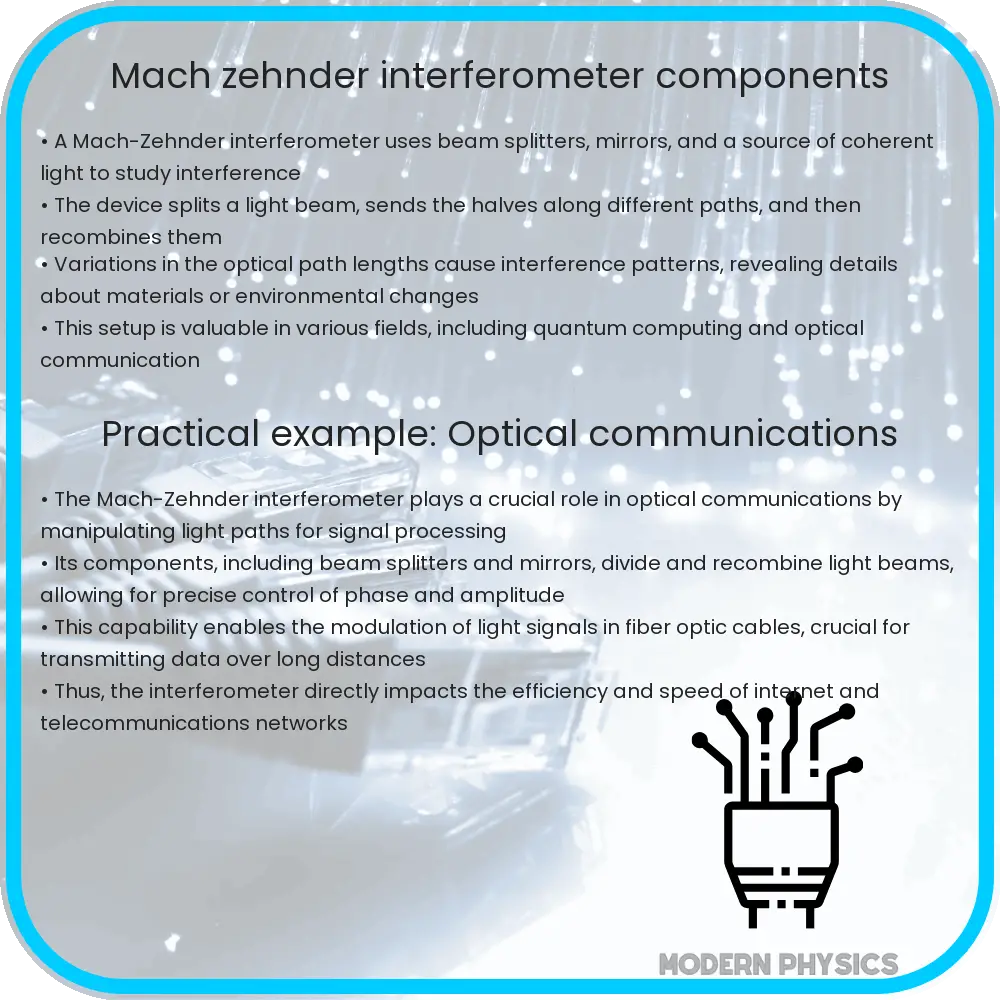
The Mach-Zehnder Interferometer, a staple in the field of optical physics, serves as a pivotal instrument for experimenting with and measuring various aspects of light wave propagation. This device capitalizes on the principle of interference, where two beams of light, originally from a single source, are split to travel different paths before being recombined. The resulting interference pattern provides invaluable insights into the properties of light, including phase shifts, coherence, and wavelength alterations.
Precision and Sensitivity
One of the Mach-Zehnder Interferometer’s most lauded attributes is its exceptional precision and sensitivity. The device can detect minute changes in the optical path length, attributable to variations in physical conditions such as temperature, pressure, or the presence of specific gases. Such sensitivity makes it an indispensable tool in scientific research, particularly in the realms of quantum mechanics, optical coherence tomography, and even in the detection of gravitational waves.
Uses and Applications
- Telecommunications: In the field of telecommunications, the interferometer is used to modulate light signals, enhancing data transmission capabilities over optical fibers.
- Environmental Monitoring: Its ability to detect tiny changes in the composition of gases makes it ideal for monitoring air quality and detecting pollutants.
- Biomedical Imaging: Optical coherence tomography, a technique based on the Mach-Zehnder Interferometer, provides high-resolution images of biological tissues, aiding in medical diagnostics.
Setup and Configuration
The setup of a Mach-Zehnder Interferometer involves a coherent light source, such as a laser, that is split into two beams. These beams traverse different paths set by mirrors and are later recombined to produce an interference pattern. Key components include beam splitters, mirrors, and detectors, each playing a crucial role in the manipulation and analysis of the light beams. The configuration can be adjusted to study various phenomena, from simple wave interference to complex quantum mechanical effects.
Adjusting the Interferometer for Enhanced Precision
To maximize the precision of the Mach-Zehnder Interferometer, careful calibration and environmental control are essential. Adjustments may involve stabilizing the temperature and isolating the setup from vibrations to prevent undesired fluctuations in the interference pattern. Additionally, the use of highly coherent laser sources and precise optical components ensures that the measurements are both accurate and reliable.
Challenges and Solutions
Despite its numerous advantages, the Mach-Zehnder Interferometer is not without its challenges. One of the primary issues is phase sensitivity, which can lead to difficulties in interpreting results if the path lengths are not precisely controlled. Advanced techniques, such as active stabilization systems and phase-shifting interferometry, have been developed to overcome these hurdles, enhancing the instrument’s utility and reliability.
Future Directions
The future of the Mach-Zehnder Interferometer looks promising, with ongoing research aimed at expanding its applications and improving its precision. Innovations in photonics and quantum computing continually push the boundaries of what is possible, making the interferometer a key tool in exploring the frontiers of science and technology.
Conclusion
The Mach-Zehnder Interferometer remains a cornerstone in the exploration and understanding of light and its properties. Its unparalleled precision, versatility in applications, and adaptability to various scientific and industrial needs underscore its significance. From telecommunications and environmental monitoring to biomedical imaging and fundamental research in physics, the interferometer has proven its value time and again. As technology advances, the Mach-Zehnder Interferometer will undoubtedly continue to play a vital role in the advancement of optical sciences, opening new avenues for discovery and innovation.