Twyman-Green Interferometer: An optical instrument for testing optical surface quality, providing high-resolution wavefront measurements and surface deviation analysis.
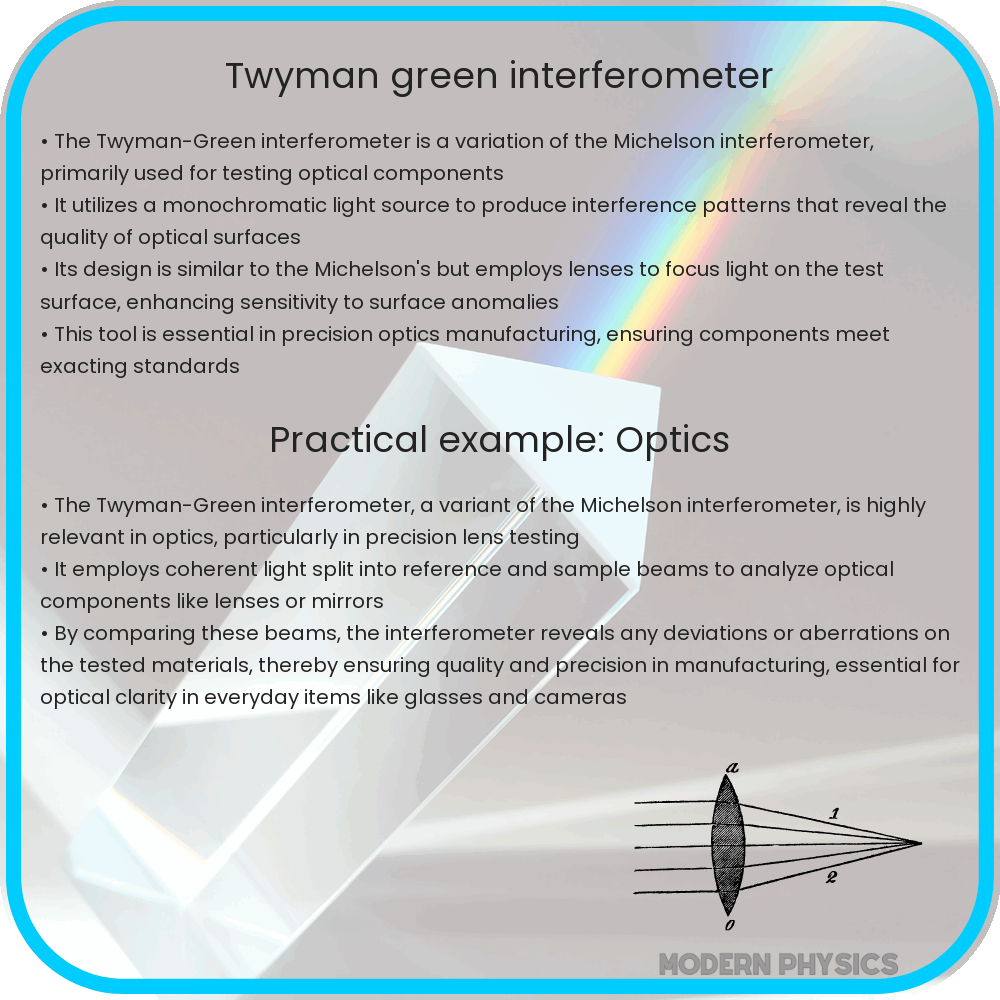
Twyman-Green Interferometer: Precision, Alignment & Wavefront Analysis
The Twyman-Green Interferometer is a powerful and precise optical instrument used primarily to test the quality of optical surfaces, such as lenses and mirrors. Developed by Frank Twyman and Arthur Green in 1916, this interferometer has become a staple in optical engineering for its ability to provide high-resolution measurements of wavefronts and surface deviations.
Principle of Operation
At its core, the Twyman-Green Interferometer operates on the principle of interference of light waves. When two coherent light waves, originating from the same source, are superposed, they create an interference pattern. This pattern can then be analyzed to uncover details about the optical path differences between the two waves, which directly correspond to the surface irregularities or wavefront distortions of the test subject.
Basic Setup
The basic setup of a Twyman-Green Interferometer includes the following components:
Light Source: Typically, a laser source is used to ensure coherence and monochromaticity.
Beam Splitter: This component divides the light beam into two paths – a reference beam and a test beam.
Mirrors: One mirror directs the reference beam back towards the beam splitter, while the other directs the test beam onto the optical surface being tested.
Detector: An optical detector or a camera captures the resulting interference pattern when the two beams recombine at the beam splitter.
Precision and Alignment
The precision of the Twyman-Green Interferometer is heavily influenced by the alignment of its components. Any misalignment can introduce errors into the measurements. Here are key aspects to consider for ensuring high precision:
Stable Mounting: All optical components must be securely mounted to prevent any movement or vibrations that could distort the interference pattern.
Accurate Calibration: The interferometer must be carefully calibrated to ensure the reference and test beams are perfectly aligned.
Temperature Control: Temperature fluctuations can affect the refractive index of the medium through which the light travels, leading to errors in measurement. Maintaining a stable environment is crucial.
Quality of Optical Components: The mirrors, beam splitter, and lenses used must be of high quality with minimal aberrations to avoid introducing distortions into the interference pattern.
Wavefront Analysis
Wavefront analysis in a Twyman-Green Interferometer involves interpreting the interference pattern to extract information about the test surface. This can include:
Interference Fringes: These are the bright and dark bands observed in the pattern. The spacing and orientation of the fringes reveal the nature of the optical path difference.
Wavefront Deviations: Any deviation from a perfectly spherical or plane wavefront indicates surface irregularities or errors in the optical component.
Phase Shifting: Advanced techniques involve shifting the phase of one of the beams and capturing multiple interference patterns to improve the accuracy and resolution of the surface measurements.
This detailed analysis enables precise quantification of surface defects, such as spherical aberration, coma, and astigmatism, which are critical for ensuring the quality and performance of optical systems.
Applications of the Twyman-Green Interferometer
The versatility and precision of the Twyman-Green Interferometer make it suitable for a wide range of applications in both scientific research and industrial manufacturing. Here are some key areas where it is routinely used:
Optical Testing: The primary application of the Twyman-Green Interferometer is in the testing and quality control of optical components like lenses, mirrors, and other optical surfaces. Its high resolution allows for the detection of minute surface errors.
Astronomical Telescopes: In astronomy, the interferometer is used to examine large mirrors, ensuring they meet the stringent quality requirements necessary for accurate celestial observations.
Semiconductor Industry: The interferometer aids in the inspection and production of semiconductor wafers, where surface quality is paramount for the fabrication of integrated circuits.
Wavefront Sensing: The instrument is employed to assess wavefront distortions in various optical systems, helping to correct and optimize their performance.
Biomedical Optics: In medical imaging and diagnostic equipment, the interferometer helps in refining the optical components used in devices like optical coherence tomography (OCT) machines.
Advancements in Twyman-Green Interferometry
Technological advancements have continued to enhance the capabilities of the Twyman-Green Interferometer. Some notable developments include:
Digital Interferometry: The integration of digital cameras and computer algorithms has greatly improved the data acquisition and analysis process, allowing for real-time analysis and more extensive data interpretation.
Automated Alignment Systems: Modern interferometers may include automated alignment systems that use feedback mechanisms to correct any misalignments dynamically, ensuring consistent precision.
Environmental Control: Advanced models feature built-in temperature and vibration control measures, further minimizing the influence of external factors on the accuracy of measurements.
Multi-Wavelength Interferometry: Using multiple wavelengths simultaneously can help mitigate errors due to chromatic aberration and expand the range of measurable surface types.
Conclusion
The Twyman-Green Interferometer remains an indispensable tool in the field of optical engineering and beyond. Its ability to provide unparalleled precision in testing and analyzing optical surfaces ensures the high quality and performance of a vast array of optical systems. From the lenses in our everyday devices to the mirrors in astronomical telescopes, the interferometer plays a critical role in advancing technology and scientific discovery. Thanks to ongoing advancements in digital and automated technologies, the future of Twyman-Green interferometry promises even greater accuracy, efficiency, and insights, continuing to illuminate the intricate details of the optical world.
