
Explore the role of Lippmann plates in holography for unparalleled clarity, stability, and precision in 3D imaging, and their future potential.
Lippmann Plates in Holography: Enhancing Optical Precision
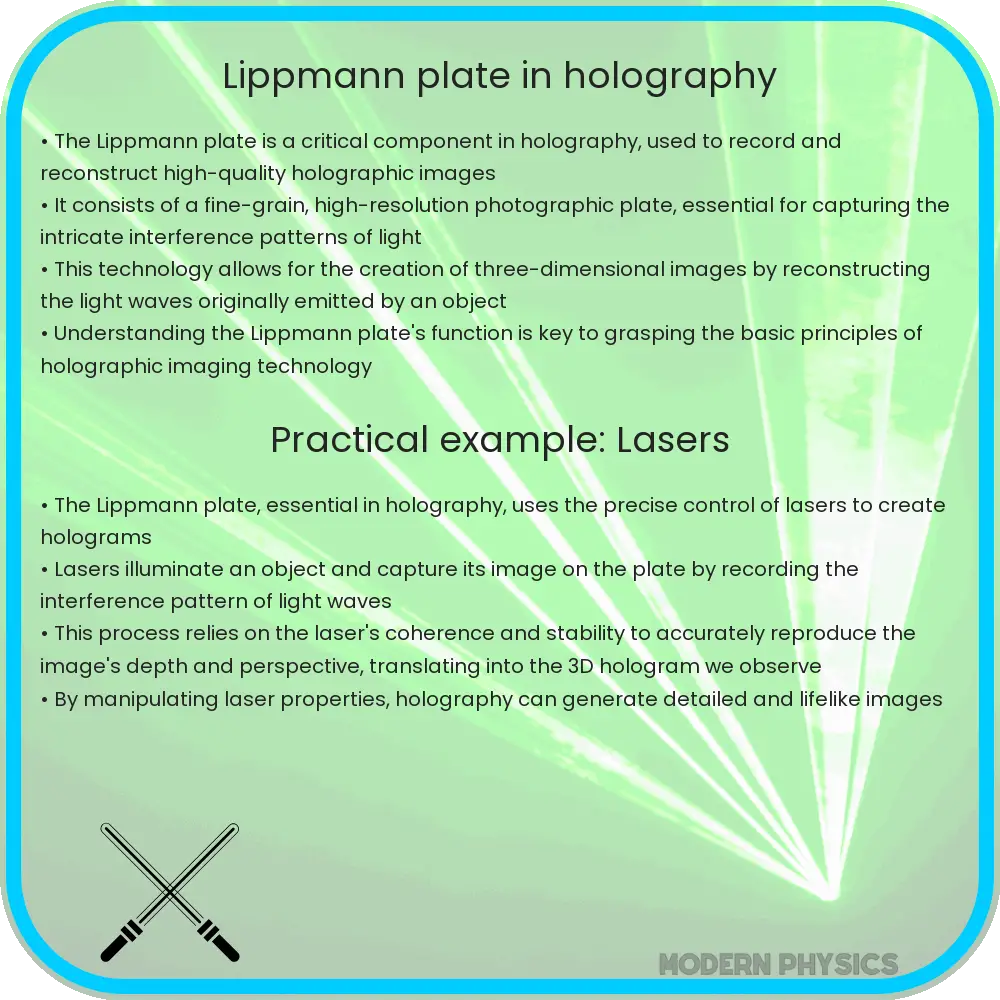
The realm of holography, an advanced technique for creating three-dimensional images, has been significantly advanced through the use of Lippmann plates. These specialized photographic plates are pivotal in achieving high clarity, stability, and precision in holographic imaging. Named after Gabriel Lippmann, the Nobel Prize-winning physicist who invented them, these plates are a cornerstone for researchers and professionals seeking to push the boundaries of optical imaging and storage.
Understanding Lippmann Plates
Lippmann plates are distinct from conventional photographic plates due to their unique composition and the process used to create holograms. They consist of a high-resolution, fine-grained emulsion layer capable of recording the interference patterns necessary for holography. This capability is essential for the reproduction of the depth and detail that characterize holographic images. The emulsion typically contains silver halide crystals suspended in gelatin, which react to light exposure to form the holographic image.
Clarity and Resolution
The clarity and resolution of holographic images produced on Lippmann plates are unparalleled. The fine grain of the emulsion allows for the recording of very small interference fringes, leading to images with exceptional detail and depth. This makes Lippmann plates especially suitable for applications requiring high fidelity, such as archival storage of data, fine art reproduction, and advanced optical research.
Stability and Durability
Another key advantage of Lippmann plates is their stability and durability over time. The chemical composition of the emulsion, when properly processed and stored, is resistant to fading and degradation. This stability is critical for applications where the longevity of the recorded image is paramount. Additionally, the physical robustness of the plates themselves contributes to their suitability for repeated handling and viewing.
Precision in Holographic Imaging
The precision of Lippmann plates in holography lies in their ability to accurately reproduce the phase and amplitude of the light waves that make up the holographic image. This precision ensures that the reconstructed image closely matches the original scene or object in terms of geometry, perspective, and depth. The meticulous control over the recording process enabled by Lippmann plates facilitates the creation of holograms that are not only visually stunning but also dimensionally accurate.
Advanced Applications of Lippmann Plates
Due to their superior characteristics, Lippmann plates find applications in a variety of advanced fields. In scientific research, they are instrumental in the precise study of optical phenomena, including the diffraction patterns of various materials and the behavior of light under unique conditions. In the realm of data storage, Lippmann plates offer a high-capacity, long-term solution that can encode large amounts of information in a compact format, benefiting archival processes where data integrity is crucial.
Technical Challenges and Solutions
While Lippmann plates offer numerous advantages, their use is not without challenges. The preparation, exposure, and development of the plates require meticulous control over environmental conditions, including temperature, humidity, and light exposure. Advances in emulsion chemistry and processing techniques have addressed some of these challenges, making Lippmann plates more accessible and reliable for users. Additionally, ongoing research in the field is focused on enhancing the sensitivity and dynamic range of the plates, further expanding their potential applications.
The Future of Lippmann Plates in Holography
The future of Lippmann plates in holography appears promising, with ongoing research and development aimed at expanding their capabilities. Innovations in emulsion formulations and recording techniques continue to enhance the quality and efficiency of holographic imaging. As technology advances, the potential for integrating Lippmann plate technology with digital processes opens new avenues for hybrid holographic systems, combining the best of analog and digital holography.
Conclusion
Lippmann plates stand at the forefront of holographic imaging technology, offering unmatched clarity, stability, and precision. Their contribution to the field of holography cannot be overstated, as they enable the creation of images with unparalleled depth and detail. Despite the technical challenges associated with their use, advances in science and technology continue to mitigate these issues, making Lippmann plates more accessible and effective. As we look to the future, the role of Lippmann plates in holography is poised to grow, driving innovation in optical imaging and beyond. Their enduring legacy, rooted in Gabriel Lippmann’s pioneering work, continues to inspire and shape the future of holographic imaging.