
Explore the world of light pipes: uncovering their efficiency in waveguiding, precision, clarity, and advancements in optical technology.
Understanding Light Pipes: Principles and Applications
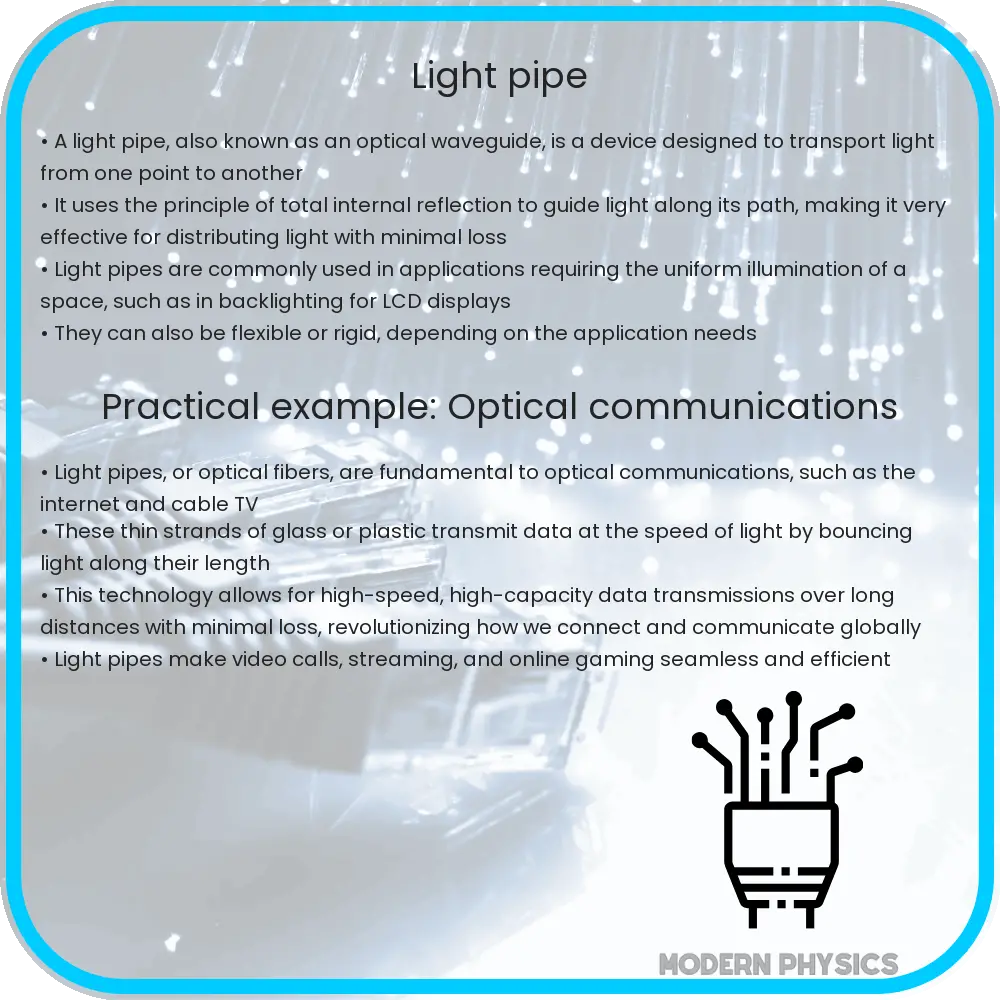
Light pipes, also known as optical waveguides, are physical structures used to guide light from one point to another. They play a crucial role in various technological applications, from simple illumination tasks to complex telecommunications systems. The efficiency, precision, and clarity of light pipes are paramount in ensuring optimal performance in these applications.
Efficient Waveguiding: The Core Mechanism
At the heart of a light pipe’s functionality is the principle of total internal reflection. This occurs when light travels through a medium with a higher refractive index and hits the boundary of a medium with a lower refractive index at a specific angle, known as the critical angle. Instead of passing through, the light is completely reflected back into the medium, effectively ‘trapped’ and guided along the pipe. The efficiency of this waveguiding process is influenced by the materials used, the structure of the pipe, and the wavelength of the light being transmitted.
Precision and Clarity: Material and Design Considerations
The precision and clarity of a light pipe are influenced by several factors. Firstly, the choice of material is critical. Common materials include glass, plastic, and silica, each with its own set of properties. For instance, silica is preferred in high-precision applications due to its low attenuation (loss of signal strength) and high thermal stability. The manufacturing process also plays a role in determining the surface smoothness and uniformity of the pipe, which in turn affects light dispersion and clarity.
Applications Across Industries
Light pipes find applications in a wide range of industries. In telecommunications, they are used in fiber optic cables, enabling high-speed data transmission over long distances with minimal signal loss. In medical technology, light pipes are used in endoscopy and other imaging techniques, providing clear and precise visualizations of internal body structures. They are also integral to architectural lighting, automotive lighting, and display technologies, where they enhance aesthetic appeal and energy efficiency.
Understanding the science behind light pipes is key to appreciating their role in modern technology. Their ability to guide light efficiently, coupled with the precision and clarity they offer, makes them indispensable in numerous applications.
Advancements and Innovations in Light Pipe Technology
Recent advancements in light pipe technology have further enhanced their efficiency and application range. Innovations in materials science, such as the development of photonic crystal fibers, offer improved control over light propagation, allowing for more precise and efficient transmission. Additionally, advancements in manufacturing techniques have led to the production of light pipes with more complex and efficient shapes, expanding their functionality and application potential.
Challenges and Future Directions
Despite their widespread use and recent advancements, light pipes face certain challenges. One major challenge is the attenuation of light over long distances, especially in telecommunications. Researchers are continually seeking ways to reduce this loss by experimenting with new materials and improved designs. Another challenge is the integration of light pipes into increasingly miniaturized and complex systems, such as in micro-optics and nanophotonics.
The future of light pipe technology looks promising, with ongoing research focused on enhancing their performance and expanding their applications. Areas such as quantum computing, where precise light manipulation is crucial, and renewable energy, where light pipes could play a role in solar energy harvesting, are particularly ripe for innovation.
Conclusion
Light pipes, with their ability to efficiently guide light with precision and clarity, are a cornerstone of modern optical technology. From enabling high-speed internet connections to assisting in medical diagnoses and enhancing energy efficiency in lighting, their impact is profound and far-reaching. As technology continues to evolve, the role of light pipes is set to become even more pivotal. The ongoing advancements in material science and engineering promise to overcome current limitations and open new frontiers in their application. Thus, light pipes not only represent a remarkable achievement in optical technology but also hold the key to future innovations in various fields of science and engineering.