
Explore the essentials of waveguides for efficient EM transmission and control in high-frequency systems, covering types, applications, and advancements.
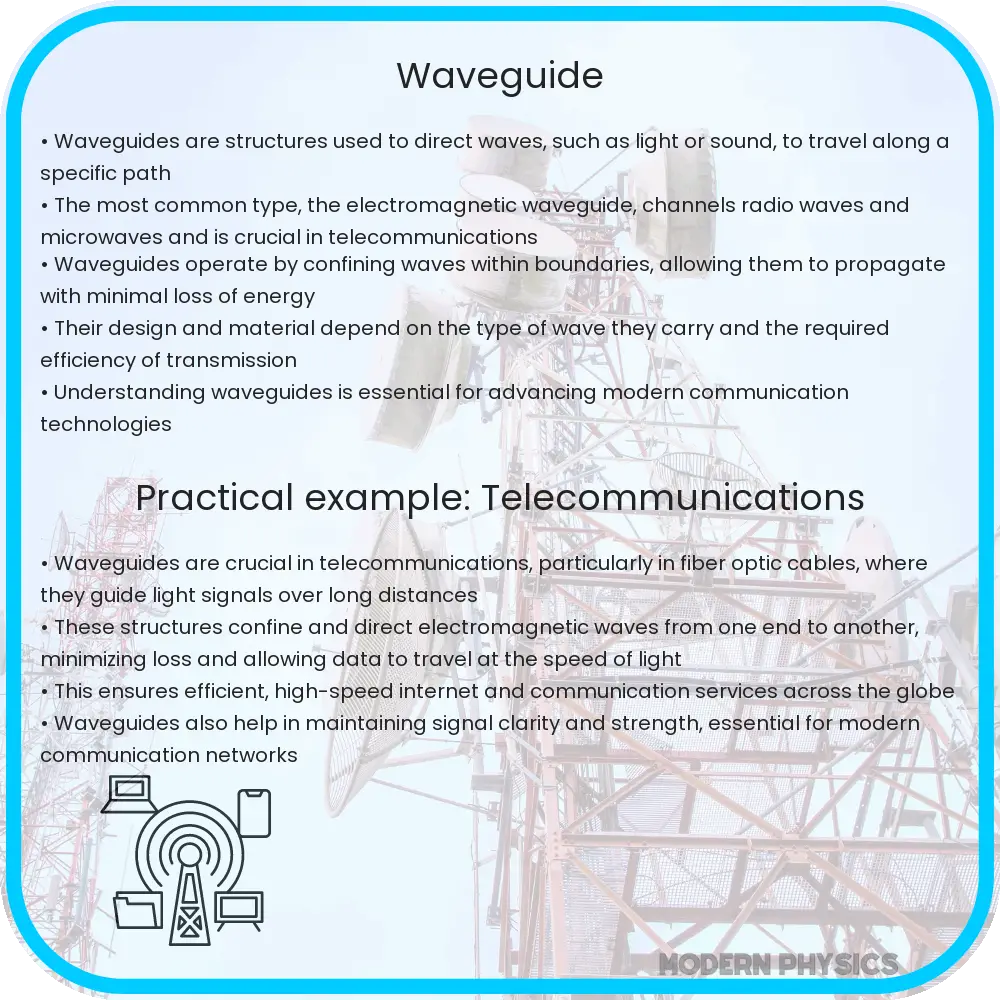
Understanding Waveguides: Essentials for Efficient Transmission and EM Control
Waveguides are a fundamental component in modern electromagnetic (EM) and high-frequency communication systems. These structures guide electromagnetic waves from one point to another, ensuring efficient transmission with minimal loss. This article delves into the core principles of waveguides, their role in high-frequency transmission, and their significance in controlling electromagnetic waves.
Principles of Waveguide Operation
At its most basic, a waveguide is a physical structure that directs electromagnetic waves along a specific path. This is achieved through the principle of total internal reflection, similar to how optical fibers transmit light. Waveguides are typically hollow metallic tubes, although they can also be made from dielectric materials. The shape and size of a waveguide determine the type and frequency of the EM waves it can efficiently transmit.
Types of Waveguides
There are several types of waveguides, each suited for specific applications:
- Rectangular Waveguides: Common in radar and satellite communication, these support Transverse Electric (TE) and Transverse Magnetic (TM) modes.
- Circular Waveguides: Used in microwave and antenna feed systems, offering flexibility in polarization and mode control.
- Dielectric Waveguides: Often used in optical communications, these utilize a dielectric material to guide light with minimal loss.
Waveguide Frequency and Bandwidth
Waveguides are particularly effective at high frequencies. This is due to their ability to confine and guide EM waves, minimizing radiation losses. The efficiency of a waveguide is closely tied to its bandwidth, which is the range of frequencies over which it can operate effectively. For instance, rectangular waveguides are designed to support specific frequency ranges, known as bands. These bands are designated by letters (e.g., X-band, K-band) and are critical in determining the appropriate waveguide for a given application.
Applications in EM Control and Transmission
Waveguides play a crucial role in controlling electromagnetic waves, especially in high-frequency applications like radar, satellite communications, and microwave links. They offer precise control over the direction and mode of EM waves, which is vital for efficient transmission and reception. This control is particularly important in environments where EM interference or signal degradation is a concern.
Waveguides also find extensive use in scientific and medical applications. For instance, in MRI machines, waveguides are essential for transmitting radiofrequency signals to and from the scanner. Their ability to handle high power levels and control EM fields makes them indispensable in these applications.
Advancements in Waveguide Technology
Recent advancements in waveguide technology have further expanded their applications and efficiency. The development of flexible waveguides and the integration of new materials have allowed for more versatile designs. Innovations in photonic and plasmonic waveguides, which operate at optical frequencies, are opening new frontiers in high-speed optical communications and computing.
Waveguides in Emerging Technologies
Waveguides are increasingly finding their place in emerging technologies. In the field of quantum computing, waveguides are used to manipulate and transport quantum information. Similarly, in the burgeoning area of terahertz communications, waveguides offer a promising solution for managing these extremely high frequencies, which are seen as the future of ultra-fast wireless communication.
Challenges and Future Directions
Despite their numerous advantages, waveguides face challenges, particularly in terms of size and flexibility. As frequencies increase, waveguides tend to become bulkier, posing integration challenges in compact systems. Research is ongoing to develop miniaturized waveguides that do not compromise on performance. Additionally, the integration of waveguides with electronic components remains an area of active development, aiming to create more efficient, hybrid communication systems.
Environmental Impact and Sustainability
Another consideration is the environmental impact of waveguide manufacturing and usage. As with any technology, it is crucial to develop sustainable practices, including the use of eco-friendly materials and energy-efficient designs. The waveguide community is increasingly focusing on these aspects, striving to balance technological advancement with environmental responsibility.
Conclusion
In conclusion, waveguides are a vital component in modern communication and scientific systems, particularly for high-frequency and EM wave control. Their ability to efficiently transmit signals with minimal loss is unmatched, making them indispensable in a wide range of applications from radar to quantum computing. While challenges remain in terms of miniaturization and integration, ongoing research and innovations promise to overcome these hurdles, pushing the boundaries of what is possible with waveguide technology. As we continue to harness the power of electromagnetic waves, waveguides will undoubtedly play a pivotal role in shaping the future of communication and technology.