
Explore the intriguing concept of Lepton Number Violation, its theoretical foundations, experimental challenges, and potential impact on modern physics.
Understanding Lepton Number Violation
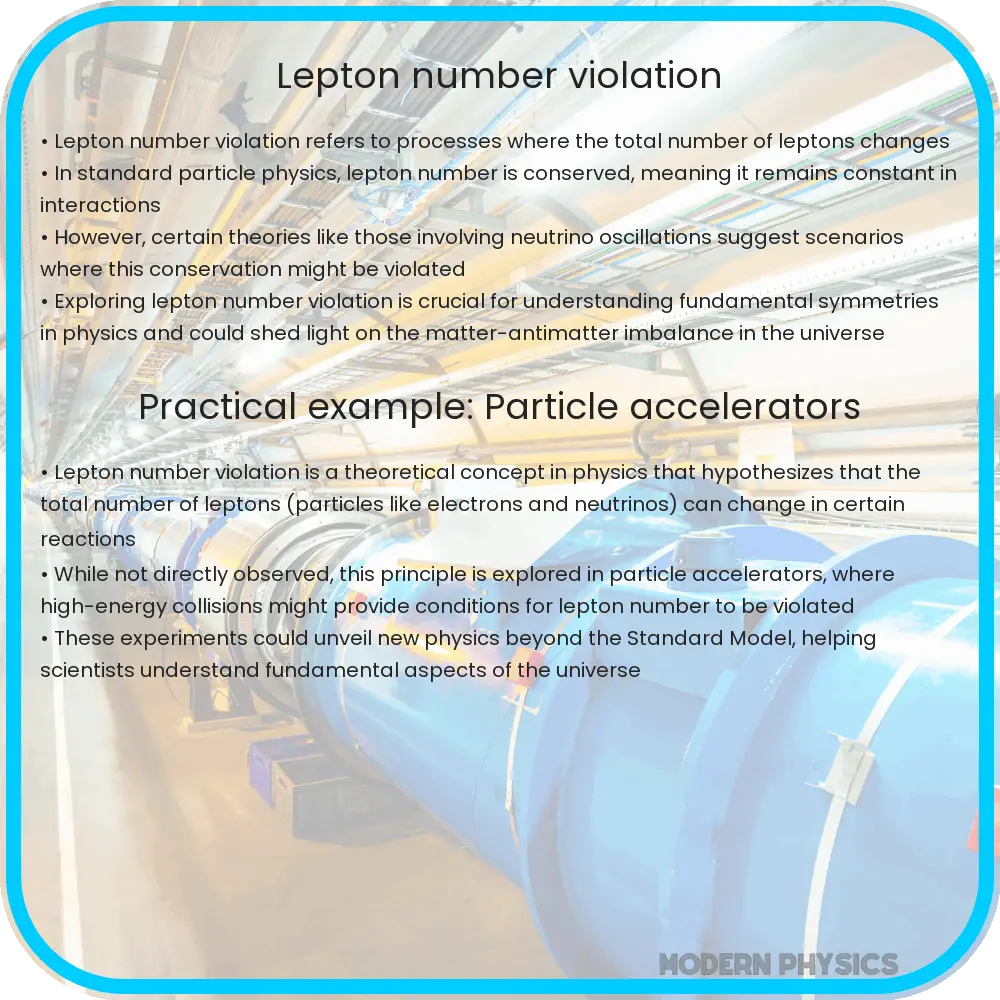
Lepton number violation (LNV) is a theoretical concept in particle physics that pertains to the non-conservation of the lepton number, a quantum number assigned to leptons. In the Standard Model of particle physics, the lepton number is a conserved quantity, meaning that the number of leptons minus the number of anti-leptons remains constant in any particle interaction. However, several theoretical frameworks beyond the Standard Model suggest scenarios where this conservation might be violated.
The lepton family consists of six members, divided into three generations: the electron (e), muon (μ), and tau (τ), along with their corresponding neutrinos (νe, νμ, and ντ). Traditionally, processes involving these particles conserve lepton number: for example, in a beta decay, a neutron transforms into a proton, an electron, and an electron antineutrino, conserving the overall lepton number.
Theoretical Foundations of LNV
Theories suggesting lepton number violation often tie into the mechanisms of neutrino mass generation. Neutrinos were initially thought to be massless, but experiments detecting neutrino oscillations, which imply a mass difference among neutrino types, have challenged this assumption. One prominent theory, the seesaw mechanism, explains the smallness of neutrino masses by introducing heavy right-handed neutrinos, which could lead to LNV through processes like neutrinoless double beta decay (0νββ).
Neutrinoless double beta decay is a hypothesized type of decay in which a nucleus emits two electrons without the corresponding anti-neutrinos. This process would not only demonstrate the violation of lepton number conservation but also prove that neutrinos are Majorana particles, meaning they are their own antiparticles.
Impact of Lepton Number Violation
The observation of LNV would have profound implications for our understanding of the universe. It could provide insights into the nature of neutrinos, the asymmetry between matter and antimatter in the universe, and the conditions of the early universe. Additionally, it would signal new physics beyond the Standard Model, guiding the development of new theories and experiments in particle physics and cosmology.
Experimental Searches and Challenges
Experimental searches for lepton number violation primarily focus on observing neutrinoless double beta decay. Experiments like EXO-200, KamLAND-Zen, and CUORE are designed to detect this rare decay by closely monitoring materials that could undergo double beta decay. Despite the sophistication of these experiments, no definitive evidence of neutrinoless double beta decay has been observed, underscoring the challenge of detecting LNV due to its expected rarity and the need for extremely low-background environments.
Aside from double beta decay, other experimental endeavors aim to uncover LNV through high-energy particle collisions at facilities like the Large Hadron Collider (LHC). Researchers look for events that produce an imbalance in the lepton number, which could hint at LNV processes. However, these experiments also face significant challenges, including distinguishing potential LNV signals from background noise and theoretical uncertainties.
Future Prospects and Significance
The search for lepton number violation is a dynamic field that promises to reshape our understanding of fundamental physics. Advances in detector technology, increased sensitivity, and new theoretical models continue to push the boundaries of what is possible. The discovery of LNV would not only revolutionize our understanding of leptons and neutrinos but also provide crucial insights into the early universe and the underlying symmetry of the fundamental forces.
Moreover, the quest for LNV intersects with other areas of particle physics and cosmology, such as the study of dark matter, the origins of matter-antimatter asymmetry, and the unification of forces. Thus, research in LNV is not only about understanding a particular type of particle interaction but also about unraveling the deeper structure of the universe.
Conclusion
In conclusion, while lepton number violation remains an unobserved phenomenon, its potential impact on physics is monumental. The pursuit of LNV challenges current theories, inspires technological advancements, and deepens our quest for a comprehensive understanding of the fundamental constituents of the universe. As experimental techniques become more refined and theoretical models more sophisticated, the coming years may well herald a new era in particle physics, marked by the unraveling of one of the universe’s most intriguing mysteries.