
Explore the mysteries of Lepton Universality Violation and its challenge to the Standard Model in physics, highlighting recent findings and future research directions.
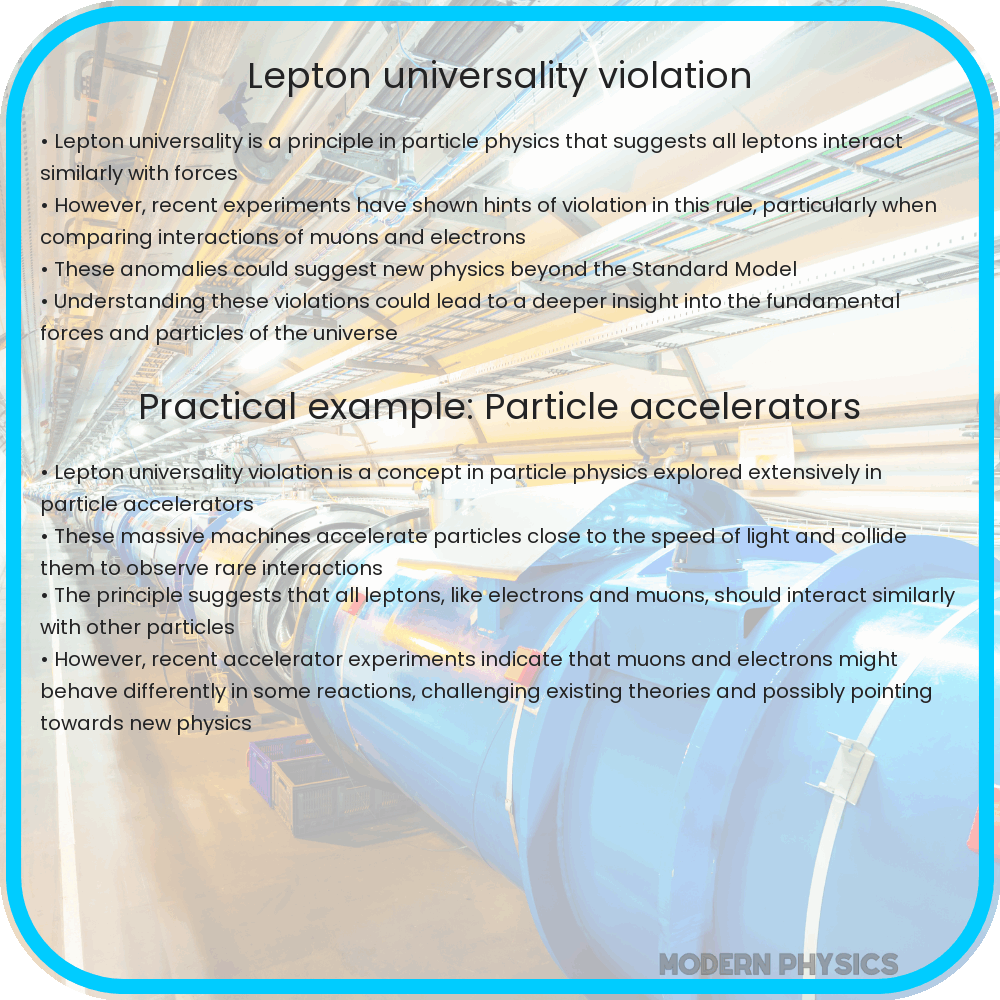
Exploring the Mystery of Lepton Universality Violation
In the field of high-energy physics, one of the intriguing puzzles challenging the Standard Model is the phenomenon known as Lepton Universality Violation (LUV). This concept originates from the principle of lepton universality, which posits that all three types of leptons (electrons, muons, and tau particles) should interact with vector bosons (such as W and Z bosons) with equal strength. However, recent experimental findings suggest discrepancies that could upend our understanding of particle physics.
Historical Context and Standard Model Expectations
The Standard Model of particle physics has long stood as a cornerstone theory, providing comprehensive explanations for the fundamental forces and particles in the universe. Within this framework, lepton universality is a key tenet, underpinning the predictability and uniformity of particle interactions. Yet, the observation of LUV hints at new physics beyond the Standard Model, potentially involving undiscovered particles or forces.
Recent Experimental Insights
Significant attention has been drawn to LUV through various experiments, notably at the Large Hadron Collider (LHC) and B-factories. These studies primarily focus on the decay rates of B mesons (particles containing a bottom quark) into lighter leptons. According to the Standard Model, the decay rates of B mesons into electrons, muons, or tau leptons should be nearly identical when corrected for their mass differences. However, experiments have reported anomalies, particularly in decays involving muons and tau leptons, suggesting a possible violation of lepton universality.
Theoretical Implications and Challenges
The implications of LUV are profound, prompting theorists to propose various extensions to the Standard Model. These include the introduction of leptoquarks, particles that could mediate interactions between quarks and leptons in a non-universal manner, or the presence of new heavy Z’n bosons that preferentially couple to different lepton families. Addressing LUV requires not only innovative theoretical models but also meticulous cross-verification through experimental data.
The quest to understand lepton universality violation is not merely an academic pursuit; it represents a crucial step towards uncovering the deeper laws of nature. As physicists delve into these anomalies, the potential to discover new physics that reshapes our understanding of the universe looms large, marking an exciting era in high-energy physics.
Advancements in Experimental Techniques and Global Collaborations
Advancing our understanding of LUV necessitates cutting-edge experimental techniques and global scientific collaboration. Facilities like the LHC are continuously upgrading their detectors and computational capacities to enhance the precision of measurements and the sensitivity to new phenomena. Collaborations among international laboratories, sharing data and resources, are crucial for cross-validating findings and fostering advancements in theoretical models. The global nature of these collaborations underscores the universal quest for understanding the fundamental principles governing our universe.
Future Directions in Lepton Universality Research
The journey to unravel the mysteries of lepton universality violation is paving the way for future research directions. Upcoming experiments, such as those planned at the High-Luminosity LHC and proposed next-generation colliders, are expected to provide even more precise data. Additionally, interdisciplinary approaches combining insights from astrophysics, cosmology, and condensed matter physics are becoming increasingly significant. These efforts aim to explore the possible connections between LUV and other phenomena, such as dark matter and cosmic ray anomalies.
Implications for Physics Beyond the Standard Model
The potential violation of lepton universality raises fundamental questions about the structure of matter, the unification of forces, and the evolution of the early universe. Exploring these questions could lead to a new paradigm in physics, extending or even replacing the Standard Model. The pursuit of these inquiries not only deepens our understanding of the microscopic world but also illuminates the workings of the cosmos at the largest scales.
Conclusion
The investigation of lepton universality violation stands at the forefront of modern physics, challenging long-held theories and promising a new frontier in our understanding of the fundamental forces of nature. As researchers worldwide collaborate and innovate, they not only seek answers to specific questions about leptons and quarks but also strive to uncover the broader truths of our universe. The path forward is uncertain and fraught with technical and conceptual challenges. Yet, it is this very journey of discovery that continues to drive the field of high-energy physics towards a deeper, more unified understanding of the cosmos. As we stand on the brink of potentially revolutionary discoveries, the study of LUV exemplifies the relentless human quest for knowledge and the unyielding desire to unravel the mysteries of the universe.