
Explore the role of gravitinos as dark matter candidates in cosmology, their unique properties, and the challenges and prospects in their detection and study.
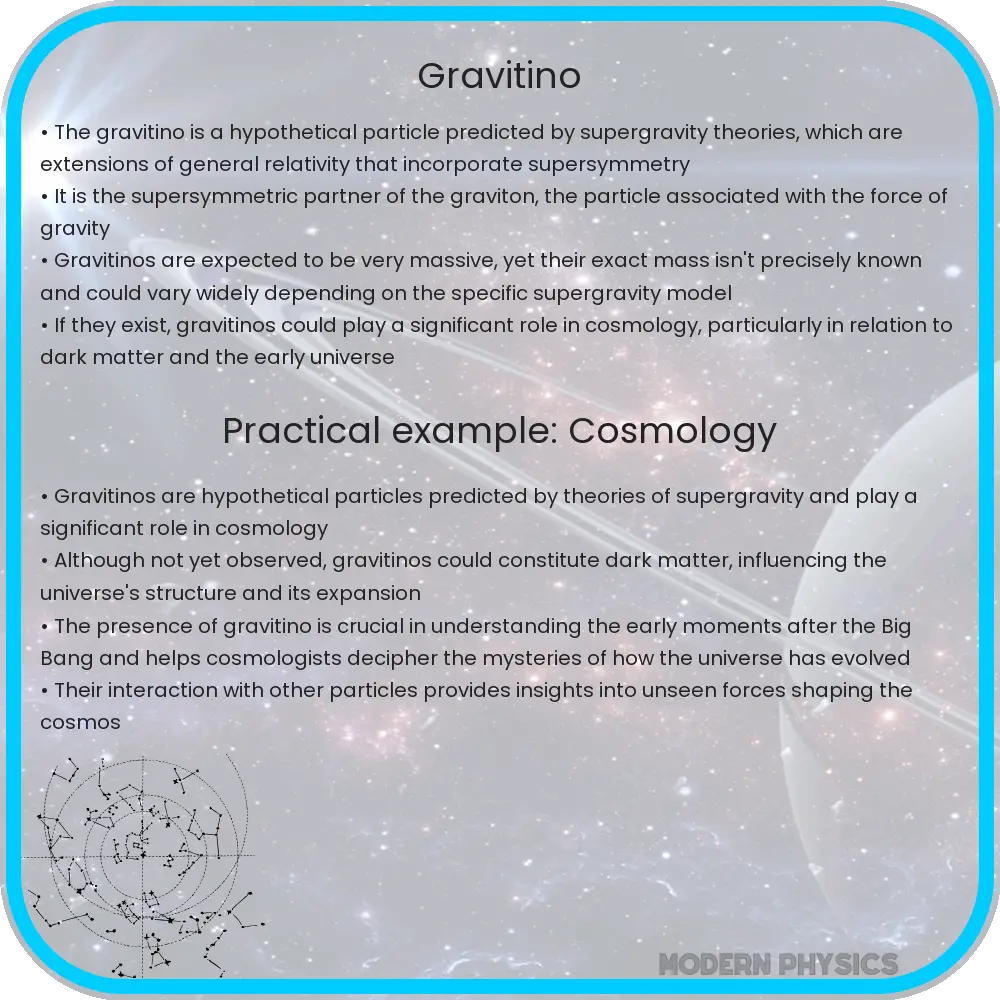
Gravitino and its Role in Dark Matter Cosmology
The concept of dark matter is pivotal in the realm of cosmology, providing solutions to various astronomical observations that cannot be explained by the presence of visible matter alone. Among the myriad candidates for dark matter, the gravitino holds a special place due to its unique properties and implications in the framework of supersymmetry (SUSY). The gravitino is the supersymmetric partner of the graviton, hypothesized in theories extending the Standard Model of particle physics.
Understanding Gravitino
Gravitinos are fermions with spin 3/2, postulated by theories that combine gravity with other fundamental forces through supersymmetry. In such theories, each particle has a supersymmetric partner with a spin differing by 1/2. The gravitino, being the partner of the graviton—the quantum of gravitational force—is thus a major point of interest in SUSY theories.
The mass of the gravitino is highly model-dependent and can vary from extremely light to very heavy. This variability plays a crucial role in its candidacy for dark matter. Light gravitinos are produced copiously in the early universe and could behave as hot dark matter, while heavier ones could act as cold dark matter, depending on their mass and the temperature of the universe at the time of their decoupling.
Gravitino in Cosmology
In cosmology, the gravitino problem arises due to the delicate balance required to maintain consistency with Big Bang nucleosynthesis (BBN). The gravitino’s interactions and decay can disrupt the standard nuclear reactions in the early universe, leading to constraints on its properties and abundance. This problem can be circumvented by assuming that gravitinos are either very light, thus remaining relativistic, or very heavy, thus decaying before affecting BBN significantly.
Furthermore, the gravitino’s role in cosmology extends to scenarios such as the inflationary universe. In these models, gravitinos can be produced during or after inflation, affecting the evolution of the early universe and the formation of cosmic structures. The precise impact of gravitinos on cosmic evolution depends on their mass, lifetime, and interaction strength with other particles.
Gravitino as a Dark Matter Candidate
The quest for understanding the composition of the universe has led to the hypothesis of dark matter, a form of matter that does not emit, absorb, or reflect light, making it completely invisible and detectable only through its gravitational effects. Among the various candidates proposed for dark matter, the gravitino—a hypothetical elementary particle predicted by supergravity theories—stands out due to its unique properties and implications for cosmology.
Gravitinos are the supersymmetric partners of gravitons, the theoretical particles that mediate the force of gravity in quantum theories of gravity. Unlike conventional particles, gravitinos do not interact with electromagnetic forces, which makes them weakly interacting and difficult to detect, similar to other dark matter candidates. However, what sets gravitinos apart is their connection to supersymmetry, a principle that proposes a relationship between the fundamental particles of matter and the particles that mediate forces.
- Mass and Stability: The mass of gravitinos can vary widely depending on the supersymmetry breaking scale, ranging from extremely light to incredibly heavy. This variance allows gravitinos to fit different dark matter scenarios, from hot to cold dark matter.
- Production Mechanisms: Gravitinos could have been produced in the early universe through various processes, including thermal production in the hot primordial soup and non-thermal processes related to the decay of other supersymmetric particles.
- Cosmological Implications: The presence of gravitinos in the universe has significant implications for cosmology, including the evolution of the early universe, the formation of galaxies, and the cosmic microwave background radiation.
The study of gravitinos not only deepens our understanding of dark matter but also offers insights into the unification of forces and particles in nature. However, the elusive nature of these particles and the complexity of supersymmetric theories present significant challenges to researchers.
Conclusion and Future Prospects
The gravitino remains a compelling candidate for dark matter due to its theoretical underpinnings and the potential to bridge gaps in our understanding of the cosmos. While direct detection remains a challenge, indirect evidence through cosmological observations and particle physics experiments continues to offer hope. Advances in accelerator technologies, astrophysical observations, and computational simulations are expected to enhance our understanding of dark matter and the role of gravitinos.
As research progresses, the gravitino could either solidify its position as a cornerstone of cosmological theory or pave the way for new, unforeseen discoveries in the quest to unravel the mysteries of the universe. The pursuit of understanding dark matter, with gravitinos as a key player, remains one of the most intriguing and important challenges in modern physics and cosmology.