
Explore the world of laser optics components, focusing on their precision, efficiency, and durability. Learn how they drive innovation in various industries.
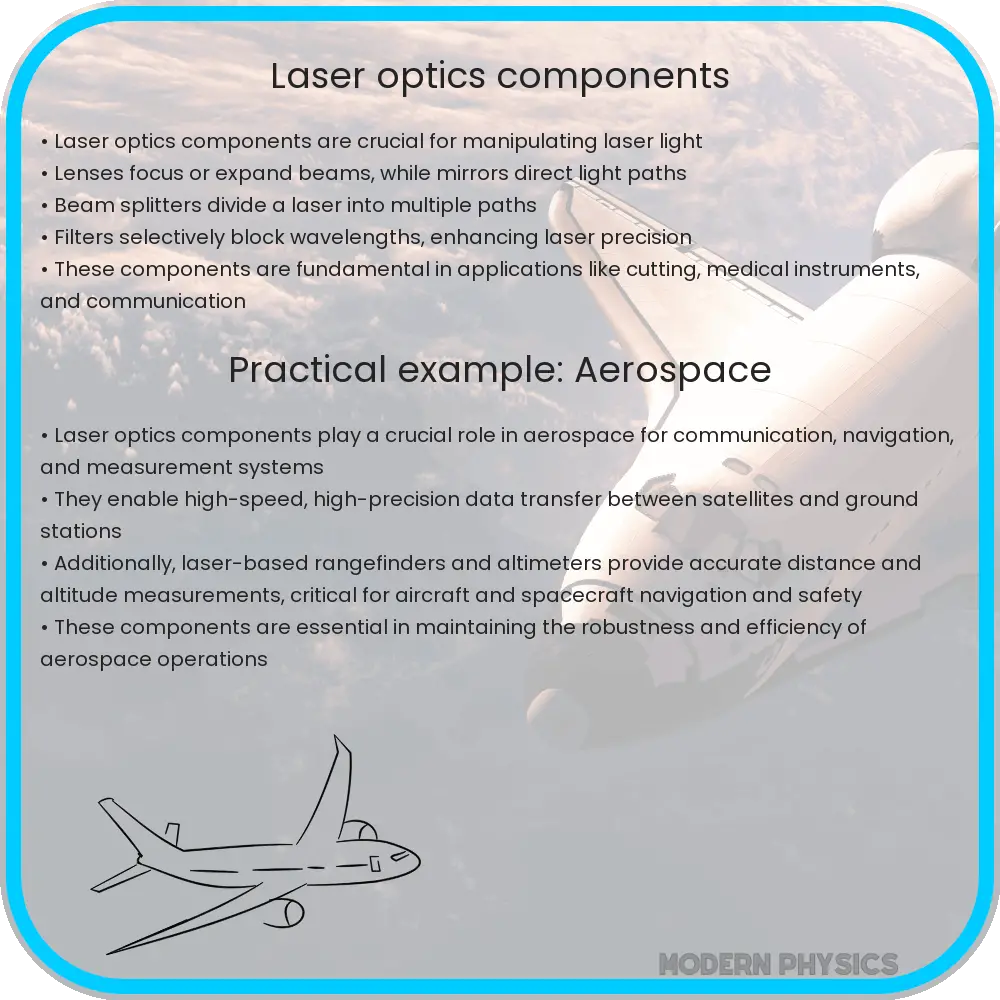
Understanding Laser Optics Components: The Path to Precision, Efficiency, and Durability
Laser optics are pivotal in harnessing the power of light for a multitude of applications, from cutting-edge medical treatments to precision manufacturing processes. At the core of these systems lie the laser optics components, which are designed to manipulate light with utmost precision, efficiency, and durability. Understanding these components is key to leveraging the full potential of laser technology.
The Cornerstones of Laser Optics: Key Components Explained
The efficiency and performance of laser systems heavily depend on the quality and design of their optical components. Here’s a closer look at the primary elements:
- Laser Crystals and Glasses: These are the heart of solid-state lasers, providing the medium for light amplification. Materials like Nd:YAG (Neodymium-doped Yttrium Aluminum Garnet), Er:YAG (Erbium-doped Yttrium Aluminum Garnet), and various types of glasses doped with rare earth elements are commonly used.
- Mirrors and Reflective Coatings: High-precision mirrors are crucial for directing and focusing laser beams. Reflective coatings, often made from materials like gold or dielectric compounds, are applied to enhance mirror reflectivity and durability.
- Optical Lenses: Lenses focus or spread laser beams as needed. They come in various shapes (e.g., plano-convex, biconvex) and materials (e.g., fused silica, zinc selenide) to cater to different wavelengths and applications.
- Beam Splitters: These components divide a laser beam into two or more beams, each with a specific intensity ratio. They are essential for applications requiring multiple beams from a single source.
- Modulators: Modulators control the intensity, phase, or polarization of the laser beam, allowing for precise manipulation of its properties for communication or material processing applications.
Each component plays a vital role in the laser’s operation, influencing the system’s overall efficiency, precision, and durability. For example, the choice of lens material can significantly affect the laser’s focus and efficiency, while the durability of mirrors and coatings determines the system’s longevity under high-intensity laser operation.
Advancements in Materials and Coatings: Enhancing Performance and Durability
Recent advancements in materials science and nanotechnology have led to significant improvements in laser optics components. Innovations such as durable anti-reflective coatings and high-damage-threshold materials have enabled lasers to operate more efficiently and withstand harsher conditions. For instance, coatings engineered at the nanoscale can significantly reduce losses and enhance the durability of optical components, extending their lifespan and reducing maintenance requirements.
Laser Optics Components: The Foundation of Precision, Efficiency, and Durability
Laser optics are critical components in a wide range of applications, from medical devices to manufacturing equipment. These components, including lenses, mirrors, and prisms, are designed to manipulate laser light with high precision, efficiency, and durability. Understanding the key aspects of laser optics components can help in selecting the right type for a specific application, ensuring optimal performance and longevity.
Materials and Coatings
The choice of material for laser optics components is vital for achieving desired results. Common materials include fused silica, which offers excellent thermal stability and resistance to laser damage, and borosilicate glass, known for its low coefficient of thermal expansion. Advanced coatings are applied to these materials to enhance their reflective or transmissive properties, thereby increasing the efficiency of laser systems. Anti-reflective coatings minimize losses due to reflection, while high-reflective coatings are used in mirrors to direct laser beams precisely.
Customization for Specific Applications
Customization plays a crucial role in the world of laser optics. Components can be tailored to specific wavelengths, power levels, and environmental conditions. For instance, in medical laser applications, precision and biocompatibility are paramount, necessitating the use of specialized materials and coatings. In industrial settings, durability under high-power conditions and resistance to harsh environments are essential for maintaining performance over time.
Conclusion
Laser optics components are at the heart of modern laser applications, driving advancements in technology and industry. The selection of materials, application of coatings, and customization for specific applications are critical factors in achieving the precision, efficiency, and durability required for these sophisticated systems. As technology evolves, the development of new materials and coatings will continue to enhance the capabilities of laser optics, enabling new applications and improving existing ones. Whether for cutting-edge medical treatments or precision manufacturing, the ongoing innovation in laser optics components promises to play a pivotal role in the technological landscape of the future.