
Explore the precision, efficiency, and innovation of laser optical components, their types, applications, and the future of laser technology.
Laser Optical Components: Bridging Precision, Efficiency, and Innovation
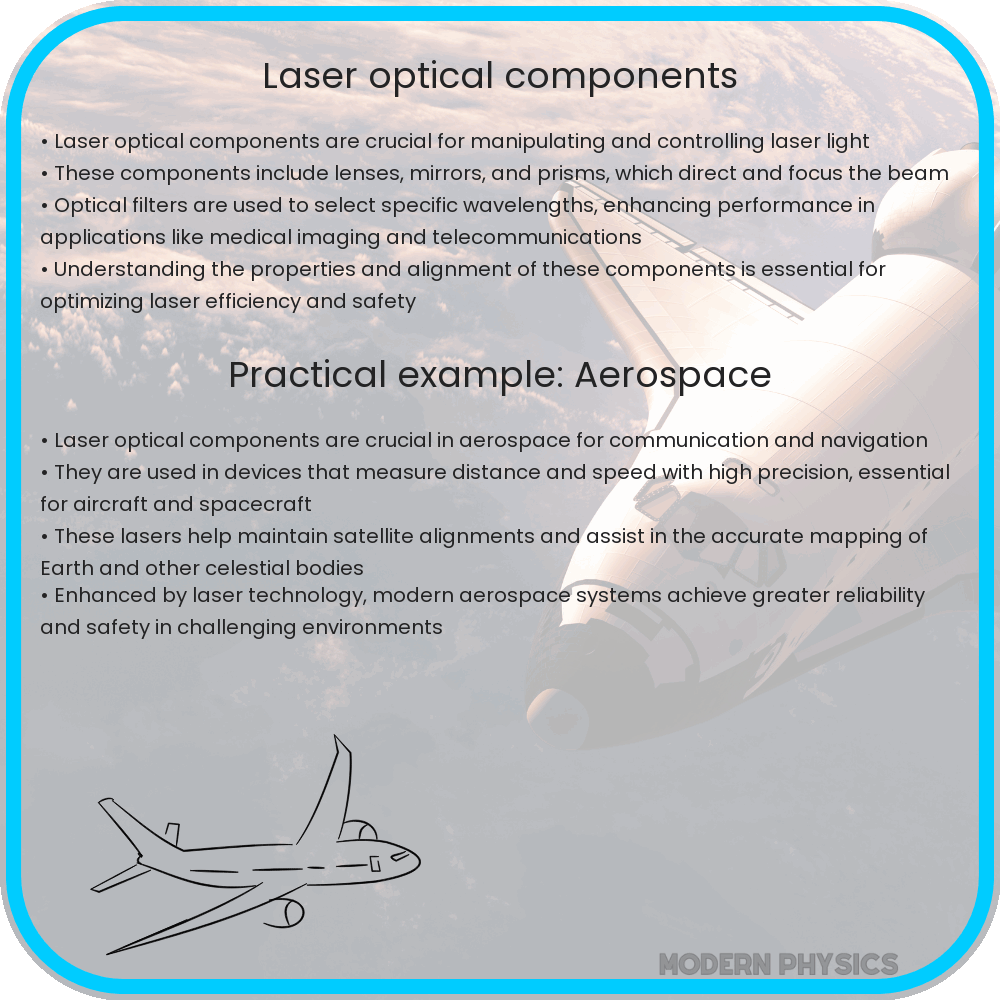
The realm of laser optical components is a fascinating confluence of precision, efficiency, and innovation, serving as the backbone for myriad applications in science, engineering, and technology. These components, including lenses, mirrors, filters, and beam splitters, are integral to manipulating light for a diverse array of purposes, from cutting-edge research to industrial processing and medical diagnostics.
Understanding Laser Optical Components
Laser optical components are specialized tools designed to control and direct laser light with utmost accuracy. Precision in these components is paramount, as the slightest deviation can lead to significant discrepancies in applications. Efficiency, on the other hand, pertains to the optimal performance of these components, ensuring minimal loss of light energy during transmission and reflection. Innovation in laser optics involves the continuous development of materials and designs to improve the performance and functionality of these components.
Types and Applications
- Lenses: Used to focus or diverge laser beams, lenses are crucial for applications requiring precise beam shaping, such as in laser cutting or microscopy.
- Mirrors: High-reflectivity mirrors direct laser beams with minimal loss, essential for the construction of laser resonators and in steering beams for material processing.
- Filters: Laser filters selectively transmit or block wavelengths, playing a key role in protecting sensitive instrumentation or enhancing the purity of laser light for spectroscopy.
- Beam Splitters: These components divide a laser beam into two or more paths, facilitating experiments in quantum optics and applications requiring simultaneous beam propagation in multiple directions.
Material and Design Innovation
The choice of material for laser optical components is critical, impacting their efficiency, durability, and application range. Traditional materials like fused silica offer excellent optical clarity and thermal stability, while newer composites and crystals, such as calcium fluoride (CaF2) and yttrium aluminum garnet (YAG), provide unique advantages in specific wavelengths and laser types. Innovations in coating technologies have also led to significant improvements in component lifespan and performance, enabling the creation of highly efficient and tailored optical systems.
Advancements in Laser Optical Technology
In recent years, the field of laser optics has witnessed remarkable advancements, driven by the relentless pursuit of higher precision, efficiency, and adaptability. One such innovation is the development of ultra-precision optics, utilizing sophisticated fabrication techniques to achieve nanometer-level surface accuracy. This leap in manufacturing precision enables the production of optical components that significantly reduce aberrations, enhancing the performance of high-power laser systems used in semiconductor manufacturing and scientific research.
Customization and Specialized Applications
Customization has become a key trend in the laser optics industry, with manufacturers offering bespoke solutions tailored to specific application needs. This includes custom coatings that optimize the transmission and reflection properties of optical components for unique wavelength ranges, and specialized geometries for components that fit into compact or unconventional laser systems. Such customization not only improves system performance but also expands the potential applications of lasers in emerging fields such as photonic computing and biophotonics.
Challenges and Future Directions
Despite the advancements, the laser optics field faces challenges, notably in material limitations and the management of thermal effects in high-power applications. Research is ongoing to discover new materials and coatings that can withstand intense laser energies without degradation. Additionally, the integration of photonics with electronic and other non-optical systems presents both challenges and opportunities for innovation, promising a future where lasers play an even more central role in technology and society.
Conclusion
The field of laser optical components is at the heart of a technological revolution, pushing the boundaries of precision, efficiency, and innovation. As the demand for more sophisticated and precise laser applications grows, so does the need for advanced optical components. The continuous improvement in materials, designs, and customization options is enabling new applications and efficiencies, from manufacturing and medicine to communication and research. Facing the challenges ahead, the industry is poised for further breakthroughs, promising to unlock new possibilities and redefine what is achievable with laser technology.
Is this conversation helpful so far?