
Explore the science and applications of laser filamentation, from atmospheric sensing to medical technology, in this comprehensive guide.
Understanding Laser Filamentation: A Fascinating Optics Phenomenon
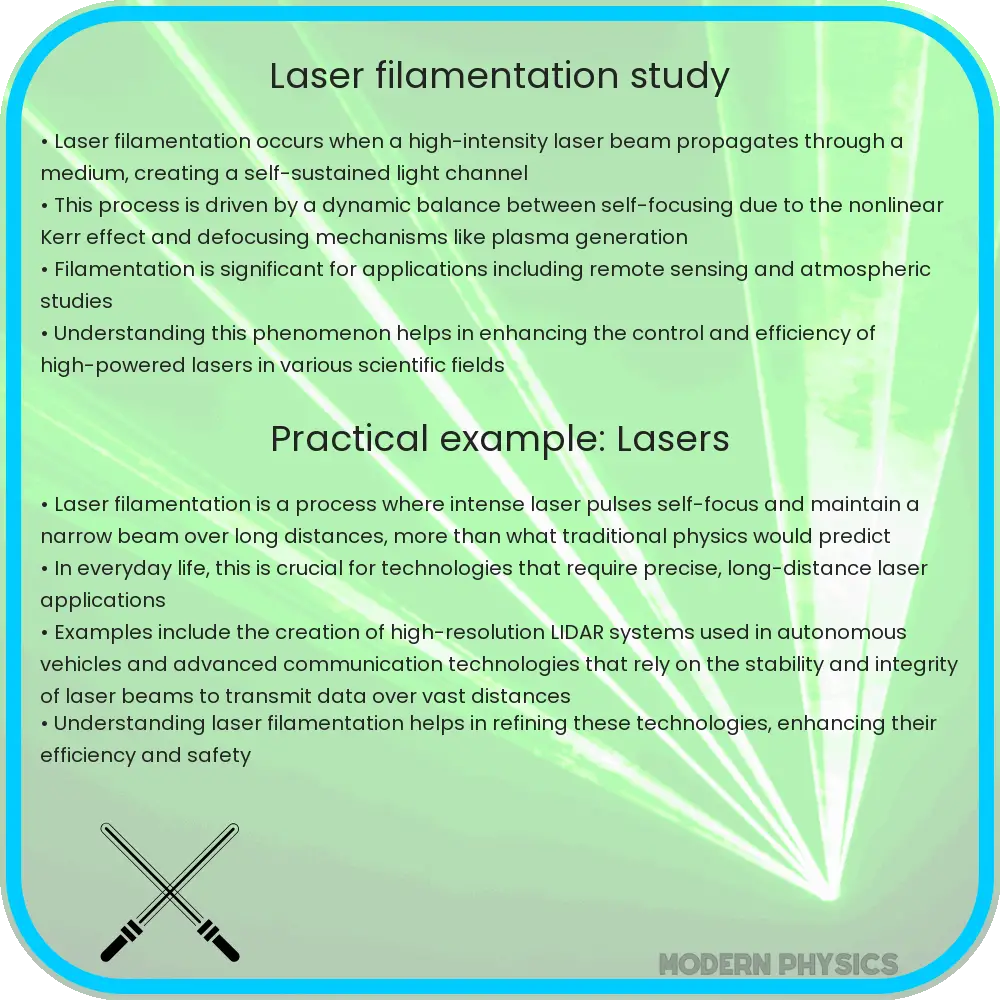
Laser filamentation, a captivating phenomenon in the field of optics, refers to the self-focusing and propagation of high-intensity laser pulses through a medium, leading to the formation of long, thin regions of ionized air known as filaments. This process, driven by the dynamic interplay between Kerr effect, diffraction, and plasma defocusing, unveils a range of intriguing applications and theoretical insights.
The Science Behind Laser Filamentation
At the heart of filamentation lies the Kerr effect, a nonlinear optical effect where the refractive index of a medium changes in response to the intensity of light passing through it. As a high-intensity laser pulse travels, it induces a localized increase in the refractive index, causing the light to self-focus. This self-focusing, in turn, intensifies the light further, leading to a runaway effect. However, the formation of a plasma – a soup of free electrons and ions – counteracts this focusing. The plasma, generated when the intense light ionizes the air, defocuses the light due to its negative refractive index. The delicate balance between these opposing forces creates a stable filament.
Applications of Laser Filamentation
Laser filamentation has diverse applications, spanning from atmospheric science to material processing. One of its most notable uses is in atmospheric sensing and weather modification. Filaments can act as conductive channels for electrical discharges, offering potential in triggering lightning or clearing the path for electrical transmission. Moreover, their ability to spectroscopically analyze the composition of the atmosphere has implications for environmental monitoring.
In materials science, filamentation enables precision material processing and micromachining. The intense, localized energy deposition of filaments can modify materials at a microscale, beneficial for applications in microelectronics and nanofabrication.
Theoretical Insights from Laser Filamentation
The study of laser filamentation also enriches our understanding of light-matter interactions. It challenges and refines our comprehension of nonlinear optics, plasma physics, and the propagation of high-intensity light beams. These insights not only enhance our theoretical knowledge but also guide the development of new technologies in photonics and laser engineering.
The phenomenon of laser filamentation, while complex, opens up a world of possibilities across various scientific fields. Its study not only broadens our understanding of optical phenomena but also paves the way for innovative applications in environmental science, material processing, and beyond.
Advanced Research and Future Directions in Laser Filamentation
Continued research in laser filamentation is paving the way for revolutionary advancements in various fields. In medical technology, the precise and controlled nature of laser filaments shows promise in non-invasive surgeries and targeted therapies. Furthermore, in the realm of communication technology, the potential of using filaments for high-speed, long-distance optical data transmission is being explored, leveraging their ability to sustain high-intensity light over considerable distances.
The exploration of ultrafast phenomena is another exciting frontier. Laser filaments, with their ultra-short pulse durations, enable the study of rapid processes at the atomic and molecular levels. This capability is invaluable in the fields of chemistry and physics, where understanding the dynamics of molecules and electrons is crucial.
Challenges and Considerations
Despite its potential, the study of laser filamentation comes with its own set of challenges. Controlling and stabilizing the filaments for consistent results remains a significant hurdle. Environmental factors such as atmospheric pressure, temperature, and humidity can influence filament behavior, necessitating precise control over experimental conditions.
Safety considerations are also paramount, given the high intensities involved in filamentation. Research and applications must adhere to strict safety protocols to prevent damage to both the equipment and the researchers.
Conclusion
Laser filamentation stands at the intersection of physics, engineering, and technology, offering a window into complex optical phenomena and a tool for groundbreaking applications. From environmental sensing to high-precision manufacturing, its implications are vast and varied. The ongoing research and exploration in this field promise to unlock further understanding and innovative applications, potentially transforming how we interact with and manipulate light. As we delve deeper into the intricacies of laser filamentation, we stand on the brink of new scientific and technological frontiers, poised to unveil the untapped potential of this fascinating optical phenomenon.
Is this conversation helpful so far?