
Explore the fascinating world of near-field diffraction patterns, their analysis methods, and groundbreaking applications in microscopy and optics.
Near-Field Diffraction Patterns: Unlocking Microscopic Worlds
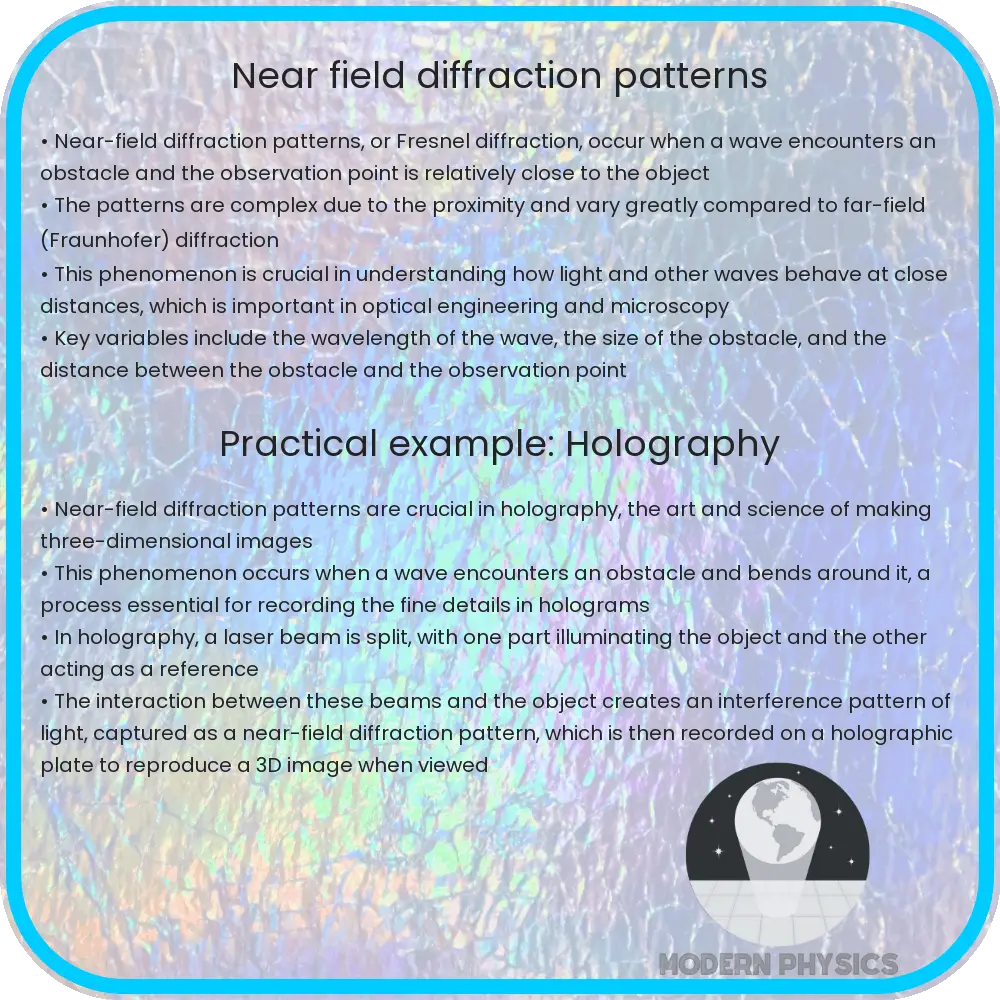
Near-field diffraction, a fundamental concept in wave optics, explores the diffraction patterns that occur close to an object causing diffraction. This phenomenon is crucial in understanding how light interacts with materials at microscopic scales, leading to advancements in various scientific and industrial fields. This article delves into the analysis, methods, and applications of near-field diffraction patterns, shedding light on their significance in contemporary research and technology.
Understanding Near-Field Diffraction
Near-field diffraction, also known as Fresnel diffraction, occurs when the observation point is relatively close to the diffracting object, within a few wavelengths of the incident wave. Unlike far-field (Fraunhofer) diffraction, where diffraction patterns are observed at a much larger distance and appear simpler, near-field patterns are complex and reveal more about the wave’s interaction with the diffracting object. The analysis of these patterns requires precise mathematical models to predict the intensity and phase of the diffracted wave at various points in the near field.
Methods of Analysis
The analysis of near-field diffraction patterns is grounded in wave optics principles, employing both analytical and numerical methods. The Kirchhoff-Fresnel principle is a cornerstone in understanding near-field diffraction, providing a framework to calculate the amplitude and phase of the diffracted wave. Advanced computational techniques, such as the Finite-Difference Time-Domain (FDTD) method and the Boundary Element Method (BEM), are also used to simulate and predict diffraction patterns with high accuracy.
Applications Across Fields
The study of near-field diffraction patterns finds applications in numerous areas, from microscopy to materials science. In microscopy, near-field scanning optical microscopy (NSOM) utilizes near-field diffraction to surpass the diffraction limit of light, providing images with nanometer resolution. This technique is invaluable in the study of biological specimens, nanomaterials, and surface phenomena. Additionally, near-field diffraction is pivotal in the design of optical elements such as diffractive optical elements (DOEs) and micro-optical components, which are integral to the development of compact, efficient optical systems for telecommunications, imaging, and sensing applications.
Advanced Techniques and Innovations
Recent advancements in computational optics have led to the development of innovative techniques for analyzing near-field diffraction patterns. Machine learning algorithms, for example, are now being employed to reconstruct high-resolution images from diffraction patterns, significantly enhancing the capabilities of optical imaging systems. Furthermore, the integration of near-field diffraction analysis with quantum optics paves the way for exploring the quantum properties of light at the nanoscale, opening new avenues for quantum computing and secure communication technologies.
Challenges and Future Directions
Despite the significant progress in understanding and applying near-field diffraction patterns, challenges remain. High-resolution imaging in the near field demands precise control over the light source and the imaging environment, which can be difficult to achieve in practice. Moreover, the interpretation of complex diffraction patterns requires sophisticated algorithms and computational resources. Future research is likely to focus on improving the efficiency and accuracy of these computational methods, as well as on developing new materials and devices that exploit near-field diffraction phenomena for enhanced performance.
Conclusion
Near-field diffraction patterns offer a window into the microscopic world, revealing details of light-matter interactions that are invisible to conventional imaging techniques. Through the analysis of these patterns, scientists and engineers can design better optical devices, improve imaging technologies, and even venture into the realms of quantum computing. The journey from understanding the basic principles of near-field diffraction to applying them in cutting-edge technologies exemplifies the transformative power of optical science. As we continue to explore and innovate, the study of near-field diffraction patterns will undoubtedly play a pivotal role in shaping the future of science and technology.