
Freeform optics are advanced optical components with non-symmetrical, customizable shapes for precise light manipulation in various high-tech applications.
Introduction to Freeform Optics Design
The realm of optical engineering is constantly evolving, with freeform optics standing at the forefront of this innovation. Unlike traditional optical components that are typically limited to spherical or aspheric surfaces, freeform optics break these constraints by having surfaces that can be smoothly curved in any shape. This burgeoning technology enables unparalleled levels of precision and adaptability in various applications, ranging from aerospace to consumer electronics.
Understanding the Basics of Freeform Optics
Freeform optics are distinguished by their unique, non-symmetrical shapes, which allow for more complex light manipulation. The surface of a freeform optic is typically designed based on the specific optical performance required for an application, such as better focusing abilities or unique beam shaping that cannot be achieved with conventional optics.
The design of freeform optics relies heavily on sophisticated mathematical models and advanced manufacturing techniques. Computational algorithms determine the ideal surface contours to achieve desired optical functionalities, making extensive use of techniques from calculus and coordinate transformations.
Advantages of Freeform Optics
- Enhanced Optical Performance: Customizable shapes lead to better control of light, improving performance in terms of aberration correction and overall optical quality.
- Compactness: The ability to achieve more with less material allows for lighter and smaller optical devices.
- Integration Flexibility: Freeform optics can be designed to fit into irregular spaces, enhancing their adaptability for complex engineering projects.
Applications of Freeform Optics
Freeform optics have found applications in a myriad of fields:
- Astronomy: Large scale telescopes benefit from freeform optics, which improve the quality of celestial imaging.
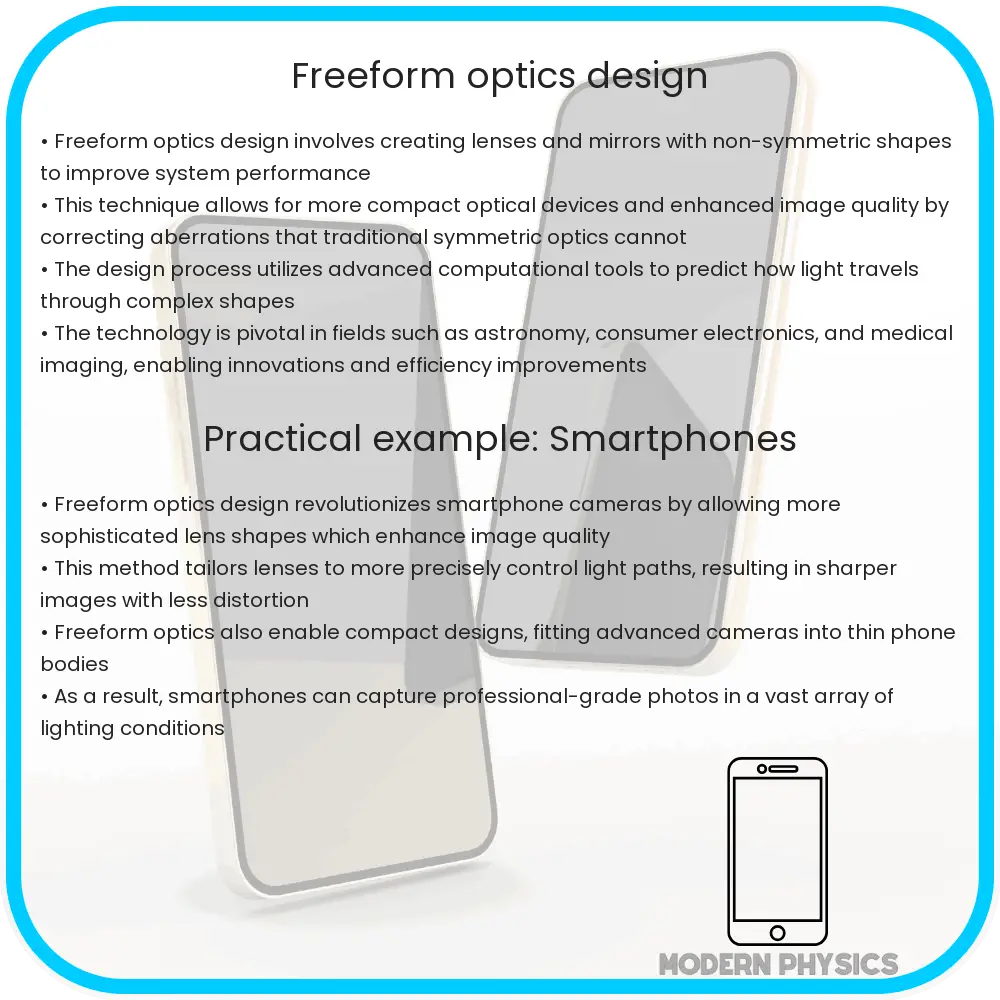
- Consumer Electronics: In devices such as smartphones and virtual reality headsets, freeform lenses contribute to reducing the size and weight of these gadgets while enhancing the user experience.
- Automotive: Advanced lighting systems, including adaptive headlights and taillights, utilize freeform optical elements to improve illumination and safety on the road.
As we delve deeper into the specifics of freeform optics design, it becomes clear that the main challenge lies in the precise manufacturing of these complex shapes. Emerging technologies in optical fabrication, such as ultra-precision machining and 3D printing of glass, play crucial roles in overcoming these challenges. The next section of this article will explore these innovative manufacturing methods to reveal how they contribute to the precision and adaptability of freeform optics.
Innovative Manufacturing Methods for Freeform Optics
The manufacturing of freeform optics requires highly precise methods to accurately achieve the complex surface geometries. Two primary technological advances have significantly improved these capabilities:
- Ultra-Precision Machining: Utilizes cutting-edge computer-controlled milling machines that can achieve surface precision down to the nanometer scale. This process is critical for producing optics with tight tolerances and complex shapes.
- 3D Printing of Glass: A relatively new technology that allows for the additive manufacturing of optical-quality glass. This technique can produce optical components with intricate designs that are difficult or impossible to achieve with traditional methods.
These technologies not only enable the production of freeform optics but also reduce the time and cost associated with their manufacturing, thus allowing for more rapid development and deployment in various applications.
Challenges and Future Directions
Despite the advantages and recent advancements, the production of freeform optics still faces several challenges:
- Quality Control: Ensuring consistent quality across batches can be difficult due to the complexities involved in manufacturing and measuring these unique shapes.
- Material Limitations: Some optical materials are difficult to shape into freeform surfaces without compromising optical properties.
On the horizon, ongoing research in materials science and precision engineering promises to mitigate these challenges. Newer materials and improved control systems are being developed to enhance the manufacturability and performance of freeform optics.
Conclusion
Freeform optics represent a significant leap forward in the field of optical engineering. By enabling more precise control of light within smaller, more efficiently designed devices, they hold the potential to revolutionize industries ranging from astronomy to consumer electronics. The unique challenges posed by their manufacturing are being met with equally innovative solutions, promising an exciting future as these technologies continue to evolve. With further advancements in ultra-precision machining, 3D printing, and materials science, the capabilities and applications of freeform optics are only set to expand, thereby making a profound impact on technology and society.