
Explore the integral role of land surface processes in climate systems, focusing on energy balances, erosion impacts, and modeling techniques for sustainable management.
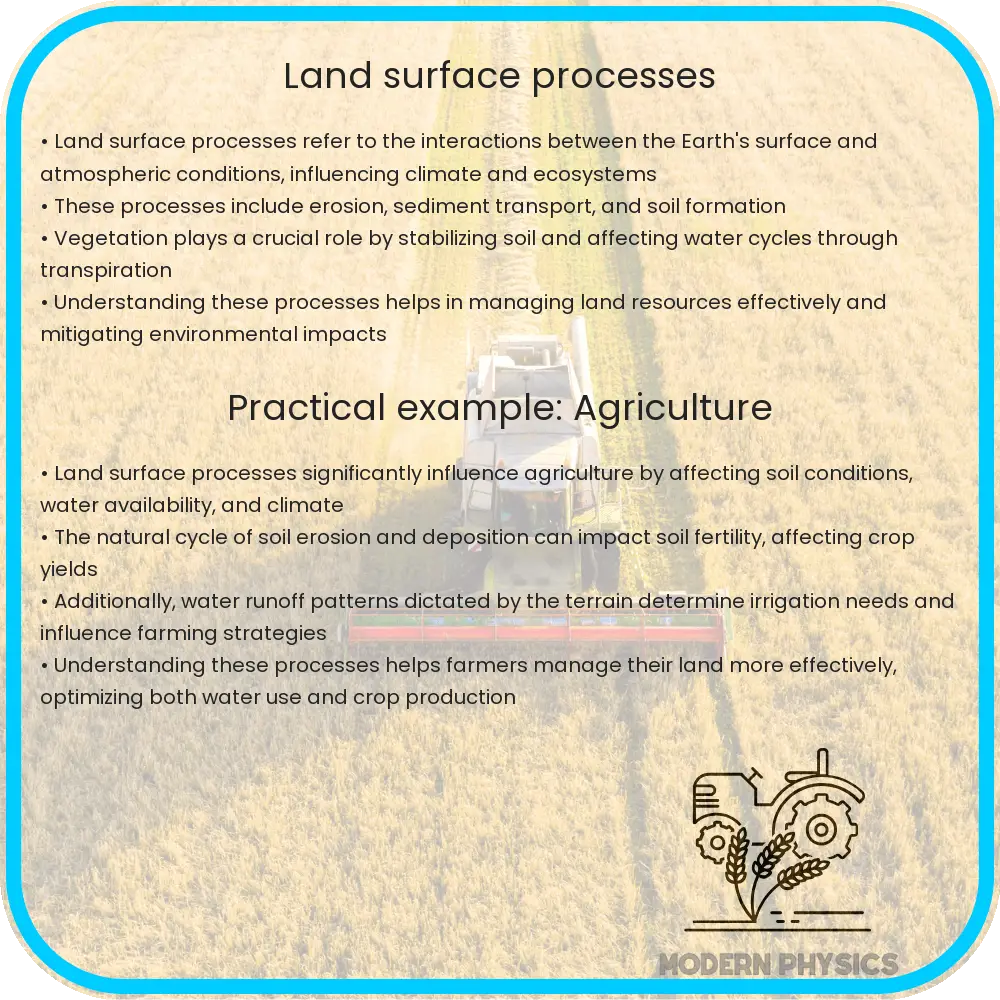
Understanding Land Surface Processes and Their Climate Impact
Land surface processes constitute a critical aspect of the Earth’s system, influencing both local and global climates. These processes include an array of interactions between the atmosphere and the Earth’s terrestrial surface, encompassing vegetation dynamics, the carbon cycle, soil moisture, and erosion. The impact of these processes reaches far beyond their immediate geographical locations, affecting atmospheric conditions, water resources, and ecological balances globally.
The Role of Land Surface in Climate Systems
Land surfaces play a pivotal role in the climate system by affecting energy balances and air movements. Solar radiation absorbed by the Earth’s surface is either transformed into heat or drives biochemical processes, which subsequently influences atmospheric conditions. For instance, areas covered with dark vegetation tend to absorb more heat compared to lighter surfaces such as deserts or ice-covered regions. This differential heating leads to variations in air temperature and pressure, which ultimately drives wind patterns and weather systems across the globe.
Erosion and Its Environmental Impact
Erosion is a natural process whereby wind, water, or other natural agents move soil and rock from one location to another. Although erosion is a natural and often beneficial process, excessive erosion can lead to significant environmental challenges. For example, it can degrade soil health by removing topsoil, the nutrient-rich upper layer, thereby reducing agricultural productivity and leading to desertification in severe cases.
- Reduction in soil fertility due to loss of vital organic matter and nutrients.
- Increased pollution and sedimentation in rivers and streams, which can harm aquatic ecosystems.
- Enhanced flood risks due to the decreased water absorption capacity of the soil.
Modeling Land Surface Processes
To predict and mitigate the impacts of erosion and other land surface processes on climate and environmental health, scientists utilize various modeling techniques. These models are essential tools for understanding the complex interactions within the Earth’s systems and for developing effective strategies for sustainable land management.
Land surface models (LSMs) form a core component of climate and weather prediction models and are integrated into Earth System Models (ESMs). These models simulate the transfer of energy, mass, and momentum between the land and the atmosphere. By incorporating detailed descriptions of biophysical and hydrological processes, LSMs help in quantifying the effects of land use changes, land management practices, and environmental changes on climate patterns.
One commonly used approach in LSMs is the representation of energy balances, where the energy received from the sun is balanced by energy emitted back into space and heat transferred to the atmosphere. The basic energy balance equation can be represented as:
\[ R_{n} = SW\_{in} – SW\_{out} + LW\_{in} – LW\_{out} + Q\_{H} + Q\_{LE} + Q\_{G} \]
Where \( R_{n} \) is the net radiation, \( SW\_{in} \) and \( SW\_{out} \) are the incoming and outgoing shortwave radiation respectively, \( LW\_{in} \) and \( LW\_{out} \) are the incoming and outgoing longwave radiation, \( Q\_{H} \) is the sensible heat flux, \( Q\_{LE} \) is the latent heat flux, and \( Q\_{G} \) is the ground heat flux.
Through these models, scientists can test scenarios, understand potential future changes, and guide policy decisions to address the challenges posed by changing land use and climate conditions.
Importance of Vegetation in Land Surface Processes
Vegetation plays a crucial role in land surface processes by influencing the cycling of energy, water, and nutrients through ecosystems. Plants absorb carbon dioxide during photosynthesis, a process that not only helps in reducing greenhouse gases but also contributes to cooling the earth’s surface. Moreover, the transpiration of water from plants adds moisture to the atmosphere, which can lead to cloud formation and potentially influence local and regional rainfall patterns.
- Forests and grasslands contribute to higher albedo effects, reflecting solar radiation away from the earth.
- The roots of vegetation help stabilize soil and prevent erosion by water and wind.
- Vegetation cover reduces surface runoff, enhancing groundwater recharge and reducing the risk of flash floods.
Human Impact on Land Surface Processes and Climate
Human activities, such as deforestation, urbanization, and industrial agriculture, have profound impacts on land surface processes. Deforestation, for example, not only reduces the capacity of the land to sequester carbon but also alters local rainfall patterns, affecting agricultural productivity and water availability. Urbanization contributes to the heat island effect, where cities become significantly warmer than their rural surroundings due to less vegetation and higher concentrations of dark, heat-absorbing surfaces.
- Urban expansion often leads to increased runoff and reduced soil permeability, exacerbating flood risk.
- Intensive agriculture can lead to soil degradation and decreased biodiversity, undermining ecosystem resilience.
- Land use changes impact the natural balance of gases in the atmosphere, contributing to climate change.
Highlighting these impacts is crucial for informing policy and conservation strategies aimed at mitigating the adverse effects of human actions on the environment and climate systems.
Conclusion
The intricate relationship between land surface processes and the climate system underscores the importance of sustainable land management and conservation practices. Understanding how vegetation, erosion, human activity, and other factors influence these processes helps us predict and prepare for their effects on global climate and local environments. By utilizing advanced modeling tools and embracing environmentally responsible policies, society can better adapt to and mitigate the impacts of these processes on our world. Continued research and public awareness are pivotal in achieving these objectives, making the pursuit of knowledge in this area both valuable and necessary.