
Explore the precision of interferometers in wave analysis and optical insights, uncovering their applications from physics to medical imaging.
Understanding Interferometers: Precision, Wave Analysis, and Optical Insight
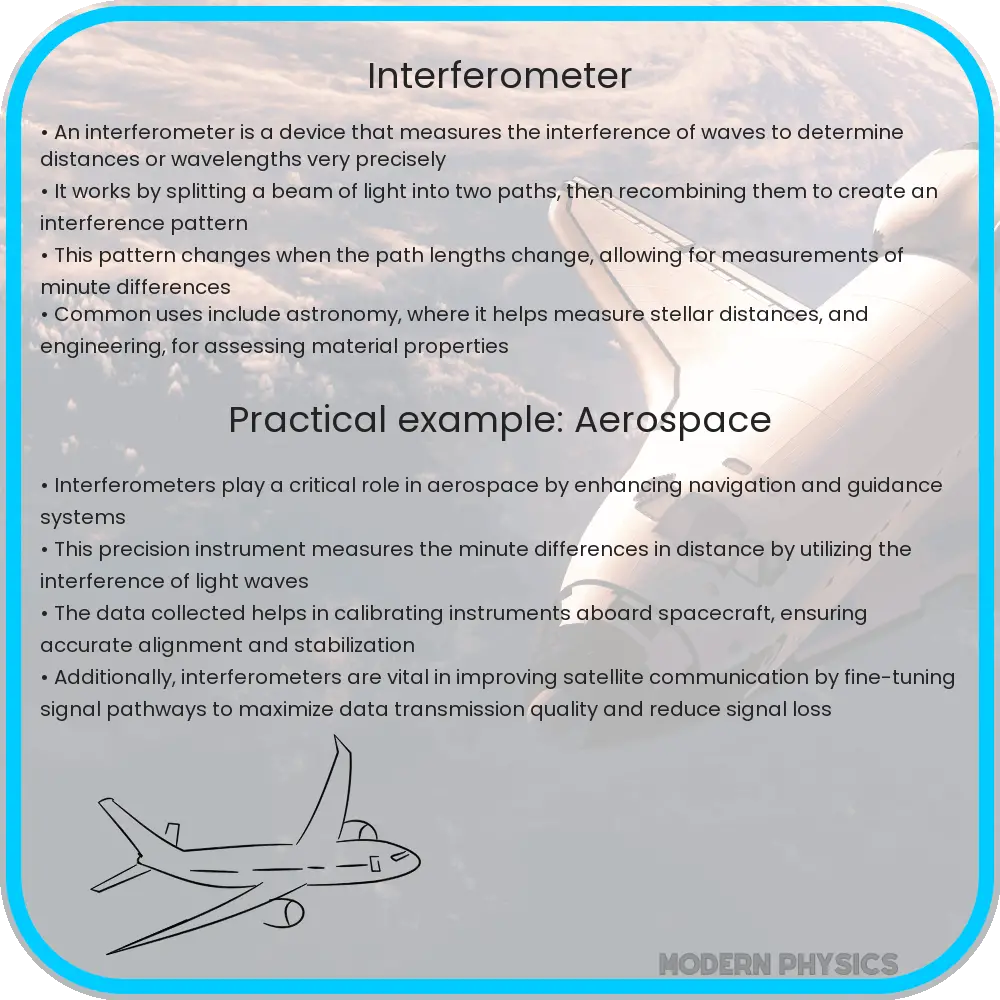
Interferometers are pivotal instruments in the realm of physics and optical engineering, offering unparalleled precision in measuring distances, refractive indices, and the detailed analysis of wave properties. These devices work on the principle of superimposing waves to measure their resultant interference pattern, a technique that reveals insights about the waves’ characteristics such as wavelength, phase, and amplitude.
The Core Principle of Interferometry
At the heart of interferometry lies the concept of wave interference, which occurs when two or more waves converge in space, leading to the formation of a new wave pattern. This pattern can be constructive (amplifying the wave) or destructive (diminishing the wave), depending on the phase relationship between the waves. Interferometers exploit this phenomenon by splitting a single light source into two paths, then recombining them to analyze the resulting interference pattern. This analysis provides precise measurements that are critical in various scientific and engineering applications.
Types of Interferometers and Their Applications
There are several types of interferometers, each designed for specific applications. The Michelson interferometer, for example, is renowned for its role in the historic Michelson-Morley experiment, which provided crucial evidence for the theory of relativity by demonstrating the constancy of the speed of light in all directions. On the other hand, the Fabry-Pérot interferometer is widely used in spectroscopy for its ability to resolve closely spaced spectral lines, offering insights into the atomic and molecular structure.
Advancements in Wave Analysis and Optical Insight
Interferometry has been instrumental in advancing our understanding of wave dynamics and optical phenomena. By analyzing interference patterns, scientists can deduce wave properties with extraordinary precision, such as wavelength to a fraction of a nanometer. This capability is invaluable in fields like metrology, where the precise calibration of instruments is crucial, and in astrophysics, where interferometers are used to measure the distances and diameters of stars with astonishing accuracy.
Moreover, the application of interferometry in optical coherence tomography (OCT) has revolutionized medical imaging, providing non-invasive, high-resolution images of the retina, which are vital for diagnosing and monitoring diseases. The depth and clarity of insight afforded by interferometers, therefore, extend not just across physical sciences but also into the realm of biomedical engineering, showcasing their versatility and the breadth of their impact.
Enhancing Precision in Measurement and Imaging
The precision offered by interferometers extends beyond traditional applications, influencing the development of gravitational wave detectors such as LIGO (Laser Interferometer Gravitational-Wave Observatory). These sophisticated instruments have opened new vistas in astrophysics by directly observing gravitational waves, thus validating a major prediction of Einstein’s general theory of relativity and enhancing our understanding of the universe. The precision measurement capabilities of interferometers are not only pivotal in detecting the ripples in spacetime caused by massive astronomical events but also in refining the accuracy of GPS systems and in the manufacturing of semiconductor devices.
Challenges and Future Directions
Despite their numerous advantages, interferometers face challenges such as sensitivity to environmental factors like temperature, vibration, and air currents, which can affect measurement accuracy. Advanced techniques such as active stabilization and isolation are employed to mitigate these effects, ensuring the reliability of the data obtained. Furthermore, the ongoing research in photonics and quantum optics promises to enhance the capabilities of interferometers, potentially leading to breakthroughs in quantum computing, secure communication, and fundamental physics.
Conclusion
Interferometers stand as a testament to the ingenious application of wave interference principles, offering a window into the unseen and undetected realms of physical and biological worlds. Their ability to measure with nanometer precision, analyze wave properties, and provide optical insights has been instrumental in numerous scientific and technological advancements. From the foundational experiments that shaped modern physics to the cutting-edge research in gravitational waves and quantum mechanics, interferometers continue to play a critical role. As technology progresses, the evolution of interferometric methods will undoubtedly unveil new discoveries, pushing the boundaries of what is measurable and observable. In essence, interferometers not only reflect the progress of optical science but also illuminate the path toward future explorations in the vast expanse of scientific inquiry.