
Explore Speckle Interferometry, a breakthrough in optical precision, its techniques, applications, and future advancements in science and industry.
Understanding Speckle Interferometry: A Breakthrough in Optical Precision
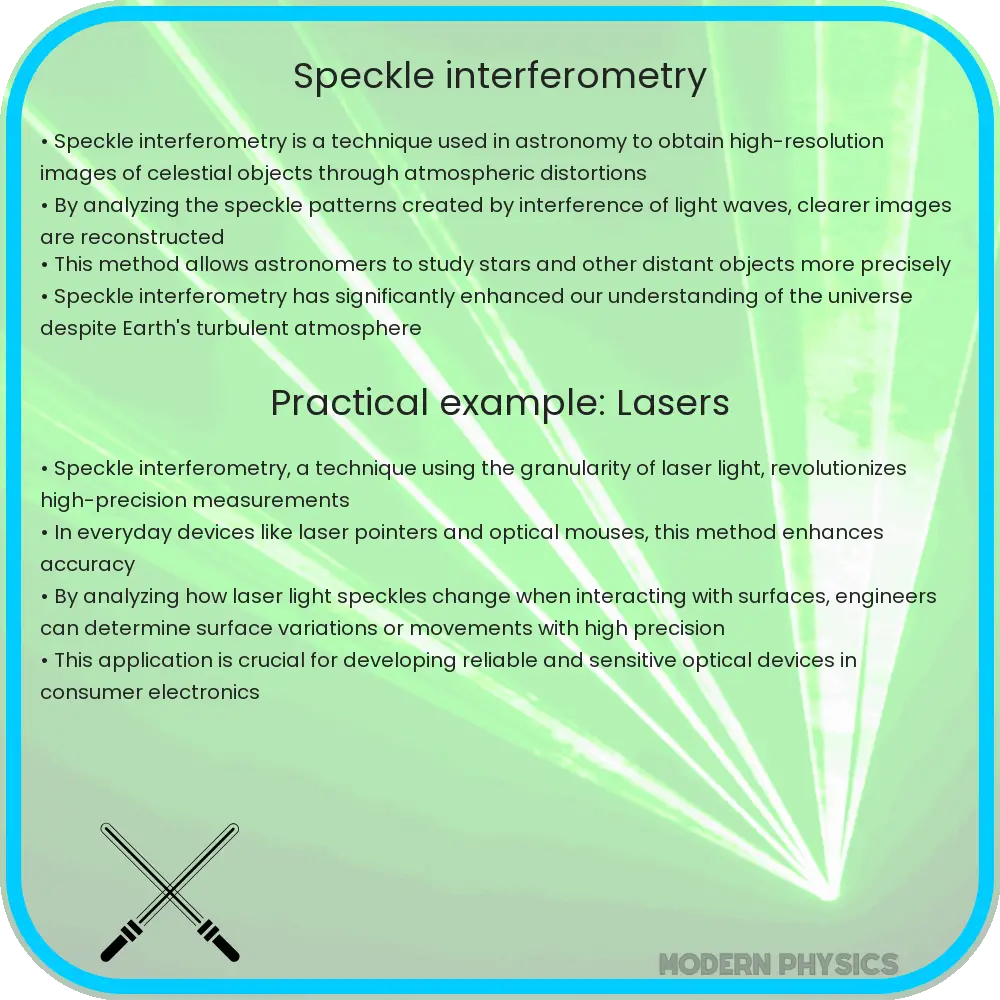
Speckle Interferometry represents a significant advancement in the field of optics, offering unparalleled precision in the analysis of various phenomena. This technique, developed primarily for astronomical applications, has rapidly expanded its utility across diverse scientific and engineering domains. By leveraging the unique properties of light and interference patterns, Speckle Interferometry has opened new frontiers in precision measurement and analysis.
The Principle Behind Speckle Interferometry
At its core, Speckle Interferometry is based on the phenomenon of interference, a fundamental property of light as described by wave theory. When light waves from a coherent source, like a laser, are scattered from a rough surface, they produce a random interference pattern known as a speckle pattern. This pattern, although appearing random, contains a wealth of information about the surface from which the light is scattered. Speckle Interferometry involves capturing and analyzing these patterns to derive precise measurements of the surface’s properties, such as its shape, texture, and even minute changes in position or deformation.
Techniques and Innovations in Speckle Interferometry
The technique of Speckle Interferometry can be broadly classified into two categories: subjective and objective. Subjective speckle patterns are formed at the image plane of an optical system and are typically used for imaging applications. In contrast, objective speckle patterns are formed at the plane conjugate to the object and are used for precise metrology and surface analysis.
- Subjective Speckle Interferometry: This method is used extensively in astronomical observations. The technique allows for the resolution of celestial objects that are too close together to be distinguished by traditional telescopes due to atmospheric distortion.
- Objective Speckle Interferometry: Utilized in engineering and material sciences, this approach measures strain, displacement, and vibration in materials. It is particularly useful in non-destructive testing and structural analysis.
Recent innovations in Speckle Interferometry have focused on enhancing precision and reducing environmental influences. Advanced algorithms for pattern analysis, integration with digital imaging technologies, and the use of adaptive optics to compensate for atmospheric turbulence are some of the key developments enhancing the capabilities of this technique.
Applications of Speckle Interferometry
The applications of Speckle Interferometry are diverse and impactful. In astronomy, it has been instrumental in studying stellar objects and galaxies, providing insights into their composition and dynamics. In engineering, it aids in the analysis of material properties, structural integrity, and the behavior of components under stress. Furthermore, the technique has found utility in biomedical imaging, helping to visualize and analyze biological tissues with high precision.
Overall, Speckle Interferometry stands as a testament to the power of optical science in unlocking new dimensions of measurement and analysis, furthering our understanding of both the macroscopic and microscopic worlds.
Advancements and Future Prospects in Speckle Interferometry
The rapid evolution of Speckle Interferometry is closely linked to advancements in computing power and imaging technology. High-speed cameras and sophisticated image processing algorithms have enabled real-time analysis of speckle patterns, opening new possibilities for dynamic measurement. The integration of machine learning techniques is further enhancing the accuracy and efficiency of pattern recognition and data interpretation in complex scenarios.
One of the most promising areas of development is the application of Speckle Interferometry in microscale and nanoscale measurements. The technique’s sensitivity to minute changes makes it ideal for studying phenomena at these scales, which is critical in fields like material science, nanotechnology, and semiconductor manufacturing.
Another area of innovation is in environmental and Earth sciences. By employing satellite-based Speckle Interferometry, researchers can monitor and analyze changes in the Earth’s surface, including land deformation due to earthquakes, volcanic activity, and the effects of climate change. This application showcases the technique’s versatility and potential for large-scale impact.
Challenges and Considerations
Despite its numerous applications, Speckle Interferometry is not without its challenges. The quality of the speckle pattern is highly dependent on the coherence of the light source and the stability of the environmental conditions. Fluctuations in temperature, humidity, and mechanical vibrations can affect the accuracy of the measurements. Addressing these challenges requires ongoing research and development, particularly in enhancing the robustness of the technique in varying conditions.
Additionally, the interpretation of speckle patterns can be complex and requires a deep understanding of optics and signal processing. This complexity can limit its usability in fields where such expertise is scarce. Efforts to develop more user-friendly software and automated systems are critical in making Speckle Interferometry more accessible to a broader range of users.
Conclusion: The Impact of Speckle Interferometry on Science and Industry
In conclusion, Speckle Interferometry stands as a remarkable achievement in the field of optics, offering unmatched precision in measurement and analysis. Its applications span a vast range of disciplines, from astronomy to engineering, and its potential for future advancements continues to grow. As technology advances, so too will the capabilities of Speckle Interferometry, promising even greater insights into the physical world. This technique not only exemplifies the power of scientific innovation but also highlights the endless possibilities that arise from understanding and manipulating the fundamental properties of light.
As we look to the future, Speckle Interferometry is poised to remain at the forefront of precision measurement, continually pushing the boundaries of what is possible in scientific research and industrial applications. Its ongoing evolution is a testament to the relentless pursuit of knowledge and the profound impact that such pursuits can have on our understanding of the universe and our ability to harness its secrets for the betterment of society.