
Hyperspherical methods in few-body physics simplify complex particle interactions through advanced mathematical coordinates.
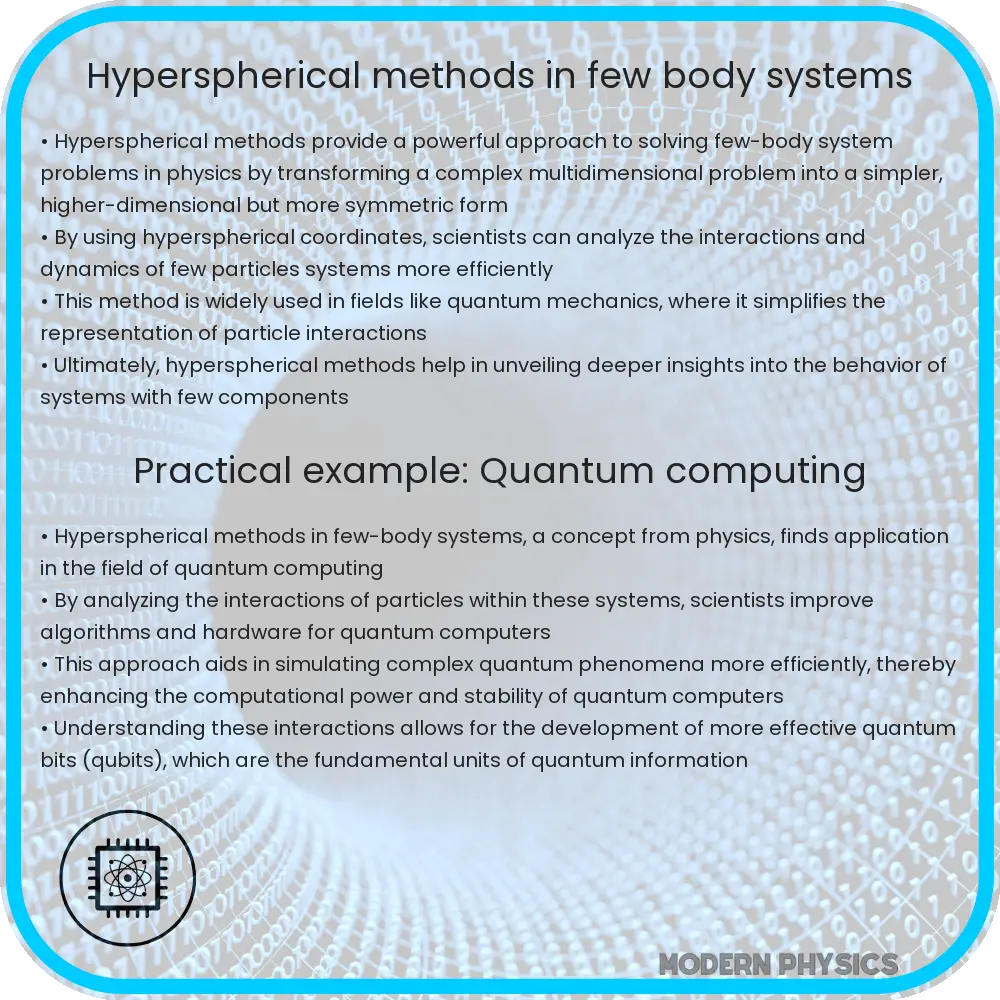
Understanding Hyperspherical Methods in Few-Body Systems
Few-body systems in physics refer to systems consisting of a few interacting particles, such as atomic nuclei, quantum dots, or molecules. The study of these systems is crucial for advancing our understanding of quantum mechanics and its applications. One advanced mathematical approach used in the analysis of few-body systems is the hyperspherical method. This method helps in simplifying the complex interactions among particles into more manageable mathematical forms.
Fundamentals of Hyperspherical Coordinates
At the heart of the hyperspherical methods are the hyperspherical coordinates. Unlike the typical Cartesian coordinates, which describe a point in space using x, y, and z axes, hyperspherical coordinates generalize spherical coordinates to higher dimensions. In three dimensions, spherical coordinates describe a point by a radius and two angles. Hyperspherical coordinates extend this idea to an N-dimensional space using one radial coordinate (R) and N-1 angular coordinates.
The Hyperspherical Method in Practice
In few-body systems, modeling the interaction between three or more particles quickly becomes complex. The hyperspherical method simplifies this by transforming the Schrödinger equation, which governs the quantum mechanics of the system, into hyperspherical coordinates. This transformation casts the complicated motion of the particles into a form where they appear to move cohesively as a point on a high-dimensional sphere.
The key to the hyperspherical approach is transforming the individual particle coordinates into one collective radius (the hyperradius) and several angles (the hyperangles). The hyperradius represents the overall size of the system, essentially encapsulating the extent of separation between all particles. The hyperangles then describe the shape or configuration of the system within this size constraint.
Advantages of Hyperspherical Methods
One major advantage of using hyperspherical methods in few-body systems is the considerable reduction in complexity. By focusing on collective coordinates (hyperradius and hyperangles) rather than individual particle positions, researchers can more easily discern the overall behavior of the system. Additionally, this method often reveals symmetries and patterns that are not apparent in Cartesian coordinates, allowing for deeper theoretical insights and more accurate predictions.
Applications Across Physics
The hyperspherical method is not only a vital tool in theoretical physics but also has practical applications across various fields. For instance, it is used in nuclear physics to model the interactions within the nucleus of an atom where three or more nucleons (protons and neutrons) are involved. This approach has also been applied in quantum chemistry to study the electron dynamics in multi-electron atoms and molecules, providing insights that are crucial for developing new materials and drugs.
Moreover, the versatility of hyperspherical methods extends to astrophysical applications, such as in the study of few-body problems in orbital mechanics. It enables researchers to analyze the gravitational interactions in systems of few celestial bodies, such as triple star systems or planetary systems with multiple moons.
Challenges and Limitations
Despite its many advantages, the hyperspherical method does have some limitations. One major challenge is the mathematical complexity involved. The higher the number of dimensions (i.e., particles), the more difficult it becomes to manage the additional angular coordinates. This can make the computations extremely intricate and resource-demanding, which might limit the method’s applicability to systems with a manageable number of particles.
Additionally, physical interpretations of the results in hyperspherical coordinates can sometimes be less intuitive than those obtained through traditional methods. This can pose a hurdle in understanding and visualizing the interactions in few-body systems, particularly for those new to the field of quantum mechanics.
Future Prospects
Despite these challenges, the future of hyperspherical methods in physics looks promising. Ongoing advancements in computational techniques and algorithms continue to broaden the scope of these methods. For example, the development of more efficient numerical methods to handle the equations involved in hyperspherical coordinates is helping to overcome some of the computational limitations.
Furthermore, as we gain a deeper understanding of the hyperspherical method, it could be adapted and extended to other complex systems in fields like biophysics and materials science. There’s also potential for interdisciplinary applications, where insights from hyperspherical analyses in physics could inform approaches in other scientific domains, such as computational chemistry and biology.
Conclusion
In summary, the hyperspherical method offers a powerful framework for simplifying and analyzing the dynamics within few-body systems in physics. By transforming challenging multi-particle interactions into more tractable mathematical forms, this method allows researchers to uncover underlying patterns and symmetries that are crucial for advancing our understanding of the quantum world. Although accompanied by formidable challenges, especially related to their computational demands and interpretational complexities, the persistent advancements in this area hold significant promise for extending its utility across various scientific realms. The hyperspherical method, with its unique ability to manage complex interactions, remains an indispensable tool in the physicist’s toolkit, paving the way for future discoveries and innovations.