
Understand Isotope Shift Spectroscopy, a physics application analyzing atomic spectra differences in isotopes due to neutron variation, affecting spectral lines.
Introduction to Isotope Shift Spectroscopy
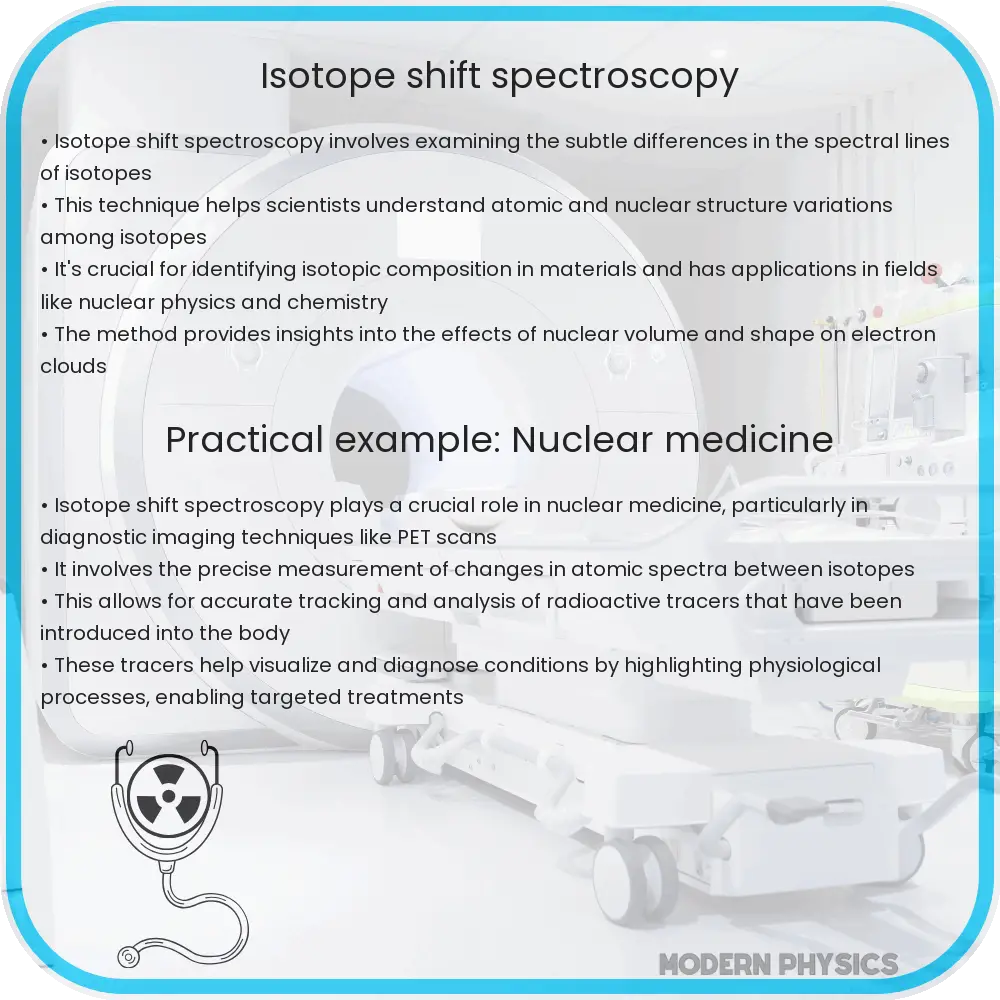
Isotope Shift Spectroscopy is a fascinating application of physics that explores the subtle differences in the atomic spectra of isotopes. Isotopes are atoms of the same element that have the same number of protons but a different number of neutrons. This variation in neutron number can subtly alter the properties of an atom, including its spectral lines. Isotope Shift Spectroscopy investigates these variations, providing insights into atomic and nuclear physics, as well as practical applications in various fields.
Basics of Isotope Shift Spectroscopy
The concept of Isotope Shift Spectroscopy revolves around the study of the spectral lines emitted or absorbed by different isotopes of the same element under similar conditions. When an isotope emits or absorbs light, the wavelength of this light can be influenced by the nuclear mass and volume. This phenomenon results in small shifts in the observed spectral lines, known as isotope shifts.
There are two main types of isotope shifts:
- Mass Shift: The mass shift arises due to the difference in the mass of the isotopes. Heavier isotopes generally have slightly altered energy levels compared to lighter ones because of their different nuclear masses affecting the electron cloud. This shift is primarily divided into the Normal Mass Shift (NMS) and the Specific Mass Shift (SMS).
- Field Shift: The field shift occurs due to changes in the distribution of charge within the nucleus, affecting the electron cloud differently for different isotopes. This shift provides important information about the changes in nuclear radius and density.
Principle Behind Isotope Shift Spectroscopy
The phenomenon can be explained by how variations in nuclear mass and volume affect the electronic energy levels. The total energy of an electron in an atom depends on its interactions with the nucleus and other electrons. Alterations in nuclear characteristics lead to slight changes in these interactions, thereby shifting the energy levels. This shift in energy levels translates to a change in the wavelength of light that an electron emits or absorbs.
Mathematically, the energy of an electron in hydrogen-like atoms can be approximated by the formula:
En = -13.6 eV / n2 * (Z2 / mr)
Where:
- En is the energy of the nth orbital,
- Z is the atomic number,
- mr is the reduced mass of the electron-nucleus system.
The effect of isotope change primarily alters mr, leading to shifts in the energy levels and thus in the spectral lines.
Applications of Isotope Shift Spectroscopy
Isotope Shift Spectroscopy has a wide range of applications, from fundamental research in physics to practical uses in various industries:
- Atomic and Nuclear Physics: It helps in the precise determination of nuclear sizes and shapes, and also in understanding the nuclear shell model.
- Chemical Analysis: Isotope analysis via spectroscopy is crucial in geochemistry, environmental science, and medicine, particularly in tracing sources of pollution and in drug metabolism studies.
- Astronomy: Astronomers use it to determine the isotopic composition of celestial objects, thus helping in the study of stellar evolution and processes.
Experimental Techniques in Isotope Shift Spectroscopy
Conducting Isotope Shift Spectroscopy requires sophisticated experimental setups. Commonly, this involves the use of spectrographs and mass spectrometers. These instruments are capable of detecting minor variations in the wavelengths of spectral lines with high precision.
Lasers also play a crucial role in these experiments. They are used to excite the electrons of the isotopes to higher energy levels. Once the electrons return to lower energy levels, they emit light at characteristic wavelengths that are then meticulously analyzed for shifts.
Another advanced technique involves the use of collinear fast-beam laser spectroscopy. In this method, isotopes are ionized and accelerated to high speeds in a beam. A laser light is aligned collinearly with the beam, allowing highly precise measurements of spectral shifts.
Challenges and Future Prospects
Despite its profound utility, Isotope Shift Spectroscopy faces some challenges. Primarily, the resolution of the spectral lines can be limited by the performance of the instrumentation. Improving the resolution and accuracy of these measurements is a key area of ongoing research.
Moreover, expanding the technique to cover a broader range of isotopes, some of which may be radioactive or scarce, presents another significant challenge. With advancements in technology and methodologies, such as more sensitive detectors and enhanced laser systems, the scope of Isotope Shift Spectroscopy continues to broaden.
In the future, the integration of digital technology and machine learning could revolutionize how data from Isotope Shift Spectroscopy is processed and interpreted. This could lead to even more precise and faster analysis, broadening the insight into atomic and nuclear phenomena.
Conclusion
Isotope Shift Spectroscopy stands as a cornerstone of modern atomic and nuclear physics, providing detailed insights into the subtle differences between isotopes of the same element. From aiding in nuclear structure analysis to supporting environmental studies and healthcare, its applications are vast and vital. The challenges it faces push the boundaries of current technological and scientific limits, inspiring new innovations and improvements. As this field continues to evolve, it promises to unveil even deeper secrets of the atomic and subatomic world, making it an intriguing and crucial area of study in physics and beyond.