
Magnetic Feshbach resonance involves controlling atomic interactions and scattering properties using external magnetic fields in quantum mechanics.
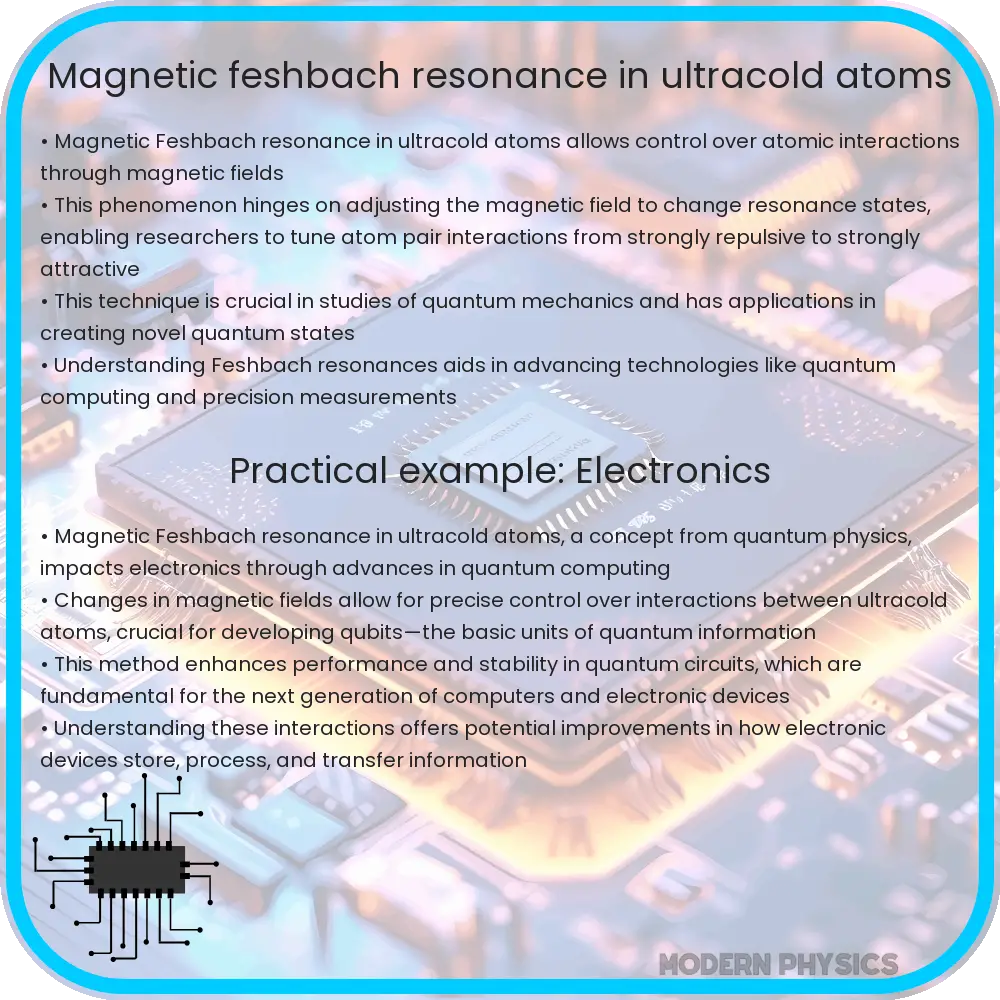
Understanding Magnetic Feshbach Resonance
Magnetic Feshbach resonance is a fascinating phenomenon in physics that plays a crucial role in the study of quantum mechanics and atomic interactions. This concept is particularly important in the fields of atomic, molecular, and optical physics. In simple terms, a Feshbach resonance occurs when the energy of a bound state in one interaction channel matches the energy of two colliding particles in another channel. This article aims to break down the complexities of magnetic Feshbach resonance and explore some of its key applications.
Basics of Magnetic Feshbach Resonance
At its core, magnetic Feshbach resonance involves the interaction of atoms under the influence of an external magnetic field. The basic mechanism can be understood by considering the interaction between ultracold atoms, which are atoms cooled to temperatures near absolute zero. In ultracold atomic gases, the interaction strength and the nature of the interaction itself can be precisely controlled using magnetic fields.
The resonance occurs because atomic collision properties, such as scattering length, can be drastically altered by tuning the magnetic field. The scattering length is a measure of how two particles scatter off each other in quantum mechanics. Near the resonance, the scattering length can change from positive to negative values, or become extremely large. This change happens due to the presence of a bound state of the interacting atoms that crosses the energy threshold of the free atoms.
Theoretical Foundation of Magnetic Feshbach Resonance
The theoretical description of Feshbach resonance starts with the Hamiltonian of the system, which includes kinetic terms and potential terms related to the interactions between atoms. The total wavefunction of the system can be described as a superposition of open and closed channel wavefunctions. The open channel corresponds to the state where atoms are free, while the closed channel corresponds to the state where atoms form a bound state. The resonance occurs when the energy difference between these two channels is bridged by tuning the external magnetic field.
Mathematically, this can be represented by the Breit-Wigner formula, which describes how the cross-section of a reaction varies as a function of energy near a resonance. The formula indicates that the cross-section peaks sharply when the energy of the incoming particles matches the energy of the bound state in the closed channel.
- Cross-section variation: The peak in the cross-section near the resonance can lead to enhanced interaction effects, such as increased collision rates or altered quantum states.
- Scattering length: As previously mentioned, the scattering length becomes a critical factor in characterizing the physics near a Feshbach resonance. The formula for the scattering length \( a \) near a resonance can be given by \( a = a_0 + \frac{\Delta}{B – B_0} \), where \( a_0 \) is the background scattering length, \( \Delta \) is the width of the resonance, \( B \) is the applied magnetic field, and \( B_0 \) is the resonant field value.
Applications in Research and Technology
Magnetic Feshbach resonance has numerous applications, particularly in the field of ultracold atomic gases. One of the most significant applications is the creation of novel quantum states, such as Bose-Einstein condensates and Fermionic condensates, whose properties can be finely tuned through manipulation of the scattering length. This tuning allows researchers to explore many-body physics in a controlled setting, providing insights into phenomena such as superfluidity, quantum phase transitions, and more.
Furthermore, the ability to control interactions via magnetic fields opens up possibilities for quantum simulation. This involves simulating complex quantum systems that are otherwise difficult to study in other contexts. Simulations like these are vital for developing quantum computing and understanding fundamental aspects of quantum mechanics.
In addition to research, magnetic Feshbach resonance can find application in precision measurements and the development of quantum sensors. These devices can exploit the sensitivity of the resonance condition to changes in the magnetic field, leading to precise measurements of magnetic fields or other related physical quantities.
Challenges and Future Directions
While the benefits of magnetic Feshbach resonance are substantial, the technique is not without its challenges. One of the primary difficulties lies in the precise control and stability of the magnetic fields required to achieve and maintain resonance conditions. Fluctuations in the magnetic field can lead to significant variations in experimental results, impacting the reliability of the studies conducted.
Additionally, the need for ultra-low temperatures for most experiments involving magnetic Feshbach resonance limits its applicability in broader contexts. Efforts are ongoing to develop technologies that can achieve the necessary cooling more efficiently and at lower costs.
In the future, advancements in magnetic field control and temperature regulation may allow for even more intricate experiments with ultracold gases. Researchers are also exploring the possibilities of applying magnetic Feshbach resonance techniques to other types of quantum systems, potentially broadening the scope of this intriguing phenomenon.
Conclusion
Magnetic Feshbach resonance constitutes a cornerstone in the exploration and manipulation of ultracold atomic gases, fundamentally enriching our understanding of quantum mechanics and atomic interactions. By enabling precise control over interaction strengths and scattering lengths, it paves the way for experimental research into complex quantum states and phase transitions, thereby fostering advancements in quantum computing and precision measurement technologies.
The insights gained from these studies not only deepen our grasp of fundamental physics but also contribute to the evolution of practical applications such as quantum sensors and simulators. As technology progresses, the continued exploration and enhancement of magnetic Feshbach resonance techniques will undoubtedly play a pivotal role in shaping the future of quantum science and its integration into various technological fields.
In summary, while there are challenges to overcome, the potential of magnetic Feshbach resonance in advancing both theoretical and applied physics remains vast and full of opportunities. By pushing the boundaries of what is possible in quantum mechanics, scientists and engineers continue to unlock new horizons in science and technology.